
Two companies are recalling certain lots of IV fluid products across the United States, citing concerns about potential contamination by certain particulate matter.
Pennsylvania-based B. Braun Medical Inc. is recalling three lots of B Braun 0.9 percent Sodium Chloride Injection USP, 100 mL, in a 150 mL PAB container, with lot numbers J6B435, J6B444, and J6B457, and an expiration date of April 30, 2027, the company said in an announcement published by the Food and Drug Administration (FDA) on Aug. 28.
The IV fluids, used as a source of electrolytes and water for hydration as well as for delivering drugs, were distributed to health care facilities and hospitals nationwide between Feb. 27 and Aug. 3. The recall was initiated due to the presence of zinc oxide particulate matter in the solution.
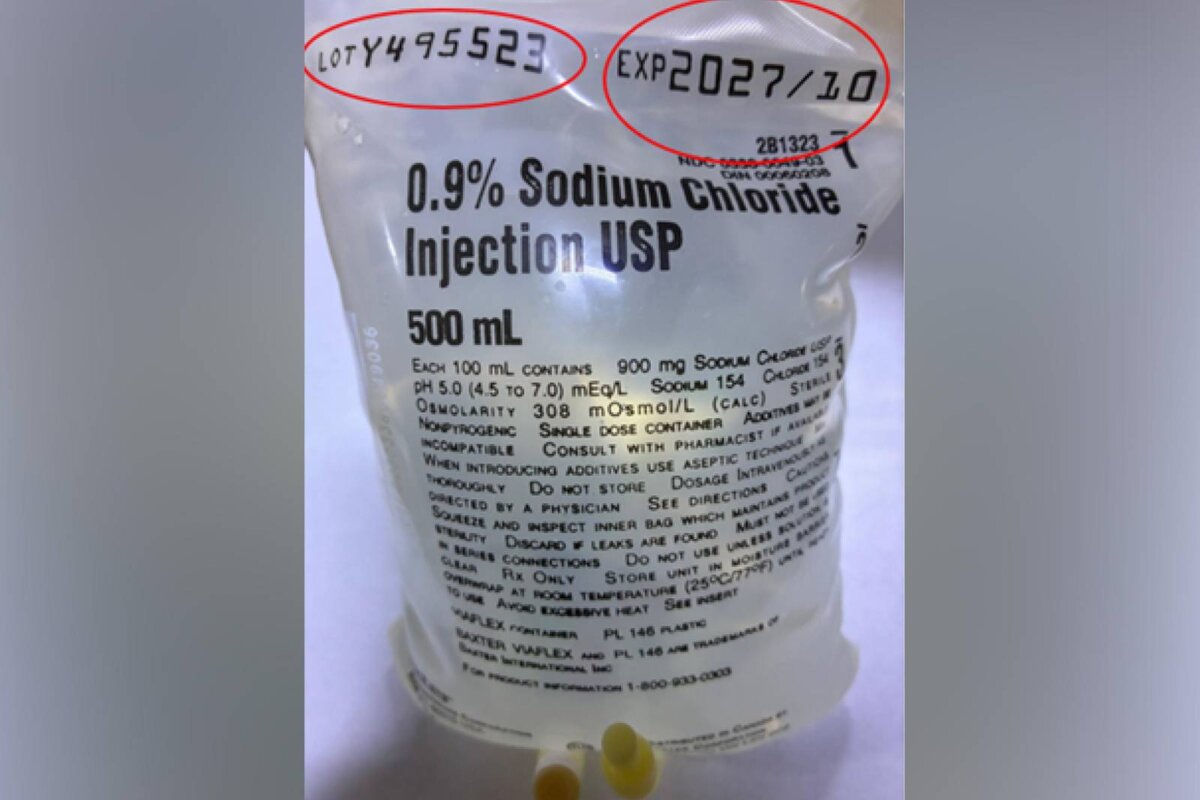
The second recall, made by Illinois-based Baxter International Inc., is applicable to two lots of Sodium Chloride Injection. The recall was issued due to fiberglass particulate matter potentially being present in the solution, according to a company announcement published by the FDA on Aug. 26. It is used as a priming solution for hemodialysis procedures, which refers to filtering blood to remove excess fluids and waste products.
The product subject to recall is 0.9 percent Sodium Chloride Injection, USP, 500 mL VIAFLEX plastic container, with lot numbers Y495523 and Y495523A, and an expiration date of Oct. 31, 2027. The items were distributed between July 31 and Aug. 3 to certain U.S. states, including Florida, Illinois, Indiana, Louisiana, Maryland, Missouri, North Carolina, New Jersey, Nevada, New York, Ohio, South Carolina, Texas, and Virginia.
Administering IV fluid containing particulate matter could cause life-threatening adverse health consequences, the companies said.
This includes pulmonary emboli, in which the pulmonary blood vessels get blocked; the occlusions of other blood vessels, which can result in tissue death and potentially damage organs; and phlebitis, which refers to inflammation of vein walls that can result in clotting.
Moreover, foreign particles injected into the body intravenously can trigger organ dysfunction, a breakdown of blood cells, and the systemic activation of the body’s immune system.
The companies clarified that there have, so far, been no reports of adverse events linked to the recalled items. B. Braun said it was notifying customers and distributors about the issue and advised those who have the recalled items to return them to the place of purchase. Baxter said it was contacting customers by email with instructions on how to identify and return the affected product.
The Epoch Times reached out to B. Braun and Baxter for comment but did not receive any response by publication time.
Baxter was the focus of an IV fluid shortage back in 2024 when its production facility in North Cove, North Carolina, was affected by Hurricane Helene. The company said it accounted for 60 percent of America’s supply of IV fluids.
The shortages extended into last year. In August 2025, the FDA announced that the nationwide shortage of sodium chloride 0.9 percent injection products had ended and that it was working with manufacturers regarding shortages in other IV fluids.
Sodium chloride IV infusion is used for treating fluid loss among individuals, especially in patients who are not able to take fluids and nutrients through the mouth. The solution must not be administered if a person has congestive heart failure, severe renal insufficiency, or clinical states in which there is sodium retention with edema, according to FDA-approved drug labeling on DailyMed.
 Friends Read Free
Copy
Facebook
Tweet
Friends Read Free
Copy
Facebook
Tweet