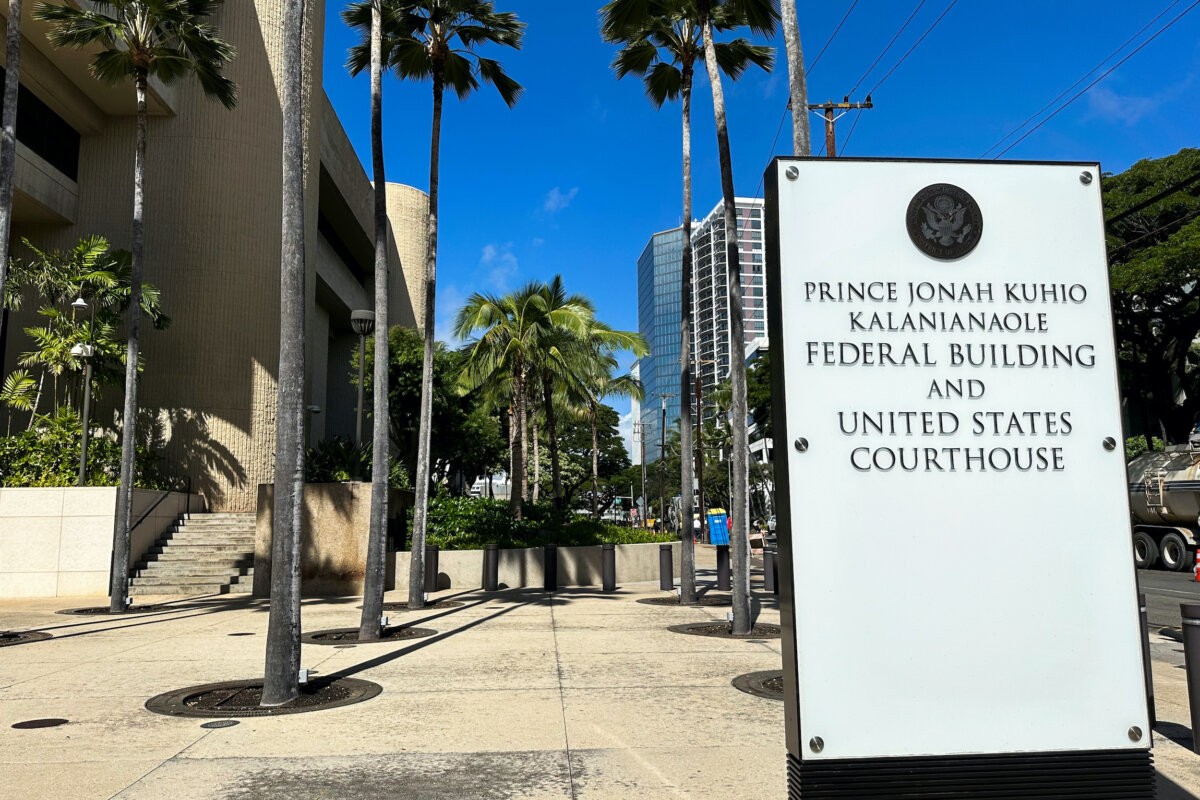

A U.S. judge on April 15 dismissed a federal government lawsuit seeking to stop Hawaii from suing fossil fuel companies in state court over climate-related actions.
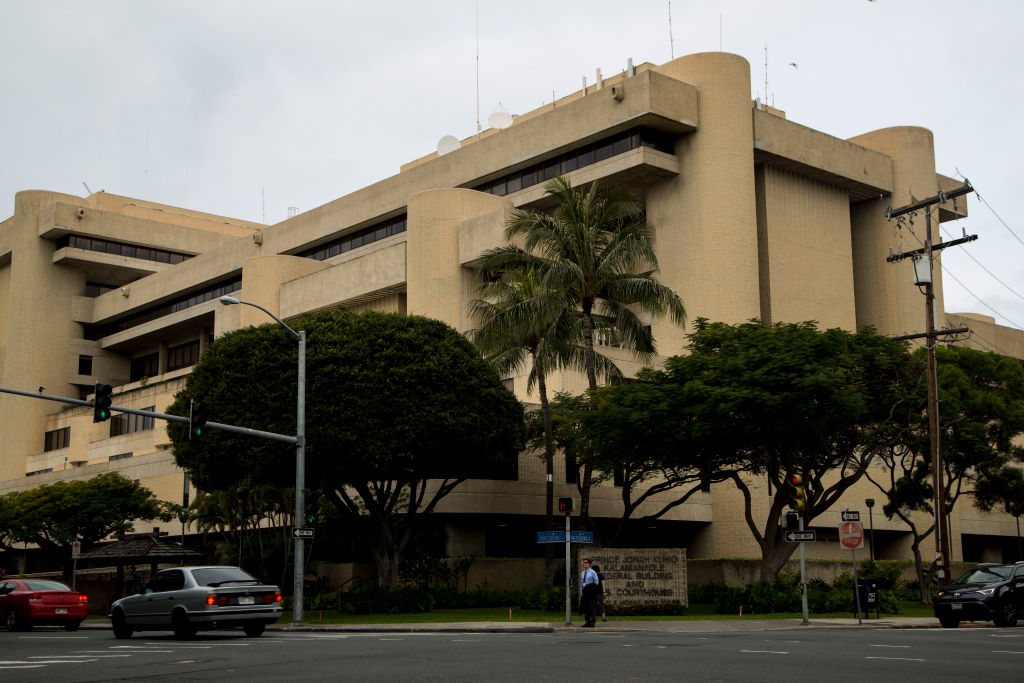
U.S. District Judge Helen Gillmor in Honolulu cited a “longstanding” policy against federal intervention in the procedures of state courts.
It is the second time this year that federal courts have blocked the Department of Justice’s efforts to halt climate-related actions in state courts. In January, Judge Jane M. Beckering in Grand Rapids, Michigan, threw out a similar lawsuit that would have blocked Michigan from suing oil companies.
The Department of Justice announced on May 1, 2025, that it had filed lawsuits against Hawaii and Michigan “to prevent each state from suing fossil fuel companies in state court to seek damages for alleged climate change harms.”
“These burdensome and ideologically motivated laws and lawsuits threaten American energy independence and our country’s economic and national security,” Attorney General Pam Bondi said at the time. “The Department of Justice is working to ‘Unleash American Energy’ by stopping these illegitimate impediments to the production of affordable, reliable energy that Americans deserve.”
A day after that suit was filed, Hawaii filed suit against various fossil fuel companies for allegedly selling products the companies knew would warm the planet.
Gillmor ruled on April 15 that the Justice Department lacked standing to sue Hawaii because its case was too speculative.
“Plaintiff United States’ theory of harm is based on a series of abstract harms and contingencies about hypothetical actions third parties may take,” Gillmor wrote in her order.
“[The Justice Department’s] attempt to predict the outcome of a yet-to-be-filed lawsuit and how it could possibly injure the federal government in the future is not a concrete injury-in-fact.”
Gillmor dismissed the case without prejudice.
In January, President Donald Trump withdrew the United States from the U.N. Framework Convention on Climate Change (UNFCCC) and 65 other international organizations dedicated to climate and social action.
The United States originally joined more than 190 other nations in the UNFCCC in 1992, when the U.S. Senate ratified the treaty. This was followed by the 1997 Kyoto Protocol, in which countries committed to carbon dioxide limits and reduction targets, and the 2015 Paris Agreement, which accelerated national governments’ commitments and spending to reduce global temperatures.
The U.S. Senate did not ratify either of these subsequent accords.
On Feb. 12, Trump and Environmental Protection Agency Administrator Lee Zeldin announced the elimination of a 2009 finding that served as the basis of U.S. action to regulate greenhouse gas emissions.
“These crippling restrictions were a major factor in driving up car prices to unprecedented levels, and the car that you were getting was not nearly as good,” Trump said at the time.
The Epoch Times reached out to Hawaii Attorney General Anne Lopez and the Department of Justice for comment, but did not receive a response by publication time.
Reuters, Kevin Stocklin, and Travis Gillmore contributed to this report.
 Friends Read Free
Copy
Facebook
Tweet
Friends Read Free
Copy
Facebook
Tweet