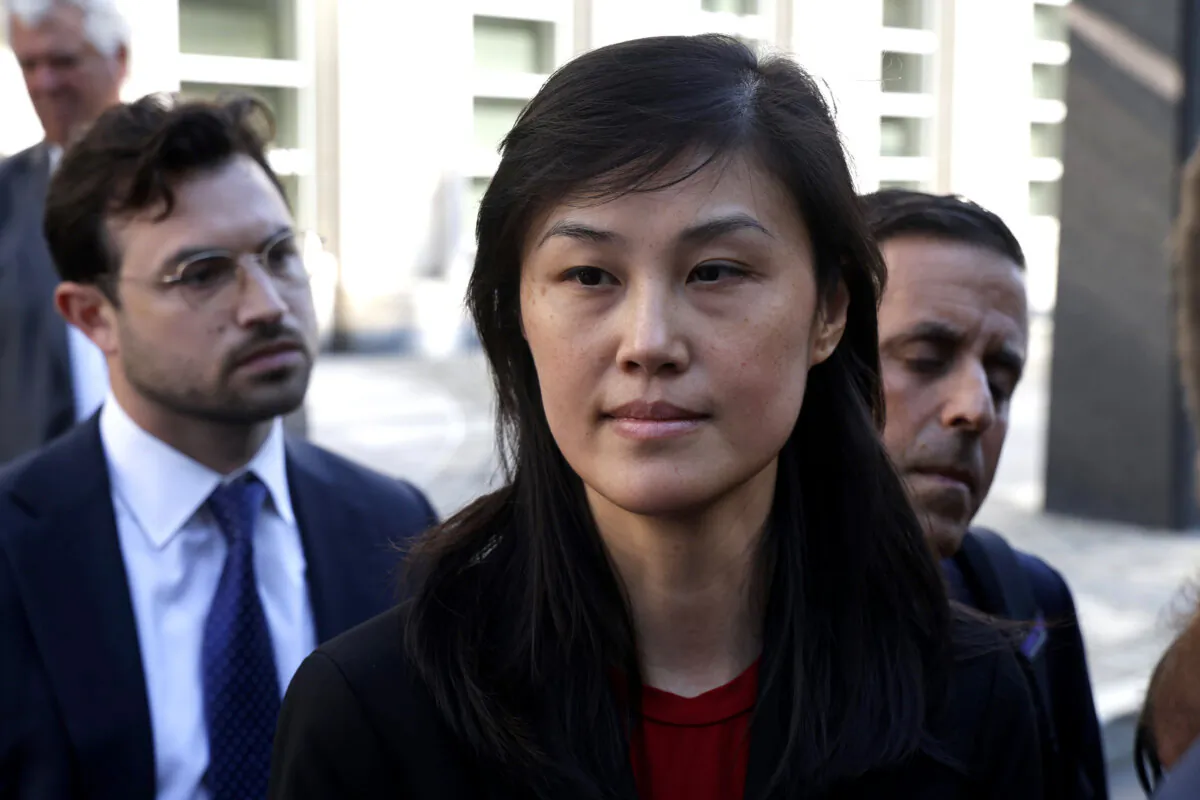

NEW YORK CITY—Jury selection in the trial of Linda Sun, former aide to New York Gov. Kathy Hochul and former New York Gov. Andrew Cuomo, began on Nov. 10 in the New York City borough of Brooklyn, in the Eastern District of New York.
Potential jurors were asked a series of questions to assess their eligibility, including their opinion or bias related to Cuomo and China.
The trial of Sun, who is accused of bribery and doing the bidding of China, is expected to last several weeks. She is charged with taking bribes and kickbacks worth tens of millions of dollars.
Sun worked for New York state from 2012 to 2023 and is accused of using her position to help advance the political priorities of the Chinese regime. Prosecutors alleged that in exchange for Sun’s alleged actions, her husband received assistance in launching his export business in China.
According to the court papers, Chinese officials allegedly helped Sun’s husband, Chris Hu, launch his seafood export business to China in exchange for Sun’s influence in the state government. When the COVID-19 pandemic hit in 2020 and New York state was purchasing surgical masks, Sun allegedly funneled contracts to her husband and cousins worth more than $40 million.
The Department of Justice (DOJ) alleged that Sun and her husband put their ill-gotten gains into a house in Manhasset, New York, valued at more than $4 million; a 47th-floor condo in Hawaii valued at $2.1 million; a 2024 Ferrari Roma; a 2024 Range Rover L460; and a 2022 Mercedes-Benz GLB250W4.
Sun allegedly blocked official invitations to the governor and forged Hochul’s signature on an invitation letter used by Chinese officials to apply for visas to the United States.
While Cuomo was governor, then-Taiwanese President Tsai Ing-wen hosted an event at a hotel in the New York City borough of Manhattan. Taiwan’s local representative sent an invitation to Cuomo. According to court documents, Sun told the Taiwanese representative that the governor was busy on the day of the event.
Court documents allege that Sun never forwarded the invitation to the governor’s scheduler or checked his availability. Just after she received the invitation, Sun forwarded the email to her contact at the Chinese Consulate, with text reading, “FYI,” the prosecution alleged. Sun then allegedly texted her contact, “I sent you an email/ Just an FYI/ I already blocked it.”
Sun is also accused of directing state contracts to her relatives. Court documents allege that when New York state sought to purchase personal protective equipment from China at the start of the COVID-19 pandemic, the Jiangsu Chamber of Commerce in China provided a list of recommended businesses.
Prosecutors alleged that Sun modified the recommendation to put her husband’s company at the top of the list. Records show that New York state ultimately paid her husband about $26 million for the procurement contracts he was awarded.
In her role, Sun worked on business development for the state of New York. According to court documents, in 2018, Sun allegedly forged Hochul’s signature to fraudulently sign an invitation letter for a delegation of officials from Henan Province, China. The officials needed the letter for their visa application and hoped to meet Hochul to develop a relationship with the state of New York.
On July 15, 2020, the FBI interviewed Sun. At the time, according to court records, it informed her that her activity on behalf of the Chinese regime may require her to register as a foreign agent.
Court filings show that her active communication with Chinese consular officials continued.
Just two months later, she allegedly texted a Chinese consular official, saying: “I’m still in charge of all Asian affairs. A few weeks [ago] when we released a press release for international travel, I almost had a heart attack when we referred to Taiwan as a country. Thankfully, I had the press team correct it immediately.”
The Chinese Consulate official responded, according to court filings: “Thank you for your every effort to improve understanding and cooperation between the two great peoples of China and the United States. Keep in touch.”
Based on defense motions, Sun’s attorneys are expected to argue that such internal state policy decisions should not fall under foreign agent registration rules, as Sun was engaged in internal state matters. For the Chinese regime, the status of Taiwan—i.e., whether it is listed as a separate country or not in official documents—is a top political priority.
The DOJ announced in February that it would shift its focus in Foreign Agents Registration Act prosecutions from those engaging in propaganda or lobbying on behalf of foreign governments to those involved in espionage cases.
Stepping up their efforts to protect U.S. interests, several states recently passed their own foreign agent registration laws that are focused on lobbying activities on behalf of foreign adversaries, with a particular focus on federally-designated foreign adversary nations such as China, Russia, Iran, Cuba, and North Korea. Individuals now need to register relevant activities with both federal and state governments.
In 2025, Louisiana, Nebraska, and Texas joined Utah in passing narrower foreign agent registration laws. The federal law covers registrable activity by all foreign entities more broadly, with the intent to bring transparency regarding all foreign efforts to influence U.S. and state policy and public opinion.
 Friends Read Free
Copy
Facebook
Tweet
Friends Read Free
Copy
Facebook
Tweet