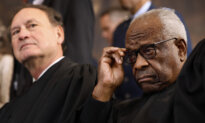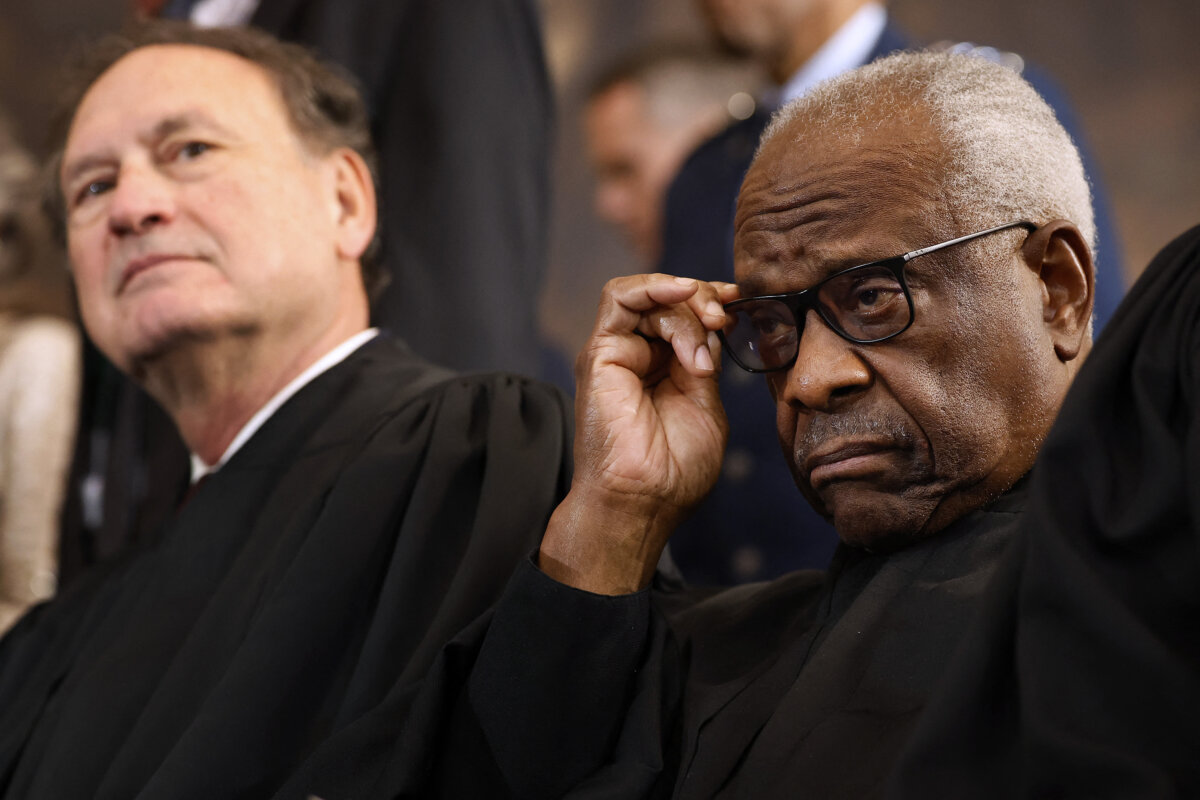
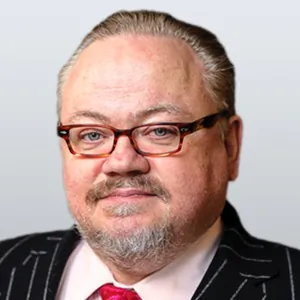
U.S. Supreme Court Justice Samuel Alito said that he will not retire during the court’s current term.
This is the second time in two months the justice has said publicly that he will not retire during the court’s new annual session, which began Oct. 5.
“I intend to stick around through this term,” Alito told Bloomberg News in an exclusive interview published on Oct. 6. “I made that decision many months ago.”
The conservative jurist brushed aside speculation that he would retire early to allow President Donald Trump to fill his seat after the Nov. 3 congressional elections but before the new Congress is seated in early January. Rumors of Alito’s possible departure have grown as polls suggest the battle for control of the U.S. Senate, which confirms judicial nominees, is in a dead heat.
A retirement during a Supreme Court term would be unusual, but it would give Republicans, who currently control the Senate, an opportunity to confirm a younger successor who could serve for decades in the post. Justices serve for life. Senate Majority Leader John Thune (R-S.D.) said in July that a lame-duck congressional session confirmation “can be done.”
Alito said the possibility of retiring had crossed his mind, but added, “I don’t feel mentally or physically decrepit.”
Alito, 76, is the second-oldest justice after Clarence Thomas, 78.
Alito said in an exclusive interview that The Wall Street Journal published on Aug. 7 that he will be staying on the court for another annual sitting after a quickly retracted NPR news bulletin weeks earlier falsely reported his imminent retirement.
“Obviously I’m here for another term,” he said at that time.
Alito’s latest comments came as his book, “So Ordered: An Originalist’s View of the Constitution, the Court, and Our Country,” an adapted collection of his speeches covering his views on topics including originalism, threats to the judiciary, and religious liberty, was released on Oct. 6.
Court Criticism by Trump and Others
Alito told The Associated Press that he is unhappy with the way President Donald Trump and his administration talk about the Supreme Court.
“I personally am not pleased with that,” he said. “Everybody in this country has the right to criticize what we do. The substance of their criticism can be quite harsh. If we deserve it, then that’s fine. But rhetoric is a different story.”
Alito is regarded as one of the most consistent members of the court’s conservative bloc. He wrote the 2022 decision in Dobbs v. Jackson Women’s Health Organization, which reversed Roe v. Wade (1973) and returned the regulation of abortion to the states.
Although Alito has supported some of Trump’s core policies—even when other conservative justices did not—he denies accusations that his rulings are politically motivated by the MAGA movement.
“It’s offensive,” he said. “I honestly try to decide every single case on the merits, every single application on the merit. And that’s true whether the president is Donald Trump or Joe Biden or Barack Obama or anybody else.”
Trump himself has lauded Alito, calling him “one of the greatest of all time,” even as he put down other justices he appointed as “unpatriotic” and “merely a shell of their original selves.”
Alito said the rough rhetoric from across the political spectrum doesn’t affect how the justices rule on a case, but does play a role in the dwindling confidence the public has in the judiciary.
“The terms used by presidents and by members of their administration, Cabinet officers, other high-ranking officers in describing the Supreme Court and their decisions, and sometimes individual justices, is far different from what we saw 15 years ago,” Alito said.
Recusal in High-Profile Oil Case
Alito sat out the court’s first oral argument of the term on Oct. 5 after recusing himself.
In the high-profile case, Suncor Energy v. County Commissioners of Boulder County, oil companies argued that federal law bars cities and states from suing them over so-called climate change.
The city of Boulder and Boulder County in Colorado sued oil companies, alleging that they broke state laws by producing and selling hydrocarbons while concealing and misrepresenting the dangers of burning them.
With Alito not participating in the case, the Supreme Court could end up deadlocked in a 4–4 vote, which would leave the Colorado Supreme Court’s ruling in place that allowed the lawsuits to move forward. A ruling is expected by June or July 2027.
The high court notified the litigants in the case of the recusal on Sept. 28, but did not explain why.
Alito came under political pressure to step away from the case because he owns stock in oil companies.
He told The Wall Street Journal in an interview posted online Oct. 6 that neither he nor his wife owns stock in the companies involved in the case, and when the court first decided to take the case, he elected not to recuse.
However, as the date of the oral argument approached, he said he “immersed himself in the arguments that were being made by both sides” and asked himself, “what would a reasonable person, aware of all the relevant circumstances, think?”
In the case, Alito said the oil companies are arguing that a ruling against them “could ultimately lead to devastating consequences for the oil and gas industry.” Given those circumstances, he “reluctantly” decided to recuse, he said.
 Friends Read Free
Copy
Facebook
Tweet
Friends Read Free
Copy
Facebook
Tweet