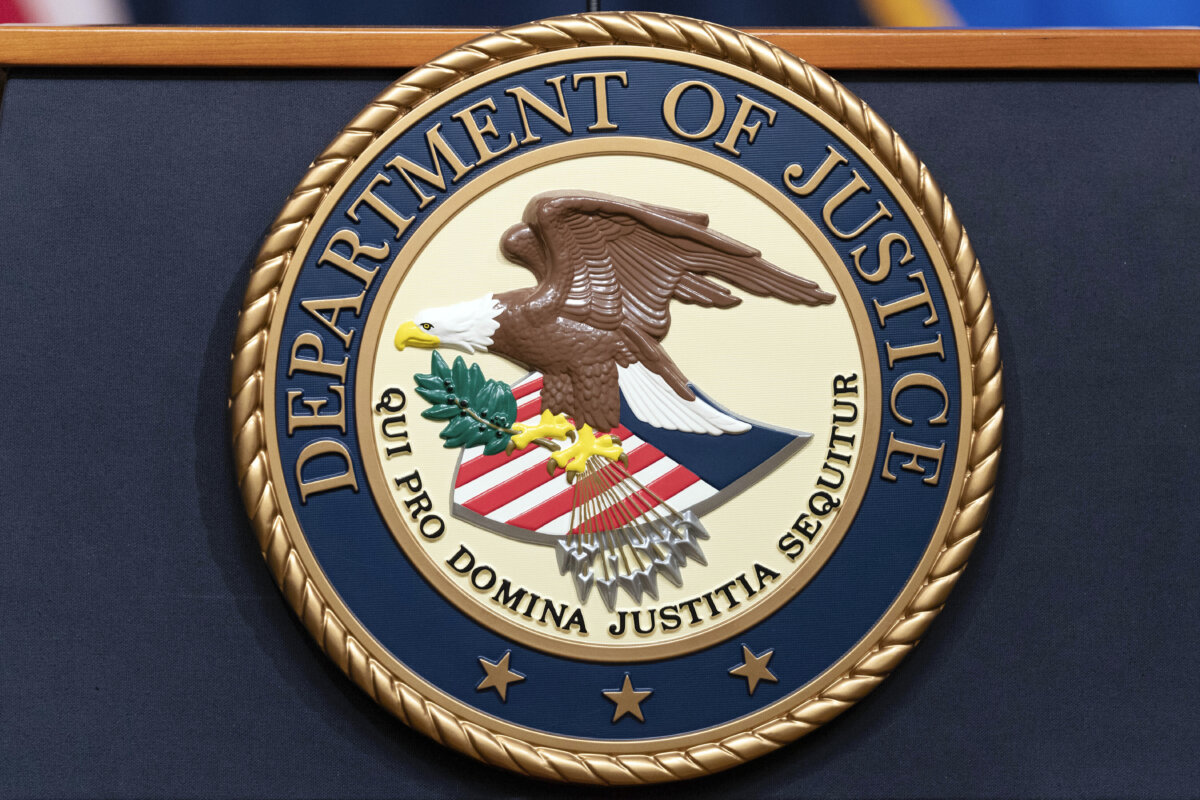

The Department of Justice (DOJ) officially launched a new anti-fraud division in August.
The DOJ on Sept. 1 said the new division is exclusively devoted to prosecuting fraud, and is “critical to restoring public confidence in the federal government’s ability to responsibly steward taxpayer dollars.”
The anti-fraud division is headed up by career federal prosecutor Colin McDonald. He was nominated in late January, confirmed to the position by the full Senate in March, and sworn in at the start of April.
McDonald was confirmed on a party line vote of 52-47 after Senate Judiciary Committee Ranking Member Dick Durbin (D-Ill.) opposed the nomination. Durbin raised some objections to McDonald himself, but most of his fire at the time was reserved for the wider Trump administration.
“The worst examples of waste, fraud, and abuse in recent years are coming from inside the Trump Administration. Want to root out fraud?” Durbin said in February. “Start at the top.”
McDonald has been working since his confirmation to staff up the division. August’s launch was similar to a grand opening after a soft launch in the private sector.
The DOJ release cited Government Accountability Office (GAO) figures that put the cost of fraud involving federal government funds at between $233 billion and $521 billion every year.
The anti-fraud division’s mission will be to take legal measures against fraud involving federal government payments, “no matter its size or complexity.”
How Much Can the Government Claw Back?
The size of the fraud may impact how much the government is able to reclaim, according to number crunchers who caution that while extensive anti-fraud efforts are worth pursuing, expectations should be tempered.
Citing a April 2024 report from the Government Accountability Office, federal government fraud losses are estimated to sit at between 3–7 percent of federal spending, or $233 billion–$521 billion annually.
A full recovery of the upper $521 billion fraud estimate could cut the annual U.S. government deficit of around $2 trillion by a quarter, which would have significant effects.
“If this fraud loss could be addressed, the savings could potentially eliminate the annual Social Security deficit and fund the departments of Homeland Security and Commerce, with enough left over to almost completely fund all of the food assistance programs run by the U.S. Department of Agriculture,” consultancy McKinsey wrote in a subsequent December 2024 report titled “Protecting public funds: The fight against government fraud.”
According to the McKinsey white paper, consistent fraud prevention efforts at the IRS from 2013 to 2014 were quite effective, with savings of $2.7 billion a year.
However, the enforcement efforts costs “real money over an extended period,” McKinsey noted.
Even at a return on investment (ROI) of 50:1, which report authors Eric Schweikert, Ishanaa Rambachan, and Tim Natriello judged to be “unsustainable,” it would take an estimated “$20 million to stop each $1 billion of fraud, against a total fraud loss of hundreds of billions of dollars.”
That would mean at the high ROI scenario, it would cost $10 billion to recover all $500 billion in estimated fraud.
The DOJ has said that it will pay for its fraud division by moving around existing resources, and noted an additional $30 million in funding from Congress.
“Prosecutions of fraudsters is critical to advancing the interests of the United States and fraudsters who dare steal from Americans and their government will be systematically targeted, prosecuted, and imprisoned,” the department said.
 Friends Read Free
Copy
Facebook
Tweet
Friends Read Free
Copy
Facebook
Tweet