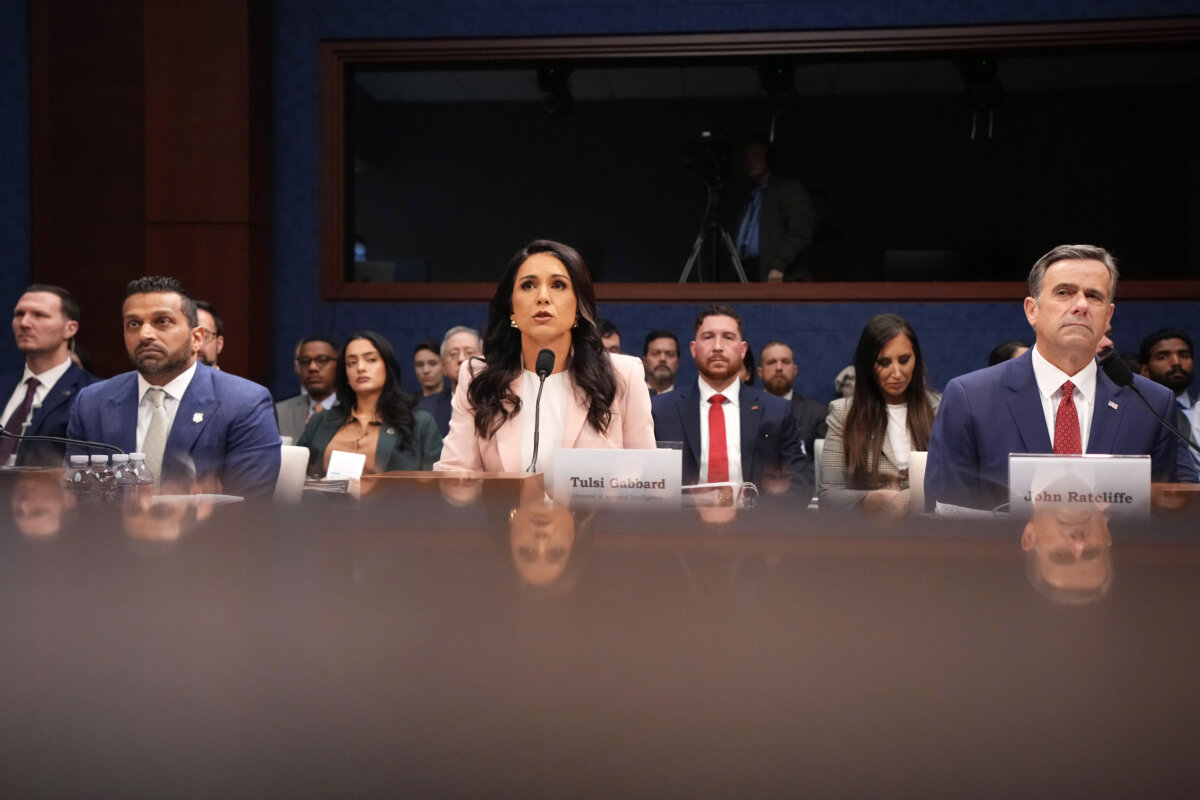

The nation’s top intelligence officials presented their annual worldwide threat assessment to the House Intelligence Committee on March 19, covering topics including the war in Iran, the terrorism landscape, and Chinese communist attempts to control U.S. land.
Among the speakers were Director of National Intelligence Tulsi Gabbard, CIA Director John Ratcliffe, and FBI Director Kash Patel. Here are some of the key takeaways.
Major Threats to the Homeland
During Gabbard’s opening statements, she noted that border security and tracking migration trends are part of the defense of the homeland. She said that during the last year there have been “significantly positive results” on the immigration front.
“The strict enforcement of U.S. policies at the U.S.–Mexico border and regionally has served as a deterrent and drastically reduced illegal immigration,” Gabbard said. “Based on Customs and Border Patrol data, January 2026 monthly encounters are down 83.8 percent compared to January of 2025.”
But she added that major drivers of migration will likely continue or worsen given the status of countries such as Cuba and Haiti. Both nations, she said, are home to transnational criminal organizations where smugglers “view chaos as an opportunity for profit.”
Fentanyl importation is still a threat to Americans, according to Gabbard. She said Mexico-based groups such as the Jalisco Cartel “dominate the production and smuggling of fentanyl, heroin, methamphetamine, and cocaine into the United States.”
In Colombia, groups such as the Revolutionary Armed Forces and the National Liberation Army are also of concern to the intelligence community.
Also, the terrorism landscape is evolving, said Gabbard, marked by “a geographically diverse set of Islamist terrorist actors seeking to propagate their ideology globally and harm Americans.”
She said the spread of Islamist ideology associated with the Muslim Brotherhood and others poses a serious threat to the “foundational principles that underpin Western civilization.”
FBI Director Kash Patel spoke to the number of terrorist threats his agency has faced, saying that last year, 2,300 arrests were made in relation to foreign terrorists.
“We had 700 counterterrorism arrests, and the FBI had 640 counterterrorism disruptions where we stopped attacks on the homeland,” Patel said. “Specifically, in December, we stopped four in an 18-day span.”
Patel highlighted one attack perpetrated by an individual who had already been convicted of terrorism and given a less severe sentence than what was recommended by the Department of Justice, allowing him to be released in 2024.
“If that had not occurred, that individual would still be in prison, and a member of our uniform military service would still be alive,” Patel said.
Operation Epic Fury
Asked about U.S. operations in Iran, the panelists described Operation Epic Fury as a strategic move to weaken Iran and its proxies to protect the American people.
“The [intelligence community] assesses that Iran appears to be intact, but largely degraded due to attacks by Israel and the U.S. on its leadership and capabilities,” Gabbard said.
However, she said that the work in the Middle East was not done, saying that if a hostile regime survives in the area, it will likely look to rebuild its military forces, infrastructure and nuclear enrichment capability and “continue to refuse to comply with its nuclear obligations.”
Ratcliffe was asked to justify the incursion into Iran. He said there’s a body of intelligence “that does reflect that in the likely event of a conflict between Iran and Israel, that the U.S. would be immediately attacked, regardless of whether the United States stayed out of that conflict.”
However, the officials were clear that it is not the role of those in the intelligence community to assess when the United States should engage in conflict, only to provide information to the president.
“And as director of national intelligence,” Gabbard said, “my responsibility is to report the intelligence community’s assessments objectively and to make sure that they are not politicized in any way, shape or form.”
Combating CCP Land Control
Patel said his agency is working to combat Chinese Communist Party (CCP) actors within the United States.
According to the FBI director, agents have worked with state and local officials to target CCP agents who own land not subject to review by the Committee on Foreign Investment in the United States.
Patel cited a 400-acre farm in Texas owned by a CCP official that was raided on the grounds of unlawful possession of firearms. The land was eventually seized in its entirety. A similar strategy was used in Louisiana, where the FBI partnered with state officials to shut down drilling sites operated by CCP operators that he said were used to “steal data and intelligence” from Americans.
The FBI also has six active investigations into CCP-affiliated properties in multiple jurisdictions across the nation.
The hearing came two days after Gabbard and others made a similar report before the Senate Intelligence Committee.
 Friends Read Free
Copy
Facebook
Tweet
Friends Read Free
Copy
Facebook
Tweet