Under a blazing summer sun, 90-year-old Gen. Lee Jin-sam, former chief of staff of the Republic of Korea army, attended an hours-long ceremony after flying in from South Korea for the dedication of a new Korean War memorial in New York state’s Orange County.
A Korean War veteran and one of the surviving members of the generation that witnessed South Korea’s fight for survival, Lee’s quiet determination became one of the most memorable moments of the day. His presence reflected a sentiment echoed repeatedly throughout the ceremony: profound gratitude to the American and U.N. service members whose sacrifices helped preserve South Korea as a free nation.
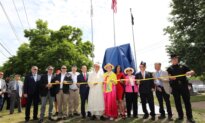
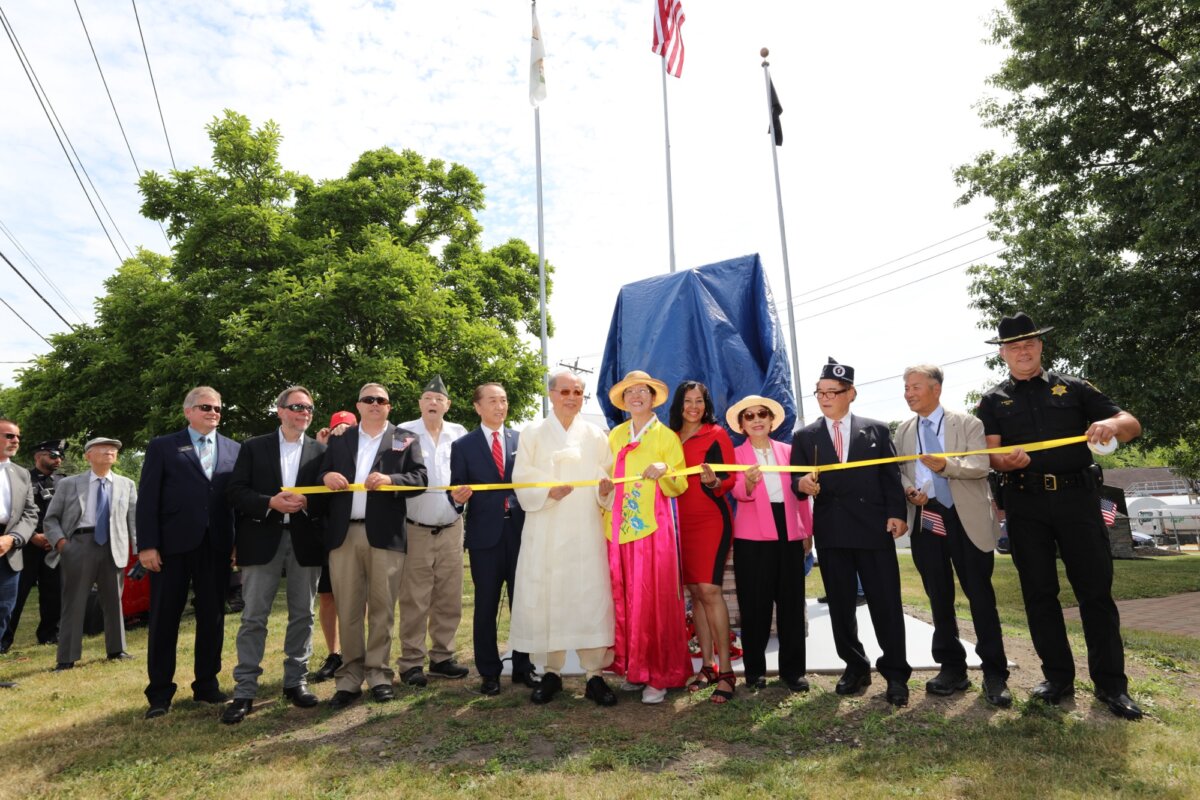
On June 25, Korean American community leaders, Korean War veterans, descendants of military leaders, U.S. veterans, local officials, and residents gathered at Veterans Memorial Park in the town of Wallkill to dedicate the memorial honoring those who fought during the 1950–1953 Korean War.
Held as the United States commemorates the 250th anniversary of its independence and the 76th anniversary of the outbreak of the Korean War, the ceremony was both a tribute to those who made the ultimate sacrifice and a celebration of the enduring alliance between the United States and South Korea.
Again and again, speakers emphasized that the lessons of the Korean War—and the enduring threat of communism—remain relevant today.
Designed by a Korean War survivor, the memorial features historical inscriptions documenting the Korean War and honors Gen. Douglas MacArthur, Gen. James A. Van Fleet, and Gen. Walton H. Walker. Their leadership played a pivotal role in the defense of South Korea during the war.
Commemorating America’s Sacrifice
The event was organized by President of the Korean American Foundation Hubert Ho-jae Lee, an economist specializing in free market and socialist economic thought and a Nobel Peace Prize nominee. A first-generation Korean immigrant, Hubert Lee has devoted years to preserving the memory of the Korean War and promoting appreciation for the alliance between the United States and South Korea.
Recalling his childhood during the war, Hubert Lee said his father, a local community leader, dug a shelter behind their home where the family hid from advancing communist forces. As a boy, Hubert Lee said, he dreamed that one day he would travel to America, earn a degree, and somehow repay the freedom, democracy, and economic prosperity that he believes were made possible through the sacrifices of MacArthur, Walker, Van Fleet, and the American and U.N. troops they commanded.
The completion of the memorial, he said, represented the fulfillment of that lifelong aspiration.
In his remarks, Hubert Lee reflected on the ideals expressed in the Declaration of Independence, emphasizing that liberty and equality remain the defining principles of the American experiment. He said individual freedom, equal rights, and the pursuit of happiness have shaped the United States since its founding and remain values worthy of protection.
Hubert Lee went on to say that Chinese communism continues to pose a serious threat to those cherished principles.
“Unfortunately, Chinese communism is threatening the great causes of freedom and liberty through cyberattacks, space warfare, and even [artificial intelligence] technologies, advocating that socialism is superior to the free-market system,” he said. “The question before America is whether we will remain united and determined to defend our country against these threats.”
Hubert Lee called on Americans to remain committed to protecting liberty, equality, and the sanctity of human life as the nation marked its historic milestone.
Those expressions of gratitude were shared by other Korean leaders attending the ceremony.
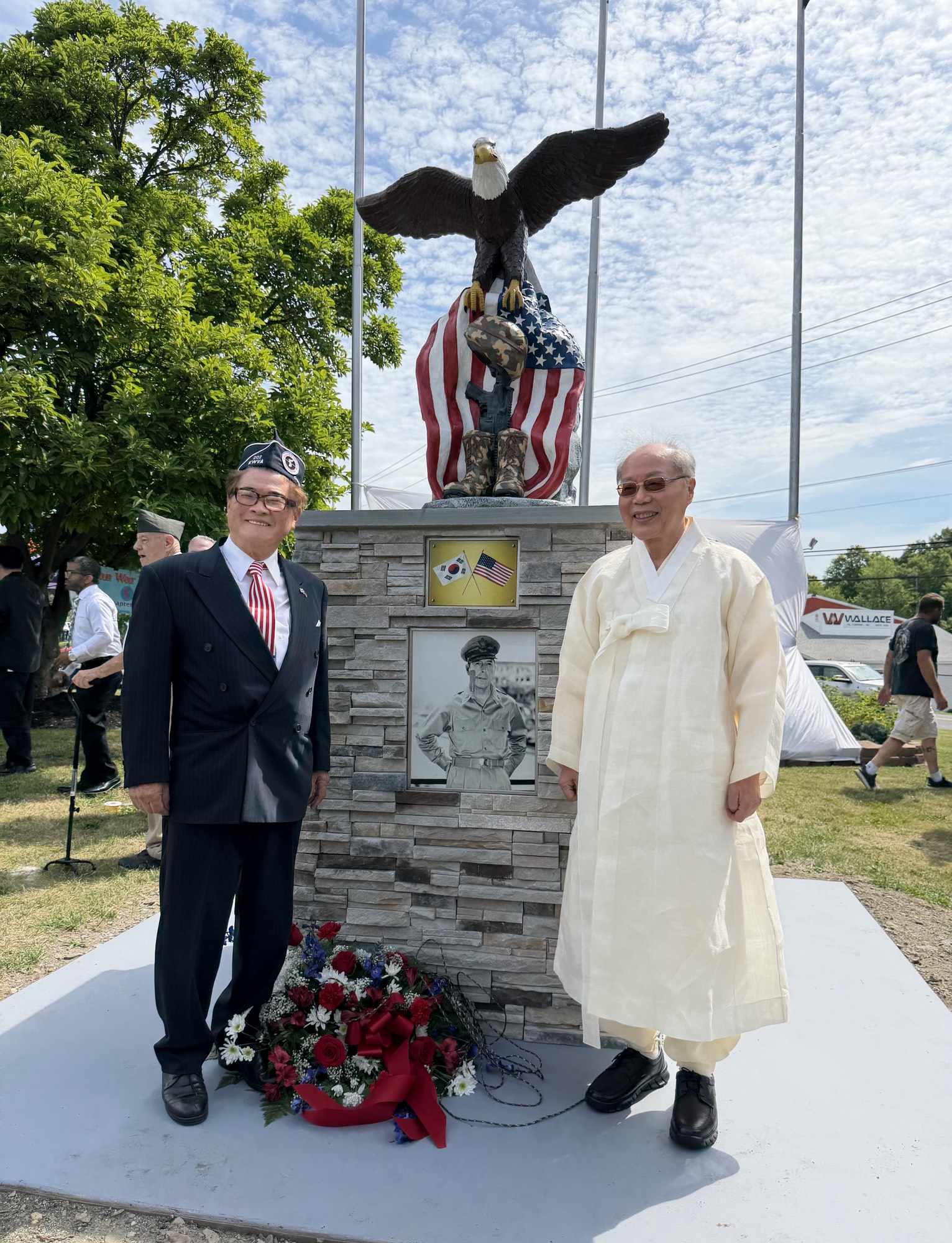
Recalling that he was 5 years old when the Korean War broke out, Seo told attendees that “all the happiness” in his life is “thanks to Gen. MacArthur.”
Speaking on behalf of the Korean people, Seo stepped forward and bowed deeply before the veterans and the descendants of MacArthur, Van Fleet, and Walker, drawing prolonged applause from those in attendance.
Seo also recounted how South Korea’s first president, Syngman Rhee, promised to award MacArthur the nation’s Founding Contribution Medal following the recapture of Seoul in September 1950—a pledge that remained unfulfilled for decades because of ideological conflict. He said preserving the legacy of the Korean War heroes has become a personal mission, recalling that he was shocked to discover that only a handful of students at a youth Go tournament in South Korea recognized MacArthur’s name. Since then, he said, he has supported numerous civic initiatives to ensure that younger generations remember the men whom he described as the saviors of his country.
The same spirit of gratitude was reflected in a letter prepared for the occasion by Don Bak, president of the General Association of Korean Vietnam Veterans of the U.S.
Bak recalled being only 4 years old when war engulfed his hometown of Uijeongbu, just north of Seoul.
“I cannot find words to express my gratitude to the United States of America and the [United Nations],” he wrote. “So naturally, I should thank Gen. MacArthur, Gen. Van Fleet, Gen. Walton Walker, and all American soldiers.”
His words echoed the sentiments heard throughout the ceremony. Again and again, Korean speakers returned to the same message: the democracy, freedom, and prosperity enjoyed by South Korea today would not exist without the sacrifices made by American and U.N. service members during the Korean War.
Descendants of Korean War Heroes
The ceremony also brought together descendants of military leaders whose names have become inseparable from the history of the Korean War.
Among them was a professional musician, a cousin of MacArthur. She performed “America the Beautiful” during the ceremony in tribute to the veterans and those who served during the war.
After Seo bowed deeply before the veterans and descendants of the three generals on behalf of the Korean people, the musician responded with a respectful bow of her own, creating one of the ceremony’s most moving exchanges.
She said participating in the dedication gave her a deeper appreciation for her family’s history and for the sacrifices made during the war.
“I was humbled to learn so much about my cousin, Gen. MacArthur,” she wrote following the ceremony, describing the event as both educational and deeply meaningful. She also expressed gratitude for receiving a commemorative medal from the South Korean army and for the opportunity to meet veterans, their descendants, and community members whose families are forever connected by the Korean War.
She said the visit also gave her a greater appreciation for MacArthur’s legacy at the U.S. Military Academy, where she learned more about his contributions to the academy and the history behind MacArthur’s Riverview Restaurant at the Thayer Hotel, named in his honor.
Military veterans from both countries attended the dedication, including David Haines, a U.S. Army veteran whose service included deployments to Germany, Kuwait, Saudi Arabia, Iraq, and Iran.
Veterans Reflect on Freedom
Throughout the ceremony, speakers emphasized that although the Korean War is often referred to as the “Forgotten War,” its lessons remain relevant more than 70 years later.
Orange County Sheriff Paul Arteta said the memorial represented not only a remembrance of the past, but also a reaffirmation of the values defended by American and Korean forces during the war.
“The best way to end the Communist Party is for all of us to talk and see that communism does not work,” Arteta said in an interview after the ceremony. “Freedom works.”
Reflecting on America’s 250th anniversary, Arteta said the nation’s greatest strength lies in the freedoms that many people may take for granted.
[series_posts_list][/series_posts_list]“In our country, with the great experiment, 250 years, we celebrate freedom and the ability to shop where you want, to do things, move around when you want, and do things whenever you want,” he said. “The freedom that exists here should exist everywhere in the world.”
Arteta said he hopes that people living under authoritarian systems will eventually have the opportunity to experience greater freedom and peace.
John Dodson, an elderly attendee who identified himself as a military veteran with multiple combat deployments and experience protecting the nation’s electrical infrastructure through cybersecurity work, expressed similar concerns from a different perspective.
Drawing on his cybersecurity experience as CEO of Thayer Gate Development Corp. and executive director of Thayer Gate Energy, Dodson said he believes that authoritarian governments seek to influence democratic societies through cyberoperations, control of information, and other forms of infiltration. He said he worries that younger generations may not fully understand the cost of preserving freedom.
“Life is great until someone takes it all away,” Dodson said. “Unless you know what it costs, you don’t value it.”
Dodson said freedom requires constant vigilance and urged younger Americans to carry forward the responsibility of protecting democratic values.
“The old people—we can’t be around much longer,” he said. “Someone young has to pick up the guide. Fight for freedom together.”
Dodson also spoke about the persecution of Falun Gong practitioners by the Chinese Communist Party, condemning forced organ harvesting from prisoners of conscience as “inhuman” and calling for greater international awareness and condemnation of the human rights atrocity.
Monument to Memory, Friendship
Several participants also expressed concern over continuing tensions on the Korean Peninsula, noting that although active fighting ended with the 1953 armistice, North and South Korea have never signed a formal peace treaty.
As the ceremony concluded, attendees gathered around the newly unveiled monument for photographs, conversations, and quiet moments of reflection.
For many participants, the granite monument now standing in Orange County represents far more than a memorial to a war fought more than seven decades ago. It stands as a lasting tribute to the American and U.N. service members whose sacrifices helped preserve South Korea’s freedom, a symbol of the enduring friendship forged between the United States and South Korea, and a reminder to future generations—American and Korean alike—that liberty, once won, must never be taken for granted.
Yu Liang and Shang Jing contributed to this report.
 Friends Read Free
Copy
Facebook
Tweet
Friends Read Free
Copy
Facebook
Tweet