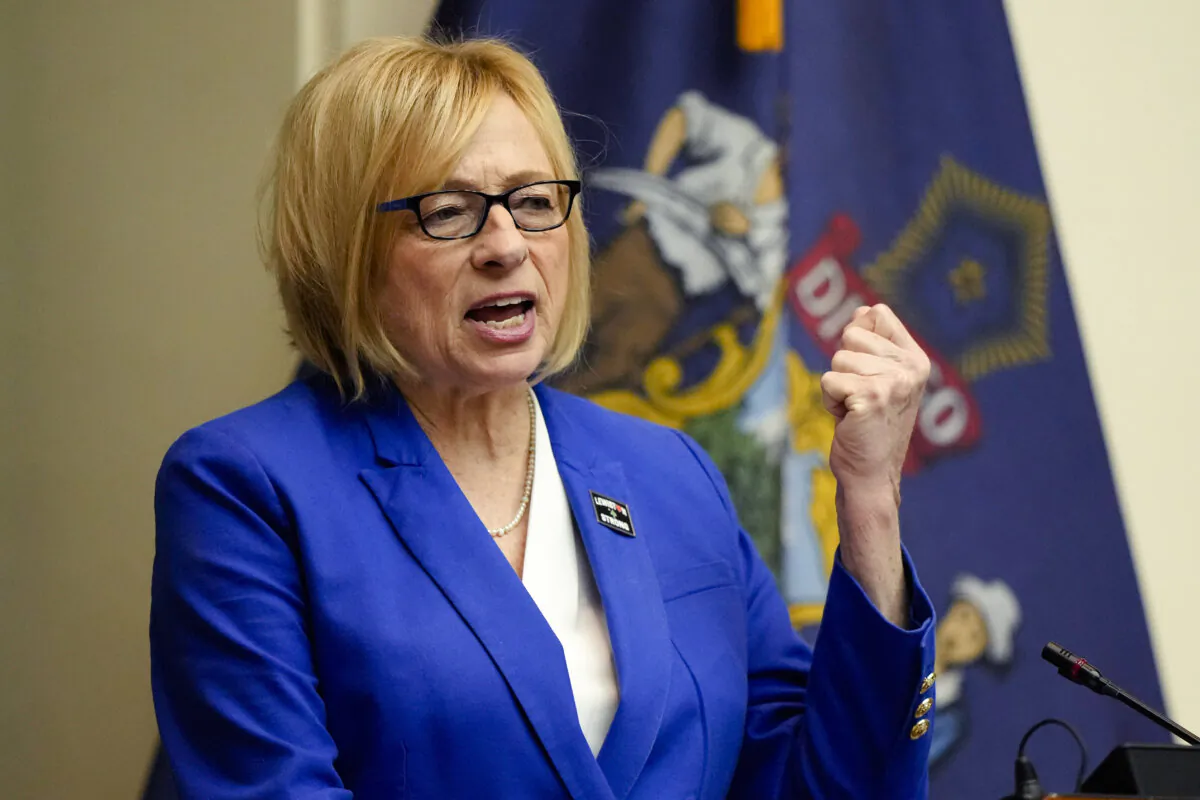

Maine Gov. Janet Mills suspended her Senate campaign on April 30, citing insufficient financial resources.
“When I decided to run for the United States Senate last year, it was because I believed Maine people were getting a bad deal from Washington and because the President of the United States was threatening our democracy and pushing our nation to the brink of disaster. I continue to believe that today,” Mills said in a statement.
“While I have the drive and passion, commitment and experience, and above all else—the fight—to continue on, I very simply do not have the one thing that political campaigns unfortunately require today: the financial resources. That is why today I have made the incredibly difficult decision to suspend my campaign for the United States Senate.”
Mills announced her intention to campaign for Sen. Susan Collins’s (R-Maine) seat in October 2025, telling voters in a video, “I’m Governor Janet Mills, and I’m running to flip Maine Senate seat blue.”
Mills, 78, is term-limited as governor.
She has faced a tough Democratic primary against progressive candidate Graham Platner, who recently took a 22-point lead in the race, according to RealClearPolitics’ polling average.
Platner, 41, has also surged past Mills in funding, leading her with $2.73 million in cash on hand compared to her $1.07 million, according to the most recent March 31 Federal Election Commission (FEC) filings.
The relative political outsider has faced criticism since he launched his campaign, including for controversial remarks he made on the website Reddit years ago, as well as an alleged Nazi tattoo on his chest that he has since covered up.
Mills recently released a series of attack ads hammering Platner for these controversies, but was unable to narrow his polling lead.
Platner received endorsements from progressive leaders in the Northeast, including Sens. Elizabeth Warren (D-Mass.) and Bernie Sanders (I-Vt.).
In a statement on April 30, Platner said “we are all eternally grateful for [Mills’s] service to Maine as Governor, Attorney General, district attorney, and in the legislature.”
“We both got into this race because we knew how critical defeating Susan Collins is. And her decision today reflects that commitment. I look forward to working with her between now and November to do just that,” he said.
“We will go to Washington, and we will start tearing down the system that for far too long has forgotten and written off the people who make Maine and this country what it is.”
Senate Minority Leader Chuck Schumer (D-N.Y.) and Sen. Kirsten Gillibrand (D-N.Y.), chair of the Democratic Senatorial Committee, released a joint statement on April 30 thanking Mills for her “principled campaign.”
“We are grateful for her hard-fought and principled campaign, and we respect her decision to continue her service to Maine as Governor. After years of allowing Trump’s abuses of power, Senator Collins has never been more vulnerable and we will work with the presumptive Democratic nominee Graham Platner to defeat her,” they said. “In 2026, Democrats will win a Senate majority.”
Maine is one of just three Senate races the Cook Political Report labeled as a toss-up in the 2026 midterms, along with Michigan and Ohio. It’s a critical contest for Democrats in their bid to nab four seats to retake the Senate majority.
Republican National Committee (RNC) spokesperson Kristen Cianci said in a statement that Collins is a “proven leader with an indisputable record of delivering for Maine.”
“It’s safe to say we are confident going into Election Day,” she said.
Chase Smith contributed to this report.
 Friends Read Free
Copy
Facebook
Tweet
Friends Read Free
Copy
Facebook
Tweet