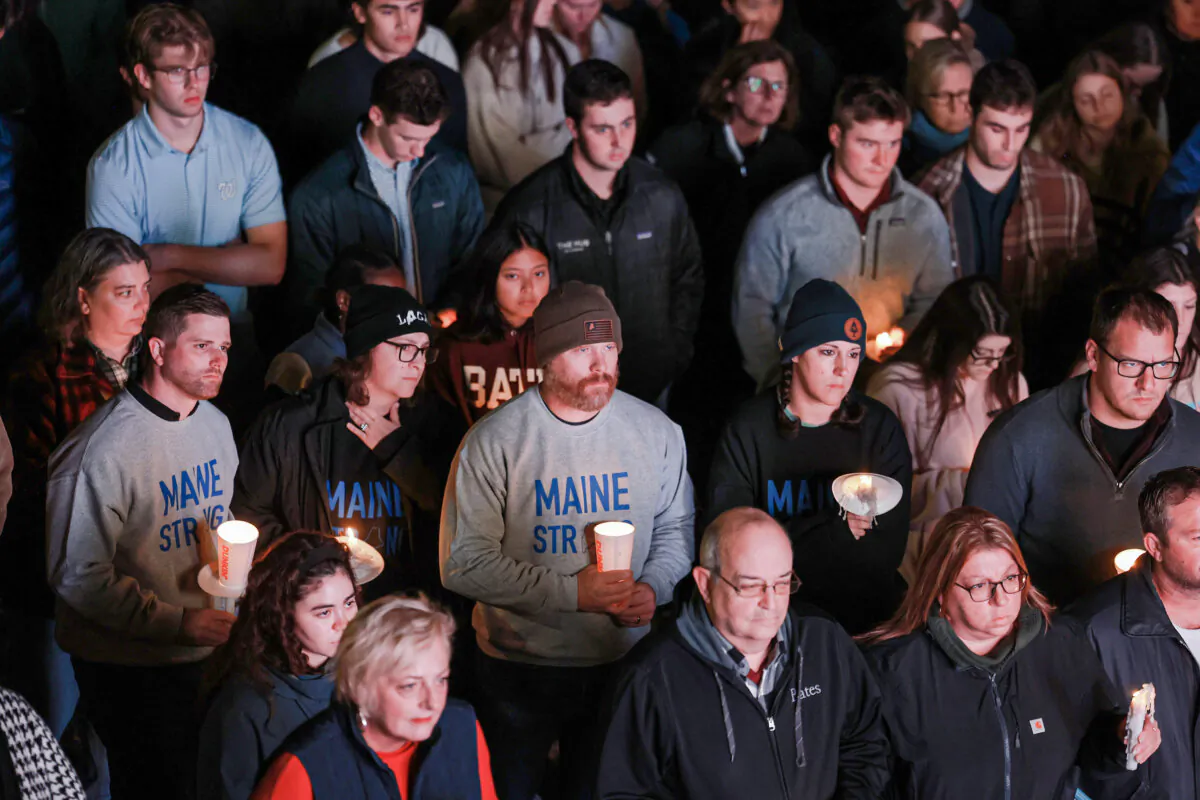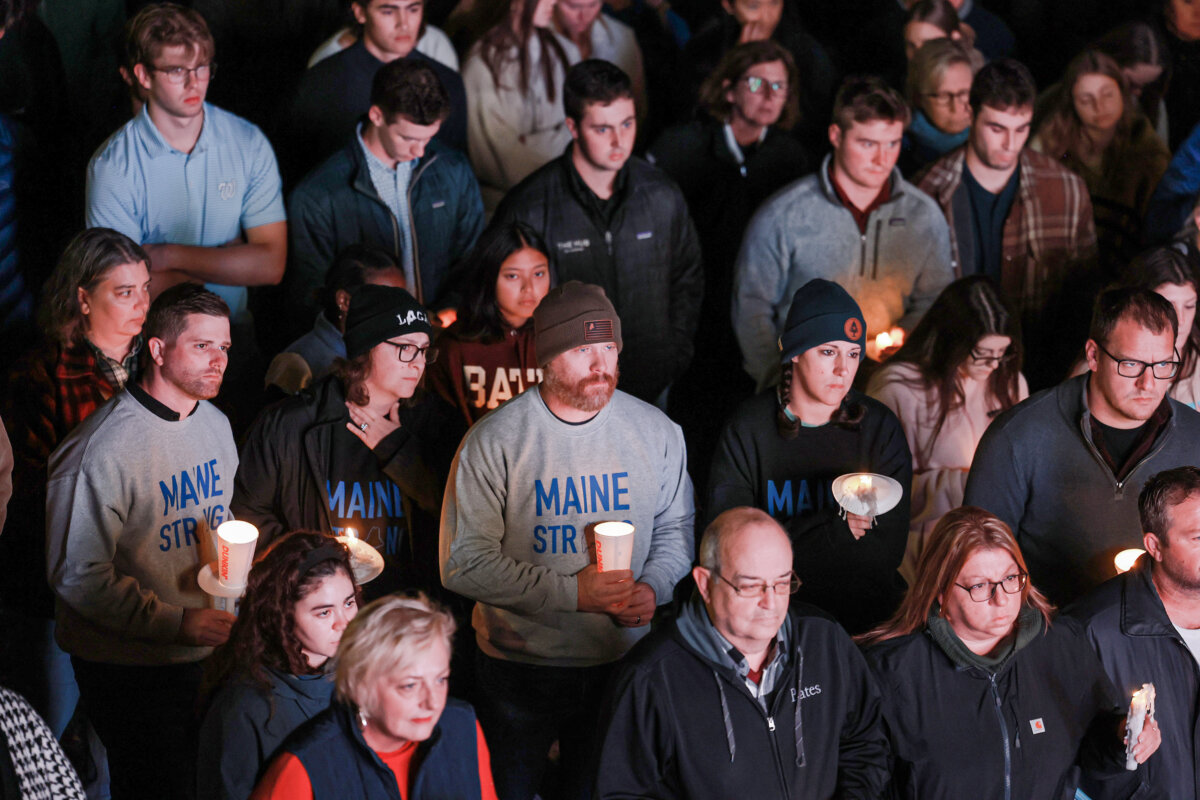

The U.S. Army is facing a negligence lawsuit brought by survivors and families of victims of the 2023 mass shooting in Lewiston, Maine, who accuse the military of ignoring warning signs before an Army reservist carried out the attack.
The complaint, filed on Wednesday in federal court in Maine on behalf of 100 individuals, also targets the U.S. Department of Defense and Keller Army Community Hospital in West Point, New York, where the perpetrator, Robert Card, underwent a mental health evaluation just six weeks before the killings.
On Oct. 25, 2023, Card opened fire at a bowling alley and a nearby restaurant in Lewiston, Maine, killing 18 people and wounding 13 more. The massacre set off a two-day manhunt that ended when Card was found dead from what was ruled a self-inflicted gunshot wound.
Although Card, 40, was a reservist civilian and not on active duty at the time, the lawsuit argues the Army should still be held accountable for its own procedures for handling service members in mental health crisis, including measures that could have restricted their access to “military grade weapons.”
“The Army repeatedly broke its promise to protect the community that it pledges to defend and must be held responsible,” attorney Travis Brennan said in a statement. “The evidence we have gathered since the shooting is disturbing. The facts show that despite every possible warning raised by Card’s behavior, the Army failed at every turn.”
The Justice and Defense departments and the Army declined to comment on the lawsuit.
Army Investigation
A military investigation into the events leading up to the shooting was concluded in July 2024. The findings largely cleared the Army of direct responsibility, but acknowledged a series of lapses and breakdowns in communication within Card’s chain of command.
Card’s mental health issue emerged around January 2023, the investigators found, noting that he told peers in the unit he heard voices and was being mocked when no one was speaking. His commanders were aware of his “ongoing behavioral health issues” but still ordered him to annual training at West Point in July 2023.
After a verbal altercation with other soldiers at West Point, Card’s unit leaders sent him to Keller Army Community Hospital for a mental health evaluation. Providers there determined that Card’s condition was severe enough to order his hospitalization at a civilian mental health facility, Four Winds Hospital in Westchester, New York.
Card spent 19 days at Four Winds, where he was diagnosed with a “brief psychotic disorder” and prescribed psychiatric medication, according to the report. Four Winds relayed his diagnosis to Keller, but investigators said the information was never passed to his chain of command.
Card was discharged on Aug. 3, 2023, and never returned to duty. The Army Reserve Psychological Health Program contacted him on Aug. 11 and noted that he had stopped taking his prescribed medication and was upset that his hospitalization limited “his ability to purchase firearms.” The Psychological Health Program made several additional attempts to contact Card before closing his case at the end of August 2023.
On Sept. 14, 2023, Card “violently assaulted his best friend”—another soldier in his unit—who contacted their chain of command afterward to warn of his concern that Card “would conduct a mass shooting at his unit or somewhere else,” the report stated. The chain of command quickly contacted local law enforcement, which failed on two occasions to contact Card.
The Army Reserve Medical Management Center made a final attempt to contact Card in October 2023 “to follow up with him about his treatment and well-being,” but was unable to reach him.
Lt. Gen. Jody Daniels, commander of Army Reserve Command at Fort Liberty, North Carolina, said at a media roundtable last July that the service lacked the authority to compel Card to undergo treatment or take away his weapons while he was not on active orders. She suggested that local law enforcement and other civilian agencies may have been better positioned to intervene.
“We’re doing the best that we can in terms of understanding what did transpire and then make changes for the future,” Daniels told reporters at the Pentagon after accepting the findings of the probe. “Whether it could have been avoided is anyone’s hindsight at this point.”
Local Police Failures
Wednesday’s lawsuit does not focus on failures on the part of local law enforcement, the subject of a separate investigation commissioned by the state of Maine.
The state investigation concluded that Card alone was responsible for the shooting, but noted there were “several opportunities that, if taken, may have changed the course of events.” For one, the Sagadahoc County Sheriff’s Office conducted a welfare check on Card in September 2023 and, according to the report, had “sufficient probable cause” to seize his guns and place him in protective custody under Maine’s so-called “yellow flag” law.
Maine currently has the nation’s only “yellow flag” law. Under this system, someone who suspects a gun owner poses an imminent threat must first report it to the police. Police officers can decide whether to take the person into protective custody and arrange for a medical evaluation. If both the evaluating doctor and police agree the person is dangerous, they may petition a court for an order temporarily suspending the individual’s gun license and removing the guns. Only after those steps can weapons be legally seized.
In November 2025, Maine voters will be asked on the ballot whether they want the state to adopt a “red flag” law that has fewer steps in the middle. This law would allow relatives or roommates to petition a court directly for an emergency order. If a judge approves, the gun owner would be required to surrender their license and firearms immediately, though they would have the right to appeal.
 Friends Read Free
Copy
Facebook
Tweet
Friends Read Free
Copy
Facebook
Tweet