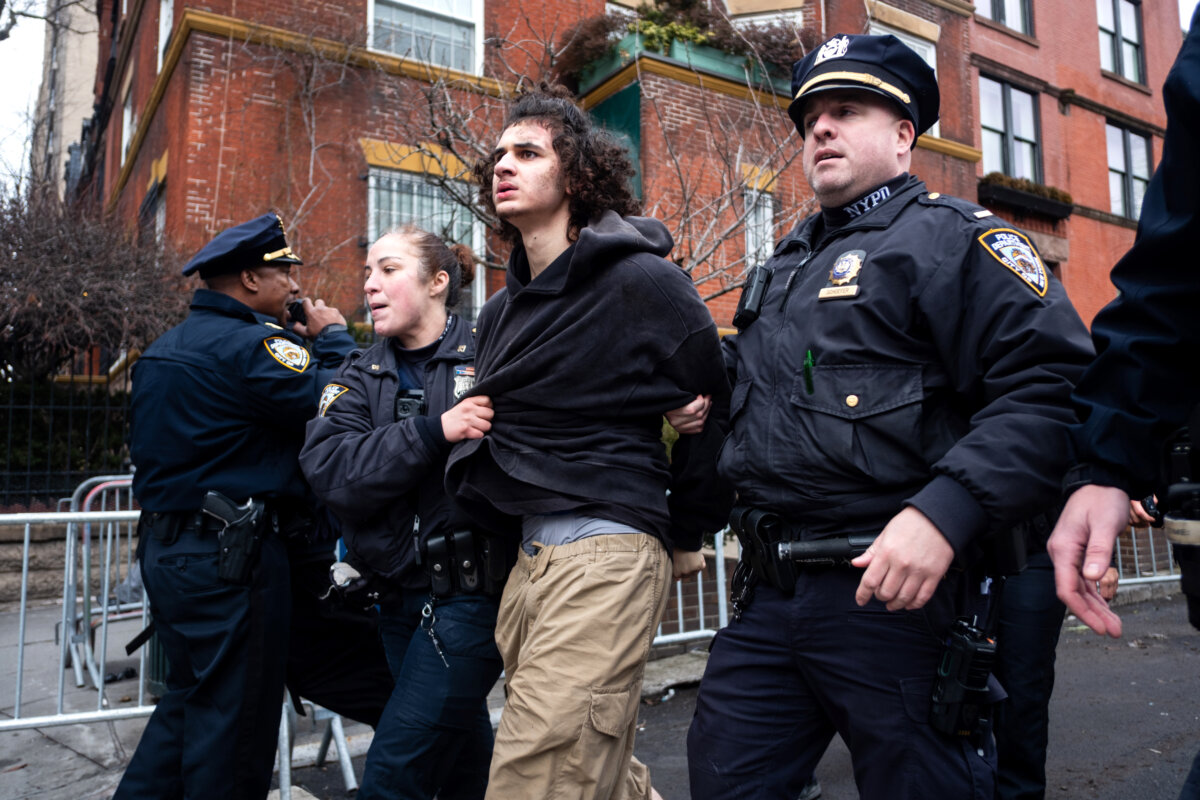

Two Pennsylvania men have been federally charged with attempting to detonate improvised explosive devices outside New York City Mayor Zohran Mamdani’s residence. The men declared allegiance to ISIS following their arrests, prosecutors announced Monday.
The New York City Police Department (NYPD) said earlier Monday that the devices were deployed in the direction of anti-Islamic protesters and NYPD officers.
Emir Balat, 18, of Langhorne, Pennsylvania, and Ibrahim Kayumi, 19, of Newtown, Pennsylvania, face charges including use of a weapon of mass destruction, which carries a maximum sentence of life in prison, and attempted provision of material support to a designated foreign terrorist organization, which carries a maximum sentence of 20 years.
After his arrest, Balat allegedly told officers, “I pledge my allegiance to the Islamic State,” and when asked whether he had hoped to replicate the Boston Marathon bombing, responded: “No, even bigger. It was only three deaths.”
Kayumi, when asked by a bystander about his motivation, responded “ISIS,” according to the complaint.
Deputy U.S. Attorney General Todd Blanche said the men “pledged allegiance to a foreign terrorist organization” and “sought to inflict mass casualties in service to ISIS with the hope of exceeding the carnage of the Boston Marathon bombing.”
Jay Clayton, U.S. Attorney General for the Southern District of New York, said both men stated after being apprehended that they were aligned with ISIS.
“Violence is not protected speech, and it’s not protected protest,” Clayton said. “In New York, violence—particularly acts of terror—will be met with swift justice.”
“Two men, Amir Balat and Ibrahim Kayumi, traveled from Pennsylvania and attempted to bring violence to New York City,” Mamdani said during a March 9 press conference outside the residence.
“They are suspected of coming here to commit an act of terrorism. There is video of these two individuals throwing 2 devices towards the protest. The police department has determined that these were improvised explosive devices made to injure, maim, or worse.”
NYPD has also referred to Ibrahim as having the last name Nick, although on March 9 in the morning press conference and on social media, NYPD Commissioner Jessica Tisch used Kayumi as the suspect’s last name.
“This is being investigated as an act of ISIS-inspired terrorism,” Tisch said.
She noted earlier that one of the bombs contained nuts, bolts, and screws.
The incident occurred on March 7, outside Gracie Mansion on Manhattan’s Upper East Side, where Mamdani and his wife reside, though neither was home at the time.
Approximately 20 protesters organized by pardoned Jan. 6, 2021, rioter Jake Lang, dubbed the “Stop the Islamic Takeover of New York City,” had gathered outside the residence. Roughly 125 counterprotesters were present at the protest’s peak, according to police.
Tisch said tensions escalated after a protester from Lang’s group used pepper spray against counterprotesters. Balat then allegedly lit and threw an ignited device toward the protest area, which landed in a crosswalk on East End Avenue, as shown on the NYPD’s Argus surveillance camera network.
Balat allegedly fled before obtaining a second device from Kayumi, which he lit before officers apprehended him. Tisch said witnesses reported seeing flames and smoke before the first device hit a barrier and extinguished itself a few feet from officers.
Preliminary bomb squad analysis, conducted in consultation with FBI special agent bomb technicians and an FBI chemist, determined that the devices were improvised explosive devices (IEDs) capable of causing serious injury or death—not hoax devices or smoke bombs. One device contained triacetone triperoxide, known as TATP, a volatile homemade explosive that has been used in IED attacks globally, Tisch said.
During a subsequent investigation, NYPD detectives found a vehicle connected to the suspects—a black 2010 Honda with New Jersey plates—on East End Avenue between 81st and 82nd streets.
A bomb squad robot discovered a third suspicious device and materials inside consistent with the first two. Officers conducted limited evacuations of nearby buildings before removing the device. It tested negative for explosive material, and residents were allowed to return to their homes once the scene was cleared.
Tisch said the NYPD has no information connecting the investigation to the ongoing U.S.–Israel strikes on Iran, although the department has been operating in a heightened state of alert since hostilities began.
Mamdani, New York City’s first Muslim mayor, said he found the anti-Islam protest “appalling” but defended the protesters’ right to demonstrate.
“Ours is a free society where the right to peaceful protest is sacred,” Mamdani said. “It does not belong only to those we agree with. It belongs to everyone.”
The mayor said the city would not tolerate violence from either side. He thanked NYPD Assistant Chief Aaron Edwards and Sgt. Luis Navarro, both present at the March 9 press conference, for running toward one of the lit devices during the protest.
Tisch said that Edwards, a 23-year department veteran who became Manhattan North borough chief in December 2025, and Navarro, who grew up in Puerto Rico and New York, acted on instinct and training to protect bystanders.
Tisch noted that the last time an IED targeting people was used in New York City was in 2017, when Akayed Ullah detonated a device in the pedestrian underpass connecting the Port Authority bus terminal and the Times Square subway station, injuring no one except the attacker.
“Luck is never a strategy,” Tisch said. “Devices like these have the potential to cause devastating harm.”
Six individuals in total, including those named earlier, have been arrested in connection with the March 7 incident, including the protester who deployed the pepper spray. Tisch said she expected to provide more details once the federal complaint is unsealed.
Aldgra Fredly contributed to this report.
 Friends Read Free
Copy
Facebook
Tweet
Friends Read Free
Copy
Facebook
Tweet