
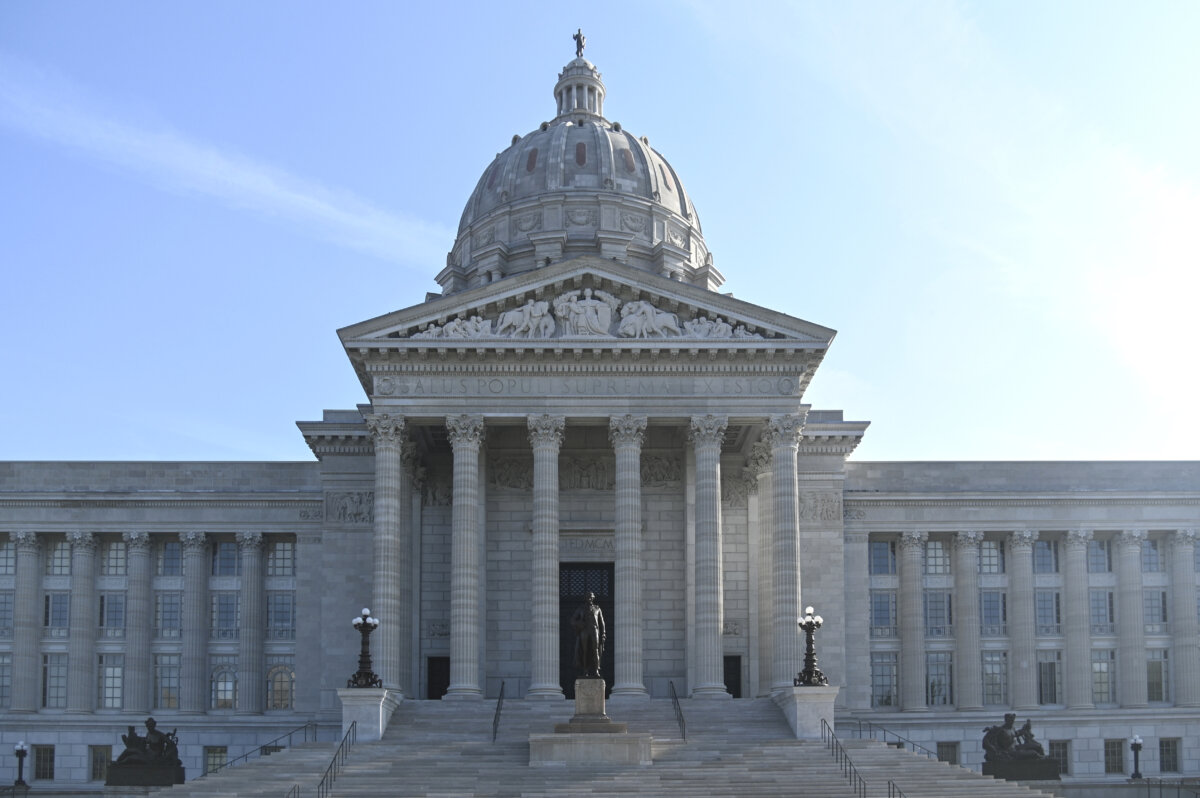

A Missouri court has rejected a legal challenge to new U.S. House districts backed by President Donald Trump, a decision that could help Republicans gain an additional congressional seat ahead of the 2026 midterm elections.
In a March 12 ruling, Jackson County Circuit Judge Adam Caine found that the plaintiffs had not met the heavy burden required under Missouri law to overturn election maps approved by the state legislature.
“Courts should not ‘interfere with the political process by finding a redistricting map unconstitutional’ unless the plaintiff meets the heavy burden required under Missouri law,” the judge wrote, concluding that the groups representing Missouri voters who filed the lawsuit had failed to meet that standard.
Caine cited Missouri Supreme Court precedent stating that decisions about congressional districts “are political in nature and best left to political leaders, not judges.”
The ruling allows Missouri’s new congressional map to remain in place for now, though a separate case pending before the Missouri Supreme Court could still determine whether lawmakers had the authority to redraw districts mid-decade.
The case stems from opposition to a new map passed during a September 2025 special legislative session, which plaintiffs said was intended to help Republicans win a Kansas City-area seat currently held by Democratic U.S. Rep. Emanuel Cleaver.
The map reassigns portions of Kansas City to two neighboring districts represented by Republicans and stretches the remainder of his 5th Congressional District eastward into Republican-leaning rural areas.
If Republicans capture the seat, Missouri’s congressional delegation could shift from its current 6–2 Republican majority to a 7–1 advantage.
Legal Challenge
The plaintiffs, represented by the ACLU and Campaign Legal Center, argued that Gov. Mike Kehoe, a Republican, violated the Missouri Constitution by convening a special session to redraw congressional districts just three years after the state approved new maps following the 2020 Census.
Calling the redistricting an unconstitutional gerrymander that dismantled Kansas City’s black Democratic representation and manipulated the 2026 elections, the plaintiffs claimed that lawmakers “sprinted through hearings and enacted a new map in just a week and a half’s time” with “no transparency,” according to the complaint.
“While publicly acknowledging that the map was being redrawn to defeat Black Democratic Congressman Emmanuel Cleaver, the Governor nonsensically cited the obviously pretextual claim that there was some Voting Rights Act or Fourteenth Amendment violation with the 2022 map in his Proclamation calling the Extraordinary Session,” the complaint adds.
The plaintiffs also argued that the map violated Missouri’s constitutional requirement that districts be “as compact as may be.”
Instead, the new 4th and 5th districts were described as unusually shaped, with one featuring a “giraffe-neck appendage” extending into Kansas City that splits black communities.
“Politics and partisan advantage are not permissible justifications for deviating from the compactness requirement,” plaintiffs stated in the complaint.
The lawsuit also alleged that lawmakers committed a critical error by assigning one Kansas City precinct to two different districts, leaving the districts improperly apportioned and, in some areas, noncontiguous, in violation of Missouri’s constitution.
Court Sides With Defendants
The judge rejected those arguments, ruling that the plaintiffs had not demonstrated that the new map violated Missouri’s constitutional requirements.
Caine noted that compactness cannot be measured solely by the visual shape of districts and that lawmakers may balance multiple redistricting considerations, such as population density, political boundaries, and historical boundaries of prior redistricting maps.
“While a visual observation of a district’s shape is ‘relevant,’ it ‘is not the decisive factor in determining whether a district departs from the principle of compactness,'” he wrote.
The judge also dismissed the claim that a precinct had been assigned to two districts, concluding there was “no evidence” of double assigning and finding that the issue stemmed from two separate voting tabulation districts sharing the same name but having distinct identifiers in the state’s election mapping system.
In a statement reacting to the ruling, Campaign Legal Center, the American Civil Liberties Union, and the ACLU of Missouri criticized the court’s decision.
“We respectfully disagree with the trial court’s ruling, which misapplied the law and overlooked overwhelming evidence that the state’s unprecedented mid-decade congressional map violates the Missouri Constitution’s compactness requirement,” the groups wrote in a statement.
“Drawn under direct pressure from the Trump administration, the map divides the Kansas City area across multiple sprawling districts in clear violation of that constitutional mandate. If allowed to stand, it would represent a significant setback for fair representation in Missouri.”
Part of Broader National Redistricting Battle
The lawsuit is the latest legal fight connected to Trump’s push to secure a Republican majority in Congress, in part through mid-decade redistricting efforts in states such as Texas and Missouri.
Trump said in a Sept. 9 post on Truth Social that the redrawn map would “give the wonderful people of Missouri the opportunity to elect an additional MAGA Republican in the 2026 Midterm Elections.”
Mid-decade redistricting—once rare outside the once-per-decade adjustments following each census—is increasingly reshaping the U.S. House map ahead of the 2026 midterms as states controlled by both parties reopen congressional district lines.
With three House seats vacant, Republicans hold 217 seats to the Democratic Party’s 214, leaving Speaker Mike Johnson (R-La.) with a fragile majority.
Republicans had held 218 seats until earlier this month when Rep. Kevin Kiley (I-Calif.) announced he was leaving the party effective immediately to become an independent. He said he would continue to caucus with Republicans, suggesting the switch could have a limited impact on the GOP’s narrow House majority.
Republicans began the latest wave of redistricting with a new Texas map aimed at adding GOP seats, prompting the Democratic Party to pursue similar efforts in states including California.
The National Conference of State Legislatures said mid-decade redistricting is occurring at levels not seen since the 1800s.
Chase Smith and Jackson Richman contributed to this report.
 Friends Read Free
Copy
Facebook
Tweet
Friends Read Free
Copy
Facebook
Tweet


























