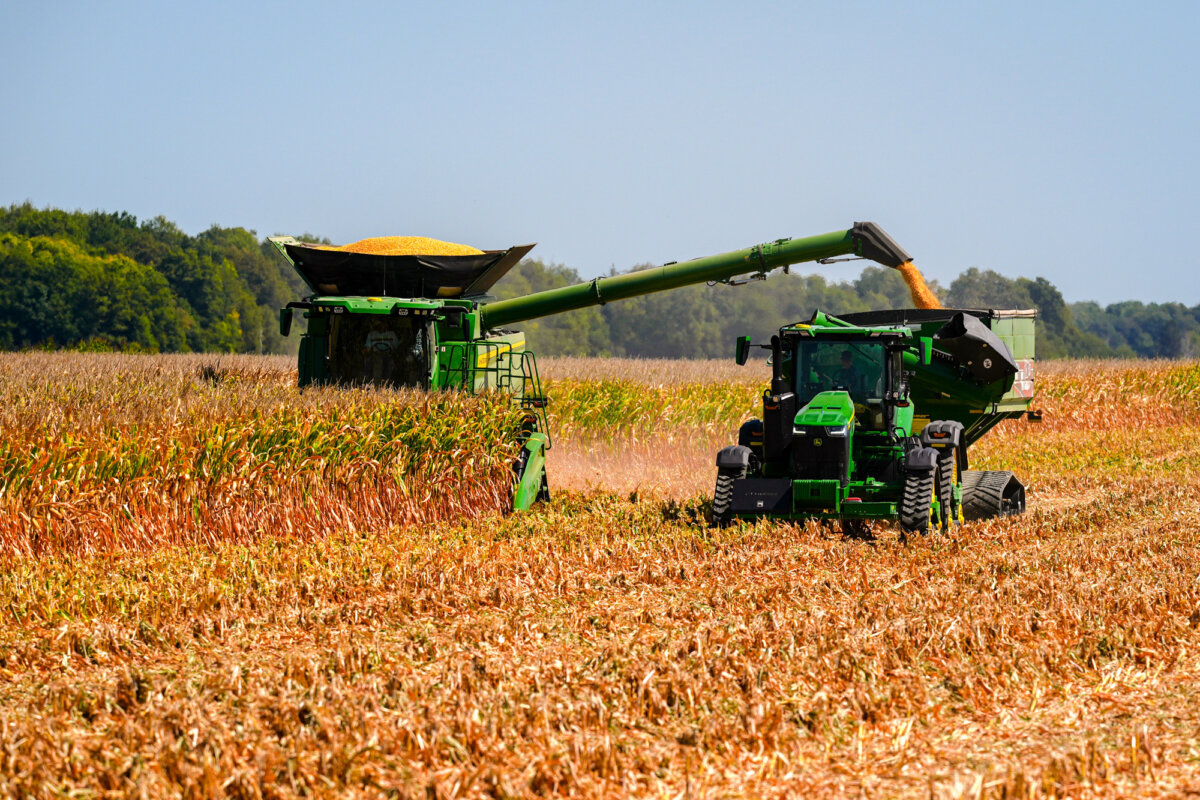

The U.S. Department of Agriculture (USDA) is not currently considering any further farm assistance beyond its recently announced $12 billion aid package amid low crop prices, high input costs, and trade disruptions, a senior agency official said.
Richard Fordyce, under secretary for farm production and conservation at the USDA, said the department is aware that the assistance will not fully stabilize the farm economy but is constrained by available funding. Still, Fordyce stopped short of ruling out future support, suggesting the administration will continue to monitor conditions and reassess in the coming months.
“At this point, we feel like we’ve kind of done what we can do,” Fordyce said in an interview. “I don’t know what next year will bring, but at this point, we’re where we’re going to be.”
The aid package, announced earlier this month by President Donald Trump, is intended to help producers weather a difficult year marked by weak commodity prices; elevated costs for fertilizer, fuel, and equipment; and trade-related disruptions, particularly involving China.
Some exports—most notably soybeans—have declined as foreign buyers shifted purchases to other markets.
Price Pressure Meets Cost Inflation
Farm economists say the downturn reflects falling crop prices colliding with elevated costs, leaving little margin for farmers to absorb trade-related shocks.
“Soybean growers have faced revenue challenges this year with the trade war,” economists at the American Soybean Association (ASA) said in a note earlier this month.
“This event caught farmers at a time when input costs were at levels that allowed no room in operating margins to absorb lower prices. Many factors have pushed up operating costs, including tariffs, regulations, lawsuits, and the broader economy.”
ASA’s analysis said November soybean futures during the 2025 harvest were about 25 to 30 percent lower than at the same point in 2022, squeezing cash flow available to cover operating expenses.
At the same time, production costs have remained high. The group cited USDA estimates that total U.S. farm production expenses will reach $467.4 billion in 2025, up roughly $12 billion from the prior year.
At the Federal Reserve Bank of Chicago’s Midwest Agriculture Conference in September, Terrain executive John Newton said crop-farm cash receipts have fallen by $71 billion over the past three years.
“It’s really hitting farm country,” Newton said.
He also said that USDA’s projection of about $467 billion in input costs would be a record high and that lingering inflationary pressures have further strained farm profitability.
“If we didn’t have the inflationary pressure that we’ve had in the farm economy over the last few years … people would be making money this year on the crops that they’re raising,” he said.
“But because we’ve had so much inflation, margins are at or below break even for the third year in a row across the corn belt.”
Overall farm losses in 2025 could reach $44 billion, according to an estimate from North Dakota State University, highlighting the scale of the financial strain on the sector.
Aid Structure, Longer-Term Support
Under the Trump administration’s farm aid plan, $11 billion will be directed to row crops such as corn, soybeans, and wheat through the USDA’s Farmer Bridge Assistance program, while $1 billion is reserved for fruits, vegetables, and other so-called specialty crops.
Farmers have broadly welcomed the Trump administration’s $12 billion aid announcement.
American Farm Bureau Federation Executive Director Joby Young said in a recent note that recent legislation—including Trump’s One Big Beautiful Bill Act—provides longer-term certainty by extending tax provisions, expanding crop insurance and commodity supports, and boosting conservation and dairy risk-management programs. However, those changes do not take effect until next year.
“That’s why the recently authorized $12 billion aid package was so important,” Young said, calling it a necessary bridge that allows farmers to pay bills, maintain equipment, and plan for the next season.
But he also said that the assistance represents “just one piece” of what producers will need to stabilize their operations.
Young said farmers have been hit by an economic storm combining historically low prices and significantly higher operating costs. He cited estimates that major crops will post more than $34 billion in combined losses this year, on top of $55 billion in losses over the previous two years. A recent uptick in farm bankruptcies, he said, should be viewed as a warning sign for the broader economy.
He also noted that many fruit, vegetable, tree nut, and nursery growers face similar cost pressures and market volatility but received less than 10 percent of the bridge funding, adding that the Farm Bureau is pressing lawmakers to close those gaps as Congress debates further action.
“Financial relief is an essential lifeline,” Young said, “but it’s only one piece of the puzzle.”
Reuters contributed to this report.
 Friends Read Free
Copy
Facebook
Tweet
Friends Read Free
Copy
Facebook
Tweet