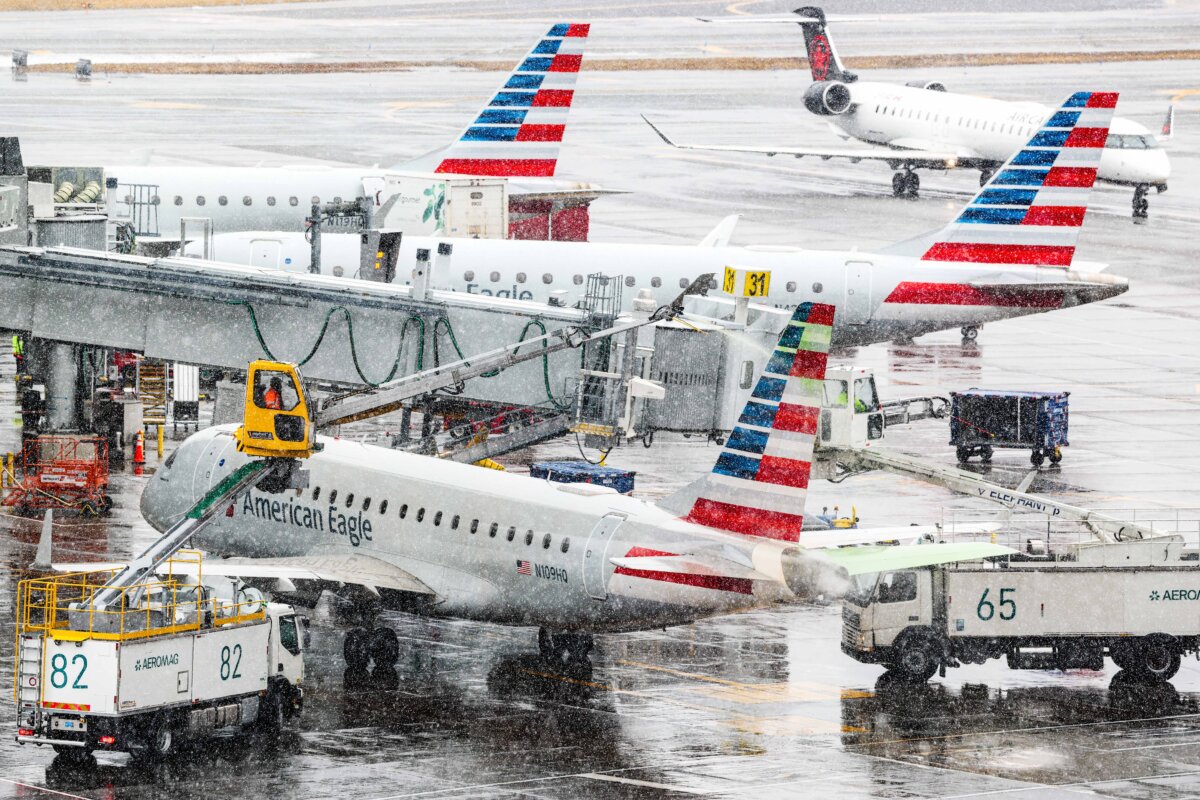
More than 10,000 flights scheduled for between Feb. 22 and Feb. 24 were canceled across the United States as a powerful nor’easter pounded the East Coast with heavy snow, strong winds, and coastal flooding, disrupting air travel and prompting emergency declarations in several states.
Data from FlightAware showed 3,442 cancellations on Feb. 22, followed by 5,535 on Feb. 23 and another 1,619 scheduled for Feb. 24.
On Feb. 23 alone, 88 percent of outgoing flights and 87 percent of incoming flights at John F. Kennedy International Airport in New York City were canceled, according to FlightAware. At Boston Logan International Airport, 92 percent of departing flights and 87 percent of arrivals were scrapped the same day.
The National Weather Service’s Weather Prediction Center warned on Feb. 23 that very heavy snowfall rates of two to three inches per hour and gusty winds of 40 to 70 miles per hour would continue battering the Northeast through Feb. 23, spreading into New England as the storm accelerated.
Coastal areas could see storm totals of one to two feet of snow by the morning of Feb. 24, it said.
For Feb. 23, it said the combination of intense snowfall and damaging wind gusts would make travel nearly impossible from the Delmarva Peninsula into southeastern New England.
“Morning satellite loop of the very strong Nor’Easter producing powerful winds and very heavy snow across the Northeast,” the Weather Prediction Center said in a Feb. 23 post on X. “Blizzard conditions and crippling impacts will continue through much of today for the region.”
The agency, in a separate post on X, also warned that heavy, wet snow combined with strong winds could lead to power outages across southeastern New England, and that minor to moderate coastal flooding was likely at about high tide from the Chesapeake Bay to southeastern New England.
State of Emergency
Authorities in several states across the region declared emergencies, lowered speed limits, and urged people to stay home.
In New York City, Mayor Zohran Kwame Mamdani said on Feb. 22 that the emergency declaration allows the authorities to “cut through red tape so emergency vehicles, sanitation crews, and essential workers can move quickly and do their jobs without delay.”
The city ordered all nonessential vehicles off the streets from 9 p.m. on Feb. 22 until at least noon on Feb. 23.
In a post on X, Mamdani told residents that more snow was expected until early afternoon, noting that roads would remain closed until at least midday on Feb. 23.
New York City Public Schools were closed on Feb. 23, except for buildings operating as warming centers. The mayor’s office said there would be a traditional snow day, with all after-school activities canceled and no remote instruction.
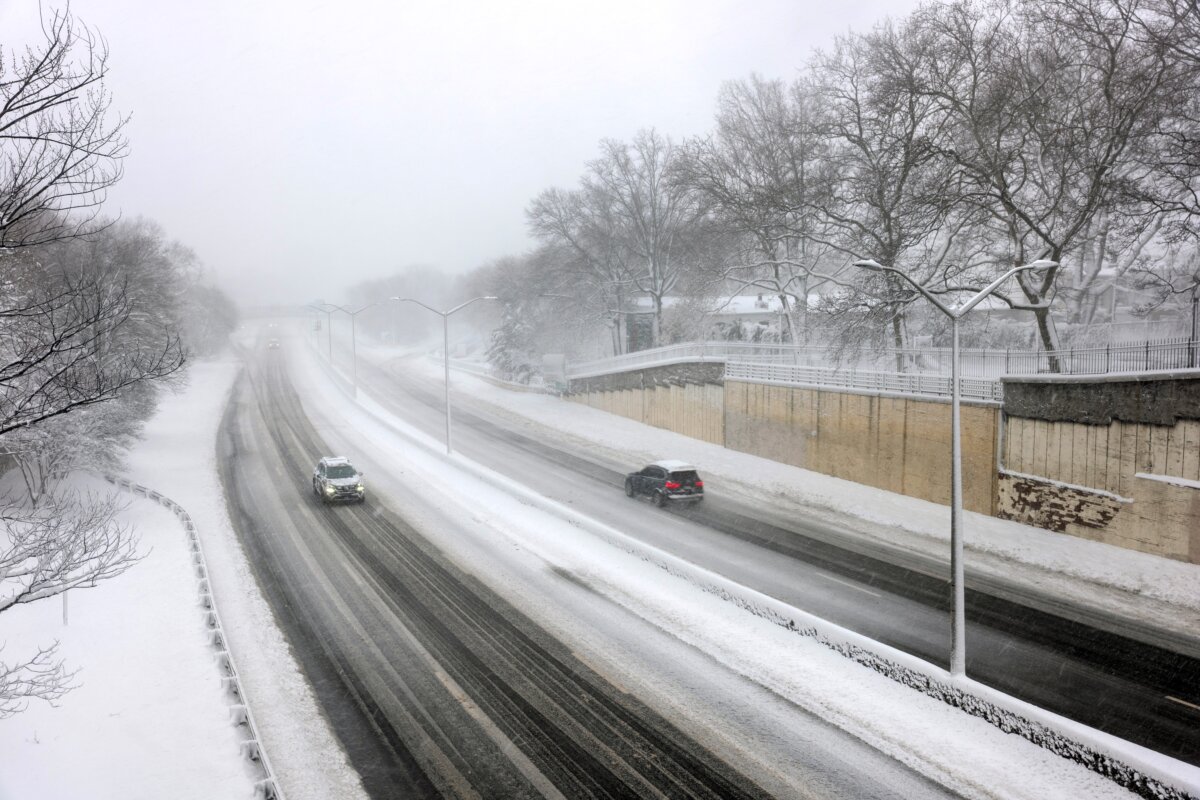 Few cars move along a highway as blizzard conditions continue in New York City on Feb. 23, 2026. (Spencer Platt/Getty Images)
In neighboring New Jersey, Gov. Mikie Sherrill declared a state of emergency for Feb. 22 and Feb. 23, citing forecasts of heavy snow, strong winds, and statewide blizzard conditions that could make driving treacherous.
In Boston, Mayor Michelle Wu declared a snow emergency effective from 2 p.m. on Feb. 22, according to a city statement. Boston Public Schools and all municipal buildings were closed on Feb. 23.
“Preparations for snow are already underway across every neighborhood, and our City teams will be out around the clock through the nor’easter and the cleanup afterwards,” Wu said in the statement.
She urged residents to stay home and off the roads to help public works and public safety crews clear streets, and asked property owners to shovel sidewalks and crosswalks after the snowfall.
Residents who must travel were encouraged to use public transportation.
 Friends Read Free
Copy
Facebook
Tweet
Friends Read Free
Copy
Facebook
Tweet