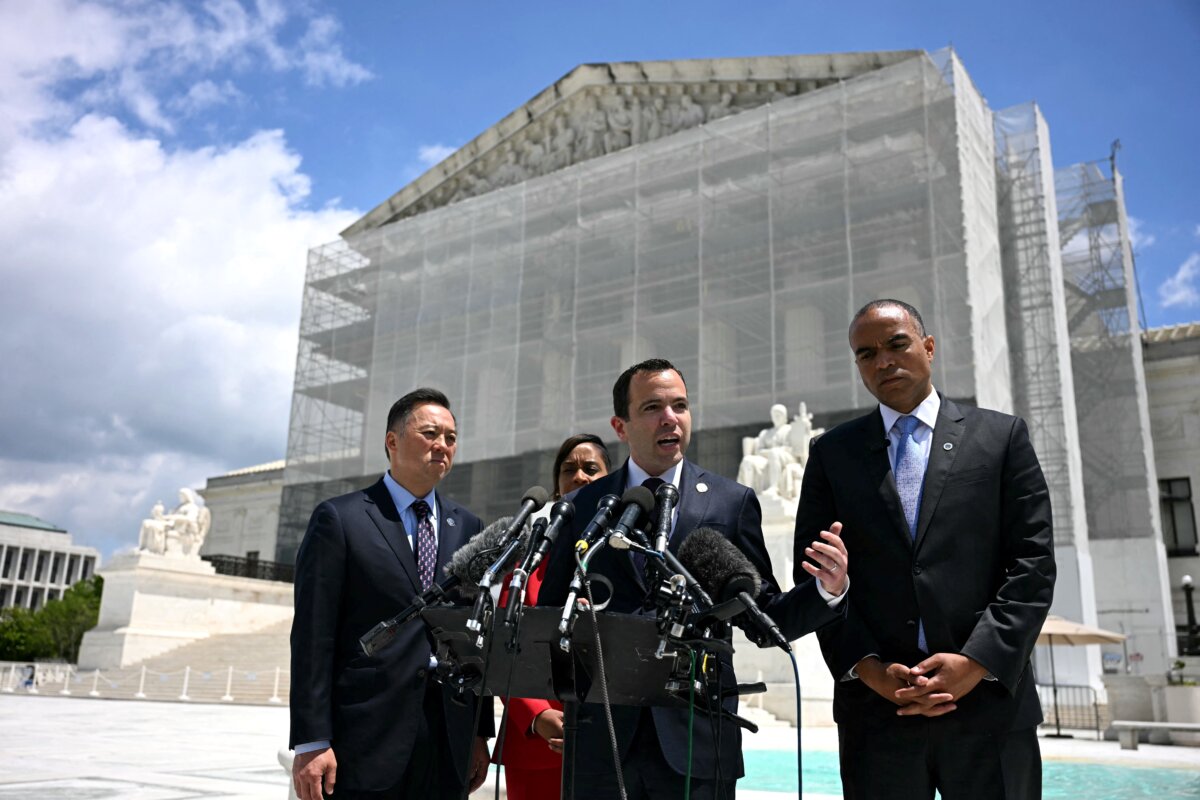

New Jersey’s attorney general said that states can still secure nationwide blocks against federal policies despite a recent Supreme Court ruling that limited the scope of such sweeping court orders, signaling continued legal battles over President Donald Trump’s bid to restrict birthright citizenship.
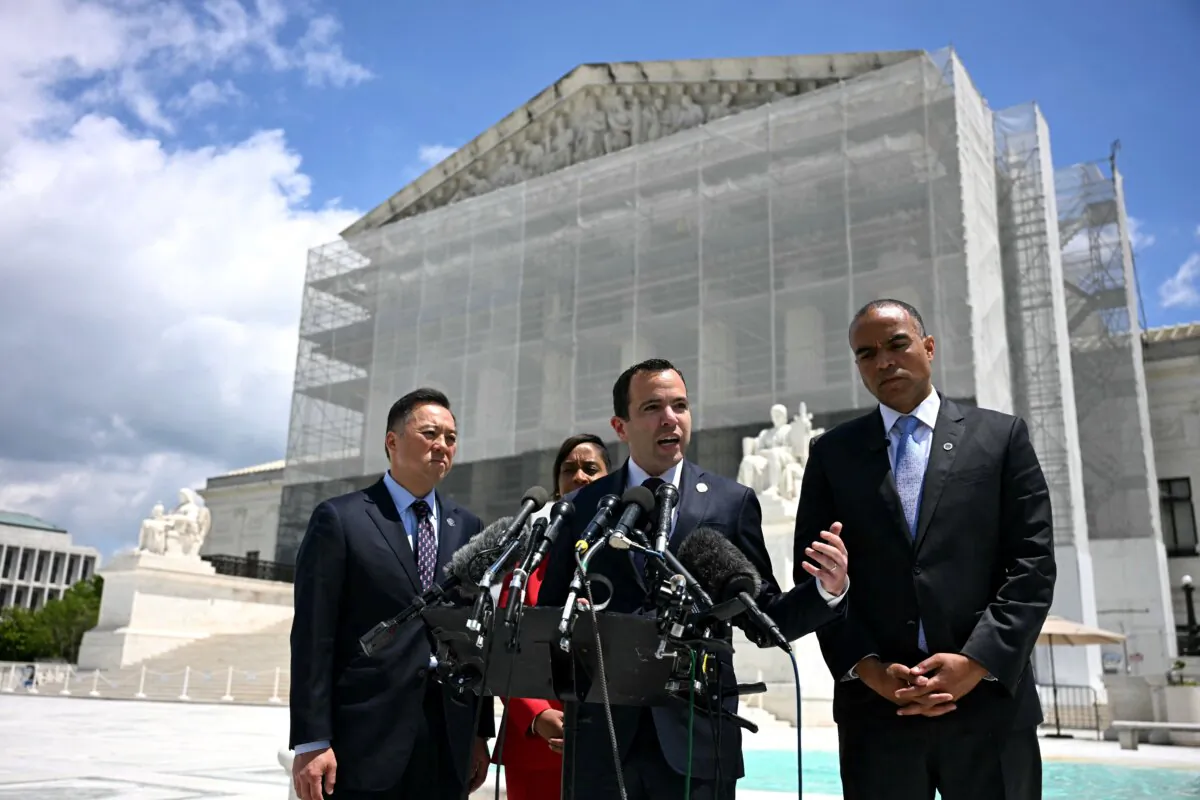
In an interview aired on CNN on June 30, New Jersey Attorney General Matthew Platkin expressed confidence that states will be able to meet the stricter standard the Supreme Court has set for issuing universal injunctions—orders that block federal policies nationwide.
Platkin pointed to the high court’s June 27 decision, in which the justices ruled that universal injunctions “likely exceed” the powers granted to federal courts by Congress. Writing for the majority, Justice Amy Coney Barrett said the judiciary’s authority is limited to providing relief only to the plaintiffs in a lawsuit, unless a broader remedy is necessary to afford them complete relief.
“But ‘complete relief’ is not synonymous with ‘universal relief,'” Barrett wrote. “It is a narrower concept, long embraced in the equitable tradition, that allows courts to ‘administer complete relief between the parties.’”
Speaking on CNN, Platkin said the Supreme Court said “very clearly” that states could still be entitled to nationwide relief if the consequences of a challenged policy are “enormous.” He described the opinion as “rhetorically very strong” but ultimately “middle of the road” in how far it restricts judicial power. Platkin added that he believes states “will very clearly be able to meet the standard that even this Supreme Court set out for states to meet” if the state needs nationwide relief.
While Platkin acknowledged that nationwide injunctions should be used only in “very rare circumstances,” he argued that the legal fight over Trump’s Jan. 20 executive order limiting birthright citizenship is precisely the type of case in which limiting an injunction’s scope makes no sense.
“For the first time since the Civil War, to decide baby citizenship based on whether the attorney general of their state joined a lawsuit, it’s absurd. It’s ridiculous,” Platkin said, warning that differing state-level enforcement of citizenship rules would create administrative chaos.
The attorney general’s remarks echo a statement he issued shortly after the Supreme Court’s ruling, in which he said that although the justices narrowed the availability of universal injunctions, they also recognized that sweeping orders might still be warranted to fully protect plaintiffs from harm. Platkin pledged to continue fighting Trump’s policy in lower courts and expressed confidence that the executive order would ultimately be struck down as unconstitutional.
Numerous states, including New Jersey and Colorado, have challenged the president’s executive order, arguing that it violates the 14th Amendment’s guarantee that “all persons born or naturalized in the United States” are citizens. District courts initially blocked the policy through nationwide injunctions, but the Supreme Court’s decision now requires those courts to reconsider whether such broad relief remains justified.
Legal experts note that although the ruling restricts universal injunctions, it leaves open other avenues for achieving broad relief, such as class actions or cases brought by state attorneys general acting on behalf of their residents.
In a recent analysis for the National Law Review, attorney Stuart Gerson wrote that despite the Supreme Court’s “categorical” language, significant pathways remain for plaintiffs seeking to halt federal policies on a nationwide scale.
“Both of these questions are left open, and each offers the possibility of expansive relief, notwithstanding Trump v. CASA,” Gerson wrote, referring to the case at the heart of the Supreme Court’s ruling. “So, the story of broad injunctive relief is likely not over.”
The Supreme Court’s decision did not address the constitutionality of Trump’s executive order itself, leaving that question for future litigation. The executive order states that the 14th Amendment’s citizenship clause does not universally grant citizenship to everyone born in the United States. In particular, it determined that the phrase “subject to the jurisdiction thereof” in the citizenship clause excludes children of illegal immigrants and some other noncitizens from automatic U.S. citizenship.
Trump praised the Supreme Court’s June 27 decision, describing it as a “monumental victory” for the Constitution and the rule of law by limiting the ability of judges to “interfere with the normal functioning of the executive branch.”
 Friends Read Free
Copy
Facebook
Tweet
Friends Read Free
Copy
Facebook
Tweet