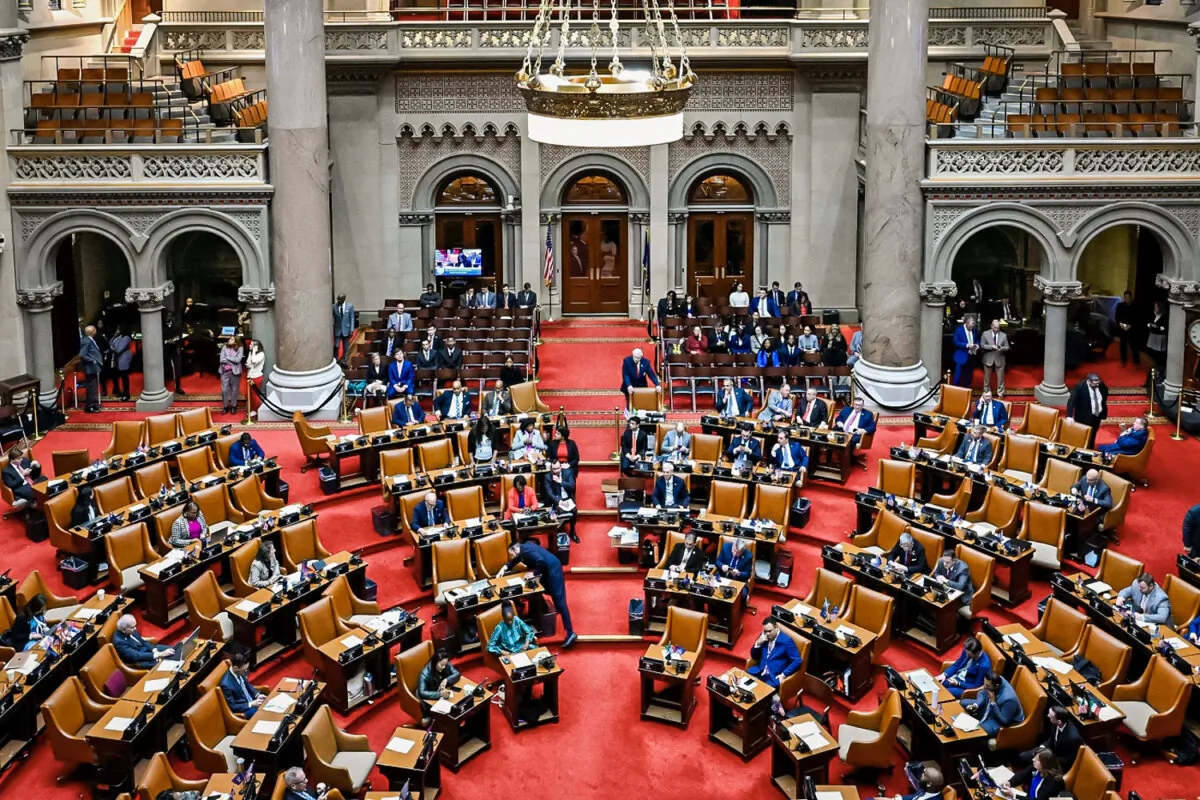

New York state’s Democrat-majority Legislature on June 3 gave first passage to a constitutional amendment that would let state lawmakers redraw New York’s congressional maps mid-decade, advancing a proposal that has become part of the national fight over control of the U.S. House.
The state Senate approved the measure, S10637-A, on party lines. All Republicans in both chambers voted against the measure, in a vote of 38–22 in the state Senate and 91–47 in the state Assembly. Lawmakers acted in the final days of the regular legislative session, which ends on June 4.
The amendment would add a new section to Article 3 of the state constitution allowing the Legislature to change one or more congressional districts by law, using the 2020 census, with those lines staying in place until new maps take effect after the 2030 census, the bill text shows. It would also let lawmakers approve maps by a simple majority and draw maps themselves if the state’s Independent Redistricting Commission does not agree on a plan.
The measure strikes language now in the constitution that bars drawing districts “for the purpose of favoring or disfavoring incumbents or other particular candidates or political parties,” and it removes a requirement that districts be “as compact in form as practicable,” according to the text. It keeps provisions barring maps that deny or abridge the voting rights of racial or language minorities, along with requirements that districts hold roughly equal populations and consist of contiguous territory.
State Assembly Speaker Carl Heastie, who sponsored the Assembly version, tied the effort to recent action at the U.S. Supreme Court.
“The recent decision by the U.S. Supreme Court has made it clear that New York State needs to be able to react and respond to protect the voices of New Yorkers,” he said in a statement.
He said amending the constitution would let the state protect its “communities of interest and ensure that the many, diverse voices of the people continue to be heard in Washington.”
In a memorandum supporting the amendment, lawmakers wrote that the current redistricting process has led to “confusion, multi-year litigation, postponed elections, and rushed consideration and adoption of district lines,” and they said the constitution’s existing constraints are out of alignment with federal court rulings.
State Senate Majority Leader Andrea Stewart-Cousins defended the plan in a statement to The Epoch Times before the vote.
“New York cannot afford to stand still,” she said.
She said that the measure “remains firmly rooted in the democratic process, giving New Yorkers themselves the final say at the ballot box.”
State Senate Republicans opposed the amendment. In a statement after the vote, state Senate Republican Leader Robert Ortt said that Democrats “voted to rip up the will of New York voters and hand themselves a pen to gerrymander districts for the Senate, Assembly, and Congress.” He said his conference “will fight this every step of the way, and in 2027 … will make sure every New Yorker knows exactly what they are voting on.”
At a June 1 news conference, state Assembly Minority Leader Ed Ra, a Republican, called the push “a shameful attempt to nullify the will of the voters” and said New York Democrats had pursued mid-decade redistricting before Republican-led states did. State Assemblyman Matt Slater, the ranking Republican on the Assembly Standing Committee on Election Law, said the existing system is “working” and has produced “some of the most competitive congressional districts anywhere in the country.”
New York voters created the Independent Redistricting Commission in 2014 to take map-drawing out of legislators’ hands. After the commission deadlocked following the 2020 census, Democrats in the Legislature drew their own maps; in 2022, the state’s highest court rejected those maps as an unconstitutional partisan gerrymander, and a court-appointed special master drew the lines used since. Voters rejected a separate Democratic measure to change the redistricting rules in 2021.
The New York effort follows a wave of mid-decade redistricting that began in Texas last year, when Republicans redrew their congressional map at President Donald Trump’s urging, prompting a counter-redraw by California Democrats. New York Republicans argue that the redistricting push sweeping the nation in the past two years actually began further back in their state and was started by Democrats.
Missouri, North Carolina, Ohio, Virginia, Florida, and Tennessee have since taken up mid-decade efforts. U.S. House Minority Leader Hakeem Jeffries (D-N.Y.) has made the redrawing of New York state’s lines part of his strategy to reclaim the House, and has tapped U.S. Rep. Joe Morelle (D-N.Y.) to coordinate with state officials.
A constitutional amendment in New York state must pass the Legislature in two consecutive sessions and then win approval from voters. Because it would need to pass again after the 2026 elections and reach the ballot in 2027, the earliest it could affect any maps is the 2028 election.
 Friends Read Free
Copy
Facebook
Tweet
Friends Read Free
Copy
Facebook
Tweet