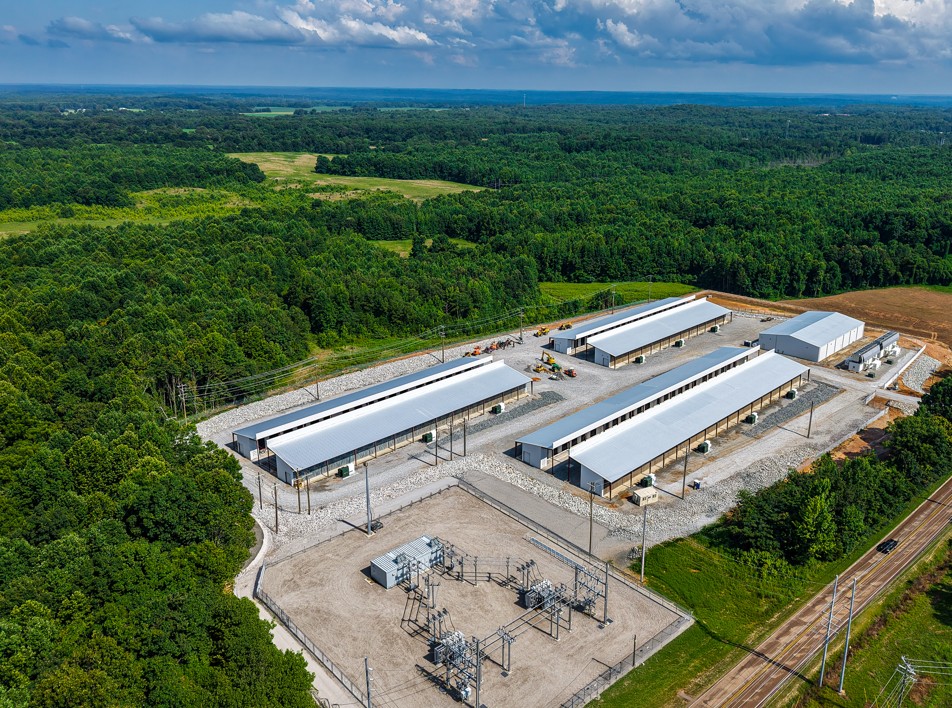

The New York State Legislature passed a one-year data center permit moratorium on June 4 in the final days of the legislative session. If Gov. Kathy Hochul signs it into law, New York would be the first to enact a statewide moratorium.
The legislation requires a pause on permitting while the state Department of Environmental Conservation conducts a comprehensive study on the impact of data centers on electricity, pollution, and water and land use.
The law would apply to data centers that draw 20 megawatts or more of power at peak use. It would also require data centers to increasingly rely on non-carbon energy sources, using one-third renewables by 2030 and 90 percent by 2040.
When asked on June 3 about the legislation during an unrelated event in Brooklyn, Hochul said she will consider the moratorium and that “the status quo can’t continue.”
Hochul said that if data centers are built in New York, she wants to ensure local communities benefit.
The governor expressed concern that although local communities may want data centers, they may not be in a strong position to handle negotiations with those looking to build them.
“Question No. 1: Is the community able to negotiate enough to get benefits?” she said.
Hyperscale data centers, which today largely handle artificial intelligence data processing, consume enormous amounts of energy, ranging from tens to hundreds of megawatts—equal to the power used by tens of thousands of homes during peak demand.
As of July 2025, New York state’s electrical grid operator had received more than two dozen large load requests to connect to the power grid, equivalent to 6,055 megawatts (MW) of power. By December 2025, the large load requests had increased to 48, totaling 12,000 MW, nearly doubling in five months.
The operators said in a report in February that maintaining on-demand power availability and grid reliability will be a major challenge given the additional demand.
This comes at a time when New York state electricity rates have been on a steady incline. According to the state power grid operator, the main factors are rising natural gas prices and a climate law that is forcing older carbon-emitting power plants to make costly upgrades or go offline faster than newer, cleaner energy sources are being added to the grid.
To address this, the moratorium legislation would also require the state utility regulator, the Public Service Commission, to require utilities to assess the costs of serving data centers, including any necessary infrastructure upgrades, and to establish separate rates for such centers.
Local Impact
Communities in upstate New York present an attractive location for large data centers with inexpensive land, cooler temperatures, and, in some areas, abundant hydroelectric power.
That’s the case in St. Lawrence County, where the St. Lawrence River delineates the border with Canada and a massive hydroelectric dam serves the region. Not only is there abundant power from the Moses-Saunders Power Dam, but the region’s manufacturing history also means that there is infrastructure to use and deliver it.
New York’s independent power grid manager has received 17 large load (10 MW or more) requests to connect to the grid in St. Lawrence County, eight of which appear to be from data centers. Whether such requests translate into solid proposals is yet to be seen, but county legislator Rita Curran said she is aware of two proposals currently under review.
Curran sponsored a resolution in the county board of legislators that passed on June 1, acknowledging the enormous impact data centers can have on the local electric grid and on communities at large, and noting significant local opposition. Even so, the resolution calls on the governor and the legislature not to usurp county authority in the review and approval process for data centers and ensures that “counties are not preempted from exercising their land use, taxation, and zoning authority.”
The resolution also urges local city governments to consider a moratorium on data centers. Curran told The Epoch Times that it is a homerule issue.
“I just feel like the people who live here and the people who govern here should have some ability to be part of the discussion versus everything being ruled by people that have never been here,” she said.
She said she is not happy that the state legislature passed the moratorium.
“I think that they will hinder any development at all,” Curran said. “We don’t have a great business environment for people.
“The decisions should be more based in the communities because what goes on in Albany is like a different world.”
Patrick Kelly, CEO of the St. Lawrence County Industrial Development Agency, agreed that the local process can handle the decision. He said the potential moratorium sends the wrong signal.
“In terms of business development, business friendliness, being open for business and investment, moratoriums aren’t necessarily an encouraging outcome,” he told The Epoch Times.
Kelly thinks local communities should decide because they are the ones most affected by the facilities. He said the existing processes for the community to review any such proposals are already in place, including local zoning, planning, permitting, and project approval.
“I think letting those processes do the work that they were set up to do leads to the best outcomes for any community,” Kelly said.
 Friends Read Free
Copy
Facebook
Tweet
Friends Read Free
Copy
Facebook
Tweet