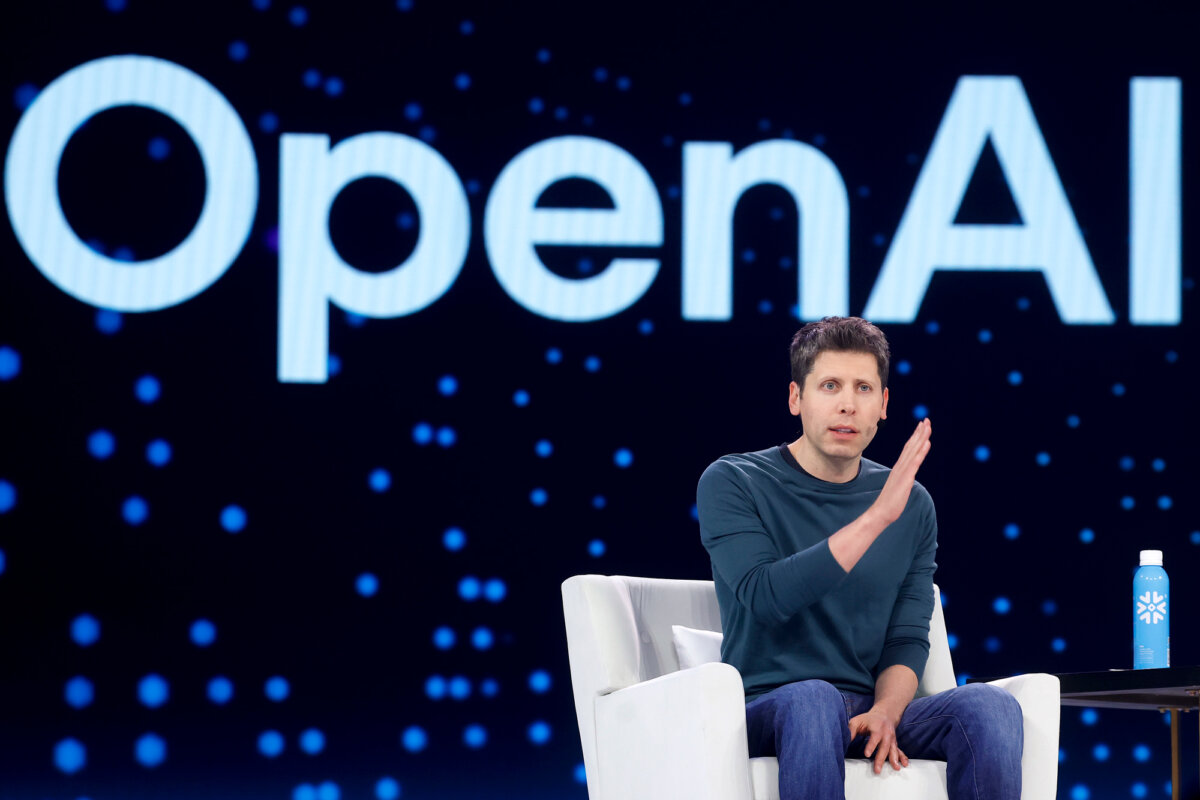

OpenAI CEO Sam Altman said on Feb. 27 that his company has struck a deal with the U.S. Department of War to deploy its artificial intelligence (AI) models on the Pentagon’s classified networks.
In a statement on social media, Altman said the company saw that the Pentagon had demonstrated “a deep respect for safety” and “a desire to partner to achieve the best possible outcome” throughout their discussions on the matter.
“Two of our most important safety principles are prohibitions on domestic mass surveillance and human responsibility for the use of force, including for autonomous weapon systems.
“The DoW agrees with these principles, reflects them in law and policy, and we put them into our agreement. We also will build technical safeguards to ensure our models behave as they should, which the DoW also wanted,” he said on X.
Altman also said that he hoped the Pentagon would offer the same terms to other AI companies in a way that all parties could agree to.
“We have expressed our strong desire to see things de-escalate away from legal and governmental actions and towards reasonable agreements,” he said. “We remain committed to serve all of humanity as best we can.”
Secretary of War Pete Hegseth reposted Altman’s post on social media but has not yet issued a statement. The Department of War did not respond to a request for comment by publication time.
Emil Michael, under secretary for Research and Engineering at the Pentagon, also reposted Altman’s post on X and wrote, “When [it] comes to matters of life and death for our warfighters, having a reliable and steady partner that engages in good faith makes all the difference as we enter into the AI Age.”
Prior to the announcement, President Donald Trump posted on Truth Social, stating that all federal agencies should stop using technology made by Anthropic after the company declined the Pentagon’s request to allow for greater access to its AI models.
Anthropic CEO Dario Amodei has said he was concerned that the technology could be used for mass domestic surveillance or fully autonomous weapons.
Pentagon spokesperson Sean Parnell said Feb. 27 the Department of War has no intention of using AI for mass surveillance purposes or to develop autonomous weapons that can function without human involvement.
Parnell said that the military only asked Anthropic to permit the use of its Claude models for lawful purposes, saying the request was intended to prevent Anthropic from “jeopardizing critical military operations” and putting U.S. military personnel at risk.
Following Trump’s directive, Hegseth ordered the Pentagon to designate Anthropic as a supply-chain risk to national security, barring any contractors, suppliers, or partners doing business with the U.S. military from engaging in commercial activity with the company.
Hegseth also said that Anthropic would continue to provide services to the Department of War for a period of six months to ensure a smooth transition to another provider.
After Hegseth’s comments, Anthropic said it would challenge the supply risk designation in court.
“We have tried in good faith to reach an agreement with the Department of War, making clear that we support all lawful uses of AI for national security aside from [mass domestic surveillance and fully autonomous weapons],” it said.
The Pentagon uses the Claude AI system, made by Anthropic, for mission-critical functions, including intelligence analysis, modeling and simulation, operational planning, and cyber operations, according to the company.
Troy Myers contributed to this report.
 Friends Read Free
Copy
Facebook
Tweet
Friends Read Free
Copy
Facebook
Tweet