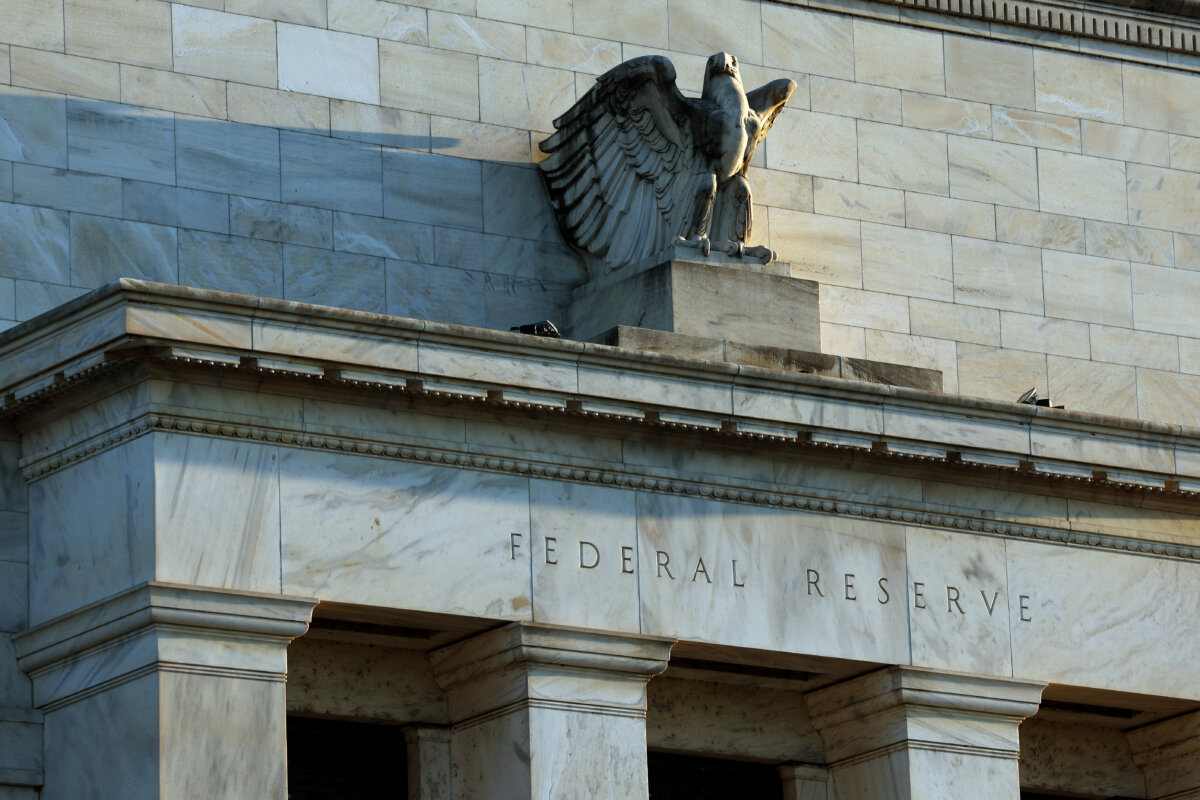

Government financing doesn’t need to play a role in the Federal Reserve’s interest-rate decisions, Fed Chairman Jerome Powell said after the central bank held rates steady for the fifth meeting in a row.
President Donald Trump has repeatedly suggested that the Fed instead lower interest rates to make it cheaper for the government to service its debts. But Powell said on July 30 that this wasn’t the concern of the central bank.
“We have a mandate—and that’s maximum employment and price stability. And it is not something we do to consider the cost to the government of our rate changes,” Powell said during a press conference following the latest meeting of the policy-making Federal Open Market Committee (FOMC).
“We don’t consider the fiscal needs of the federal government. No advanced economy’s central bank does that. If we did do that, it wouldn’t be good for our credibility nor for the credibility of U.S. fiscal policy.”
The Fed kept its benchmark policy rate in a range of 4.25 percent to 4.50 percent. Even after last year’s cuts, borrowing costs are still significantly higher than they were in the pre-pandemic years. Interest payments on government debt reached $1.1 trillion in 2024, more than double the pre-pandemic level, and that’s in large part driven by the Fed’s elevated rates aimed at keeping inflation in check.
Also on July 30, although the FOMC acknowledged slowing economic activity in the first half of 2025, it noted that unemployment remains low and that labor market conditions remain solid. With inflation still “somewhat elevated” and the economic outlook uncertain, according to the FOMC, a majority of the committee concluded that it is not yet time to cut rates.
Two FOMC members, Governors Chris Waller and Michelle Bowman, dissented from the majority and instead called for a cut of 25 basis points. It was the first time since 1993 that two sitting Fed governors dissented in the same meeting.
In theory, lowering rates could stimulate the economy and bolster employment, especially if inflation is under control. But the Fed said recent developments have complicated that picture.
In June, the Fed issued a forecast outlining concerns about a potential resurgence of inflation as elevated tariffs began to slowly work their way through the U.S. economy. Importers typically pass along a share of the higher import duty through price increases.
The personal consumption expenditures price index, the Fed’s go-to inflation tracker, will rise from 2.1 percent to 3 percent over the remainder of 2025, according to the prediction. That is a notable upward revision from its March forecast.
The Fed also forecasted two quarter-point interest-rate cuts by the end of 2025, followed by two additional cuts in 2026 and one more in 2027.
 Friends Read Free
Copy
Facebook
Tweet
Friends Read Free
Copy
Facebook
Tweet