The Religious Liberty Commission, a newly established body formed by President Donald Trump, is preparing to tackle tough questions about the balance between the government and religion.
The commission is a team of 13 religious leaders, scholars, and celebrities from different faith backgrounds, including television host “Dr. Phil” McGraw, Cardinal Timothy Dolan, and Rabbi Meir Soloveichik.
Texas Lieutenant Governor Dan Patrick and Dr. Ben Carson, former secretary of Housing and Urban Development, are chair and vice chair, respectively.
The interfaith panel met for the first time on June 16 to discuss its objectives: eliminating religious discrimination by the federal government, and promoting the public good through encouraging moral principles held in common by various faith groups.
“I’ve been watching for the past many years … an attempt to get religion out of public life, to get religion out of health care, to get it out of education,” Bishop Robert Barron said at the commission’s hearing at the Museum of the Bible in Washington.
“So I think that’s the battle that we’re in.”
In their opening remarks, the commission’s members touted the advantages religion provides to society, quoting Founding Fathers such as John Adams, who said the Constitution “was made only for a moral and religious people.”
Expert witness Gerard Bradley, former director of Notre Dame’s Natural Law Institute, encouraged the panel to ditch the modern concept that “religious and secular are opposites,” and instead “think about government promoting religion for the sake of the common good.”
The members were keenly aware of the potential problems of such an approach.
“We’re talking about the government promoting religion, and that kind of gets a little scary,” McGraw said.
He said that everyone brings his or her own bias.
“Are we talking about promoting religion, or are we talking about promoting liberty to choose religion—if that’s what you choose?”
Dr. Ben Carson raised questions about the darker side of religious governance, citing examples from the past when “basically good people” punished citizens for falling short of strict religious observance.
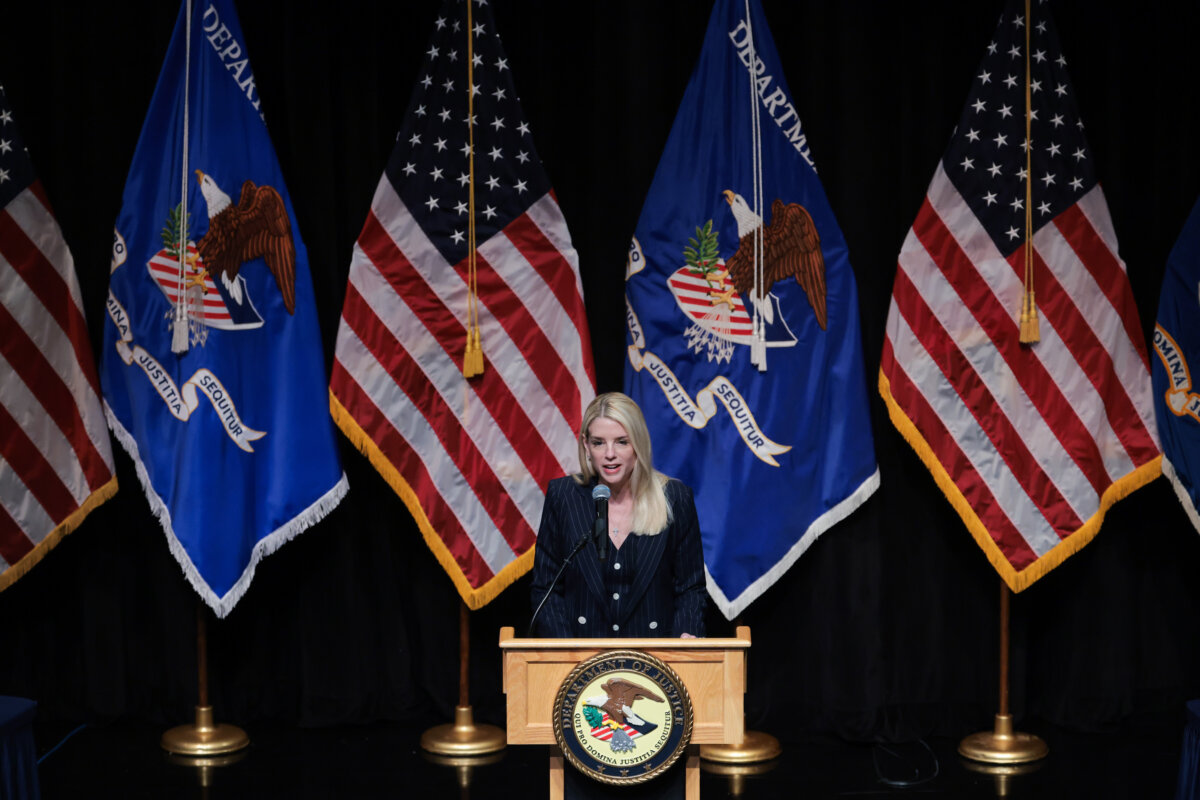
Attorney General Pam Bondi also addressed the group, thanking them for their work, calling the commission “the tip of the spear” in undoing past government overreach against religion, and promising that the Department of Justice would guard against such excesses in the future.
“Our Founding Fathers understood that every individual must be free to worship without fear, without coercion, and without government interference. They also understood the liberty of conscience is the cornerstone of religious freedom,” she said.
The commission plans to hold seven to nine meetings over the next year; the next is scheduled for September.
It has three advisory boards. The first is made up of religious leaders such as San Francisco Archbishop Salvatore Cordileone, Rabbi Yaakov Menken of the Coalition for Jewish Values, and Greek Orthodox Archbishop Elpidophoros, a member of the World Council of Churches.
Legal experts such as Kristen Waggoner, CEO of Alliance Defending Freedom, form the second board. The third board is made up of religious thought leaders such as Shaykh Hamza Yusuf, co-founder of the Muslim liberal arts college Zaytuna.
 Friends Read Free
Copy
Facebook
Tweet
Friends Read Free
Copy
Facebook
Tweet