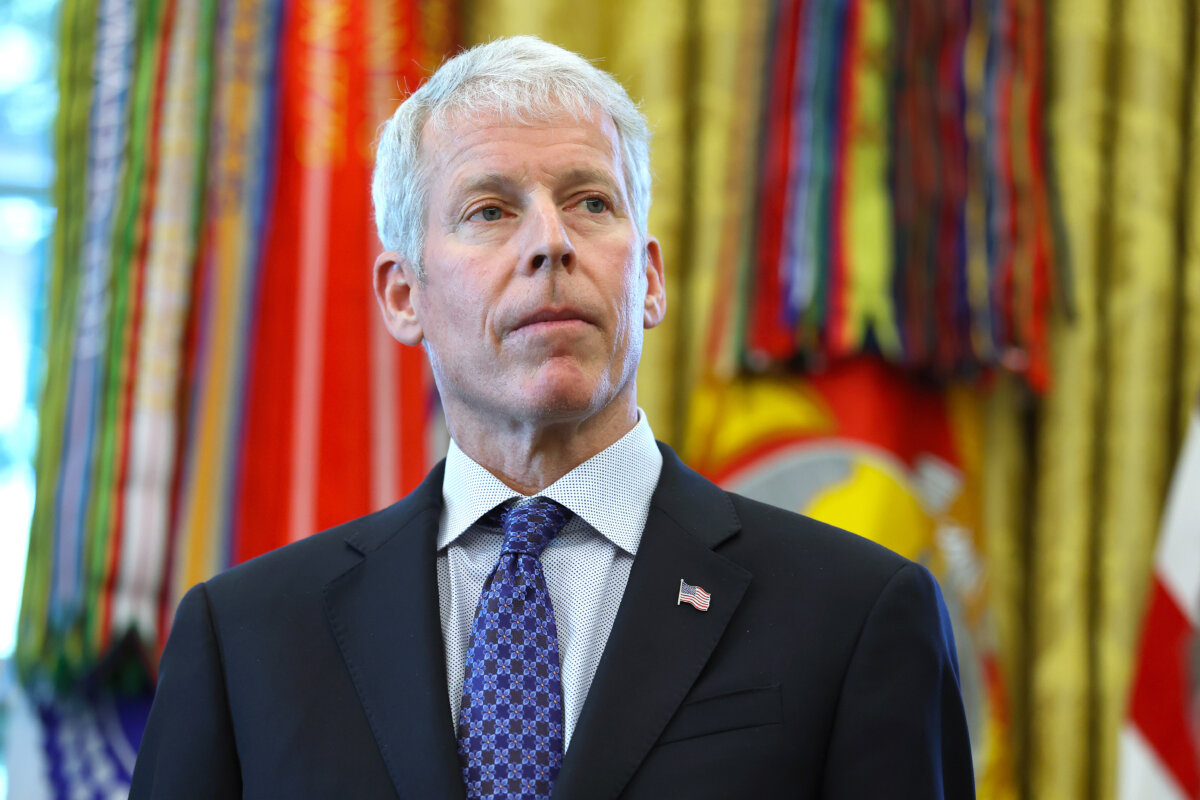
There could be room for both the United States and China to do business in Venezuela as long as Washington, not Beijing, maintains the dominant influence over the Latin American country, Energy Secretary Chris Wright said.
In a Jan. 8 interview on Fox Business, Wright was asked what the United States should do about long-term contracts between Nicolás Maduro’s regime and China now that the Venezuelan leader has been arrested and brought to New York to stand trial on narco-terrorism charges.
Those contracts include multiple oil partnerships with China National Petroleum Corporation (CNPC) and China Petroleum and Chemical Corporation (Sinopec), China’s two biggest state-owned energy enterprises. The deals cover both conventional and heavy crude and trace back to arrangements Maduro inherited from his predecessor, socialist strongman Hugo Chávez, who dramatically expanded state control over Venezuela’s oil sector.
Maduro later signed additional agreements with Chinese firms. Most recently, in August 2025, private company China Concord Resources Corp began developing two Venezuelan oilfields as part of a 20-year deal signed in 2024. With a planned investment of $1 billion, the project aims to reach a production capacity of 60,000 barrels per day by late 2026.
Asked whether these entitlements “need to be terminated,” Wright did not give a direct yes-or-no answer. Instead, he acknowledged that China is “an economic powerhouse” and “a major oil consumer.”
“[China] can be a constructive partner with the United States, or it can be a force to undermine the United States, as I think is the case in Venezuela,” Wright told Fox Business host Maria Bartiromo.
“I think you will probably see some long-term involvement of China in Venezuela,” he continued. “As long as America is the dominant force there, the rule of law is there, the United States controls oil flow, that will be fine.”
Wright also drew a line between Venezuela doing business with China and doing business with Russia and Iran, describing the latter two as “bordering on criminal organizations.”
“We don’t want Iranian or other terrorist organizations and Russians playing a major role in Venezuela,” he said.
Bartiromo pressed Wright on how Washington could ensure that Beijing does not repeat in Venezuela the pattern it has been accused of using in other resource-rich, underdeveloped countries. She pointed to what observers describe as a “debt trap” strategy: extending loans that local governments are unlikely to repay, and seizing infrastructure and resources when they default.
“So you’re talking about the terrorists in Iran and Russia, but you’re saying perhaps China can be part of an arrangement between the U.S. and Venezuela long term?” she asked.
Wright responded that while China “often has very nefarious goals,” the United States still has enough influence in its own backyard that Venezuela is more willing to do business with American companies than fall into the Chinese regime’s playbook.
“This is in the Western Hemisphere,” he said. “Venezuela’s main partner, as it has been throughout the country’s history, is the United States.
“Can there be commerce with China? Sure. Are we going to allow Venezuela to become a client state of China? Absolutely not. Not under President [Donald] Trump,” he continued.
At another point of the interview, Wright said he expects Chevron to expand its activities in Venezuela, with ConocoPhillips and ExxonMobil also looking to play a constructive role.
During the Chávez years, foreign energy giants such as ExxonMobil and ConocoPhillips left Venezuela after being forced into minority positions alongside Venezuela’s national oil company, PDVSA, or facing outright seizures of their assets. Some companies, including Chevron, stayed on under joint ventures with the state.
Venezuela’s oil output has since plummeted due to a combination of underinvestment, mismanagement, crumbling infrastructure, and Western sanctions, shrinking from about 3 million barrels per day in the late 1990s to an estimated 1 million barrels per day in 2025.
Under a license issued by the U.S. Department of Treasury, Chevron manages exports of roughly 120,000 to 150,000 barrels per day of crude oil to U.S. Gulf Coast refiners. Most of the rest of Venezuela’s oil exports are sold to China at steep discounts through what are popularly called “shadow fleets,” typically older tankers that use deceptive shipping practices to transport sanctioned goods while concealing their true origins or destinations.
 Friends Read Free
Copy
Facebook
Tweet
Friends Read Free
Copy
Facebook
Tweet