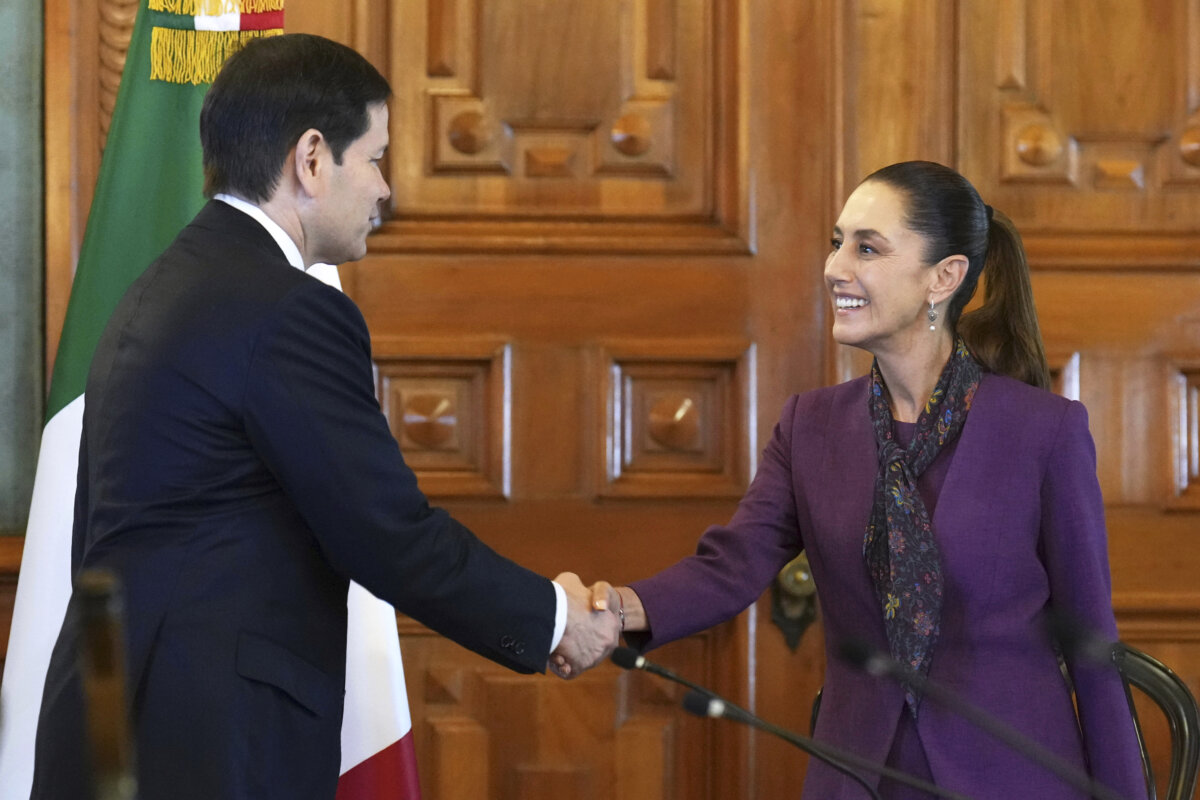

U.S. Secretary of State Marco Rubio met with Mexican President Claudia Sheinbaum and Foreign Secretary Juan Ramón de la Fuente on Sept. 3 in Mexico City to formulate a cooperative plan to address the flow of drugs, guns, and illegal immigrants through the shared border.
Rubio and de la Fuente announced the joint agreement, which reaffirms the two nations’ commitments to security, during a news conference in the capital city.
“This is a significant day in the relations of our two countries as we are able to formalize this unprecedented, historic, and so far, highly successful security cooperation between the government of Mexico and the government of the United States,” Rubio said.
“It’s the closest cooperation we’ve ever had, maybe between any country, but definitely between the U.S. and Mexico.”
According to the agreement, cooperation is “based on the principles of reciprocity, respect for sovereignty and territorial integrity, shared and differentiated responsibility, as well as mutual trust.”
Dismantling organized criminal networks and U.S.-designated foreign terrorist organizations is a primary goal of the arrangement.
Mitigating the flow of drugs, guns, and illegal immigrants through Mexico and the U.S. southern border is another key element of the framework, the leaders noted.
“It’s fundamental to show to U.S. society, Mexican society, that yes, models of cooperation, of collaboration, can be built that work, that give results,” de la Fuente said during the event.
“Our joint coordination and collaboration will allow us to strengthen the border, reduce fentanyl trafficking, and move forward in terms of intelligence exchanges, all through and within our legal frameworks.”
An implementation group founded by the two nations’ governments is directed to oversee investigations, inspections, and operations to identify and disrupt financial crimes, eliminate illegal underground tunnels built and used by smugglers that exist between the United States and Mexico, among other objectives.
Many of the questions for the leaders were related to the U.S. military’s Sept. 2 strike on a drug boat that left Venezuela. U.S. President Donald Trump has said that the boat was destined for the United States.
The use of force was authorized because the craft with narcotics posed an “immediate threat” to the United States, Rubio said.
De la Fuente said in response to questions about the strike that Mexican officials are guided by the country’s Constitution, specifically its 89th Article, which outlines presidential authority that is limited by a noninterventionist foreign policy that prioritizes diplomatic, peaceful solutions and self-determination, with the use of force and threats outlawed.
Strong US–Mexico Partnership
A meeting with Sheinbaum earlier in the day was “very productive,” according to Rubio.
Discussions included border encounters, water resources, and barriers—trade and non-trade—that are affecting economic relations between the two partners, according to a statement from the U.S. State Department.
“They reaffirmed our strong U.S.–Mexico partnership and joint commitment to dismantle cartels, tackle the scourge of fentanyl and the violence perpetuated by transnational criminal organizations, end illegal immigration, and promote economic prosperity and security,” Tommy Pigott, State Department principal deputy spokesperson, said in a statement.
The secretary of state is on a three-day tour, having visited Florida on Sept. 2, stopping in Mexico for the first time since joining the Trump administration. He plans to meet with officials in Ecuador on Sept. 4.
Rubio said during the event that Trump has spoken with Sheinbaum 14 times and that an open dialogue will continue.
The U.S. president has proposed 30 percent tariffs on Mexico for allowing cartels to freely operate and leading to the loss of hundreds of thousands of American lives, according to a February statement from the White House.
“The Mexican drug trafficking organizations have an intolerable alliance with the government of Mexico,” the White House stated.
“This alliance endangers the national security of the United States, and we must eradicate the influence of these dangerous cartels.”
Originally set to take effect on Feb. 1, the levies were delayed until Aug. 1, and they were again put on hold for 90 days when a last-minute agreement materialized the day before.
 Friends Read Free
Copy
Facebook
Tweet
Friends Read Free
Copy
Facebook
Tweet