LYNCHBURG, Va.—Senate Democrats will withhold votes on legislation to fund the government unless Republicans and the Trump administration commit to reversing cuts to education, healthcare, and research spending, Sen. Mark Warner (D-Va.) told The Epoch Times on Aug. 28.
Warner made the remarks during a tour across the state—through Bedford, Lynchburg, and Appomattox—where he discussed cuts in federal funding and their effects on Virginians.
He said that Republicans would have to not only restore funding, but also guarantee that the executive branch wouldn’t withhold funds previously authorized by Congress, as it is currently doing.
“So far, these cuts have been done entirely by one party. … To get a budget going through, you are going to have to get Democratic votes. If they want our votes, it’s not only time to restore some of these cuts, particularly around healthcare, but also [we need] a guarantee that if there’s a budget agreed to, and President Trump signs it, they’re not going to renege,” Warner said.
Warner also accused the Office of Management and Budget, which oversees the administration of government agencies for the president, of unlawfully withholding funds for education institutions, such as research grants, as well as for the National Institutes of Health.
The senator charged that this year “we have a budget, and it’s been signed off on, and yet the director of OMB—this agency that doesn’t have this power—is arbitrarily picking programs it likes and doesn’t like and overturning the will of Congress.”
The director of the Office of Management and Budget, Russell Vought, has denied that his organization is unlawfully withholding funds. Litigation regarding funding freezes has reached the Supreme Court, though lower federal courts have ruled that certain individual decisions to freeze funding were unlawful.
Warner was particularly critical about cuts to education funding, which has entailed several universities being refused federal funds on the allegation that they’ve violated federal laws to prevent the harassment of students.
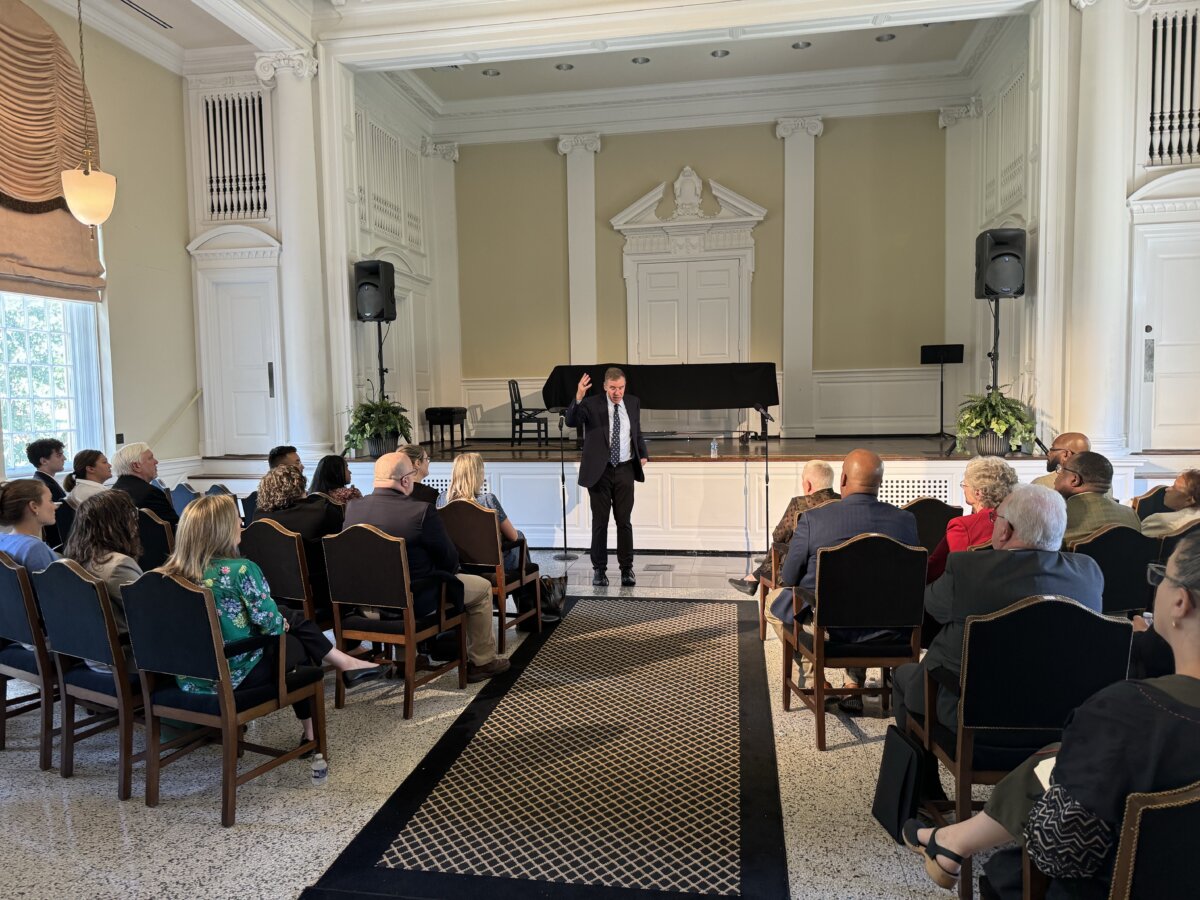
“They’ve arbitrarily been cutting education. They have dismantled the Department of Education without any congressional [signoff],” said Warner at a press conference at Randolph College in Lynchburg, where he addressed a group of university and college leaders.
In Appomattox, Warner criticized the One Big Beautiful Bill Act for its Medicaid revamp, which imposes more stringent requirements. Republicans have defended the reforms by suggesting that they target only ineligible recipients, though Sen. Thom Tillis (R-N.C.) voted against the bill based on its alleged harms to Medicaid recipients.
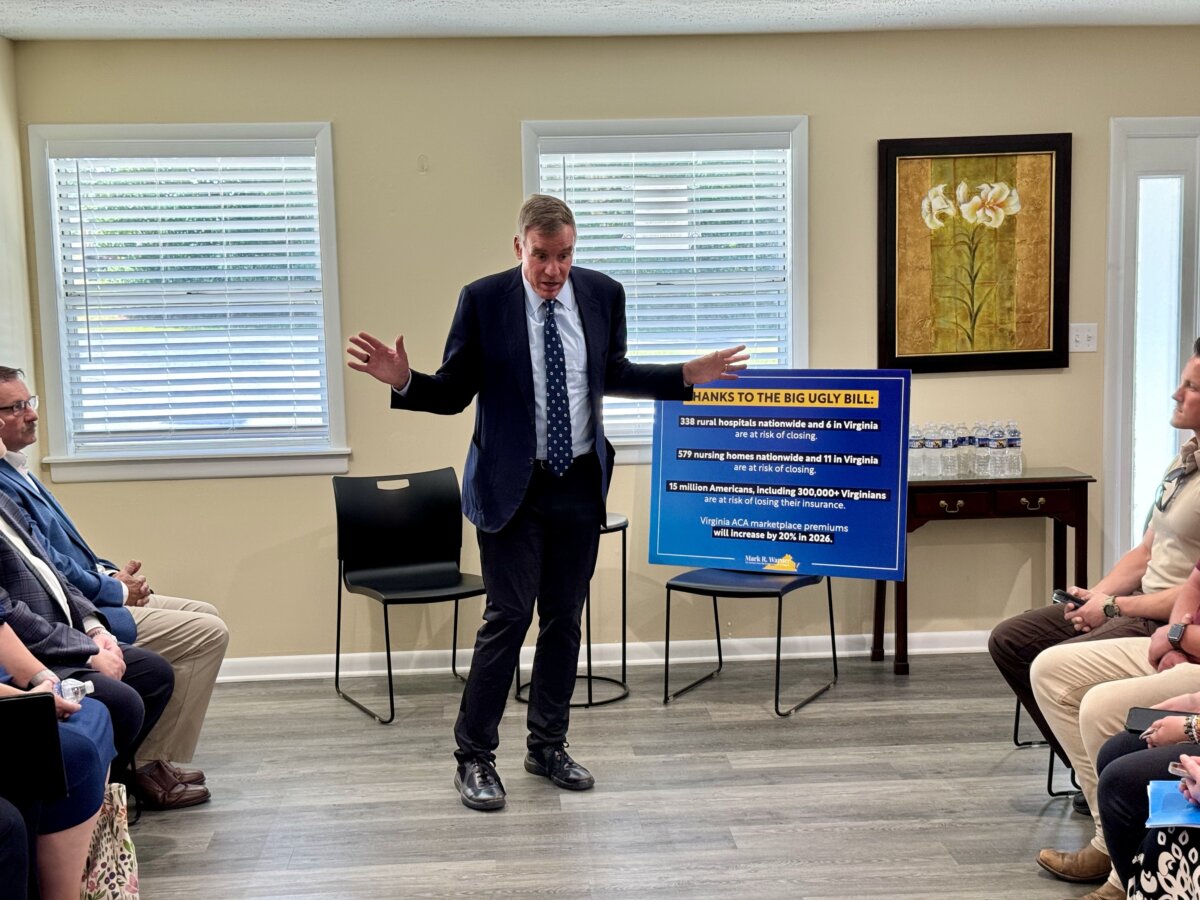
“There’s a real unease, particularly with some of these budget cuts. … [The bill has] cut 300,000 Virginians loose from Medicaid and a couple hundred thousand more from their health insurance because of the Obamacare premiums going up, and these [rural] communities are going to get overwhelmed,” Warner said, displaying a chart while he spoke to the audience.
Members of the audience—comprising healthcare workers and executives, local officials, and the Appomattox County sheriff—also expressed grievances about the loss of funding and changes to Medicaid, which they said would hurt health.
In Bedford, Warner’s commentary on rural broadband involved celebrating Biden administration policies to increase connectivity through the Inflation Reduction Act. Warner showed charts suggesting that many areas of Bedford County had gained access to the internet for the first time, with speeds in excess of 100 Mbps.
“[We have] close to 20,000 homes passed. … The ISPs are laying the fiber, bringing it home and, I think, by mid-2026 virtually everyone will have that coverage,” said Warner.
 Friends Read Free
Copy
Facebook
Tweet
Friends Read Free
Copy
Facebook
Tweet