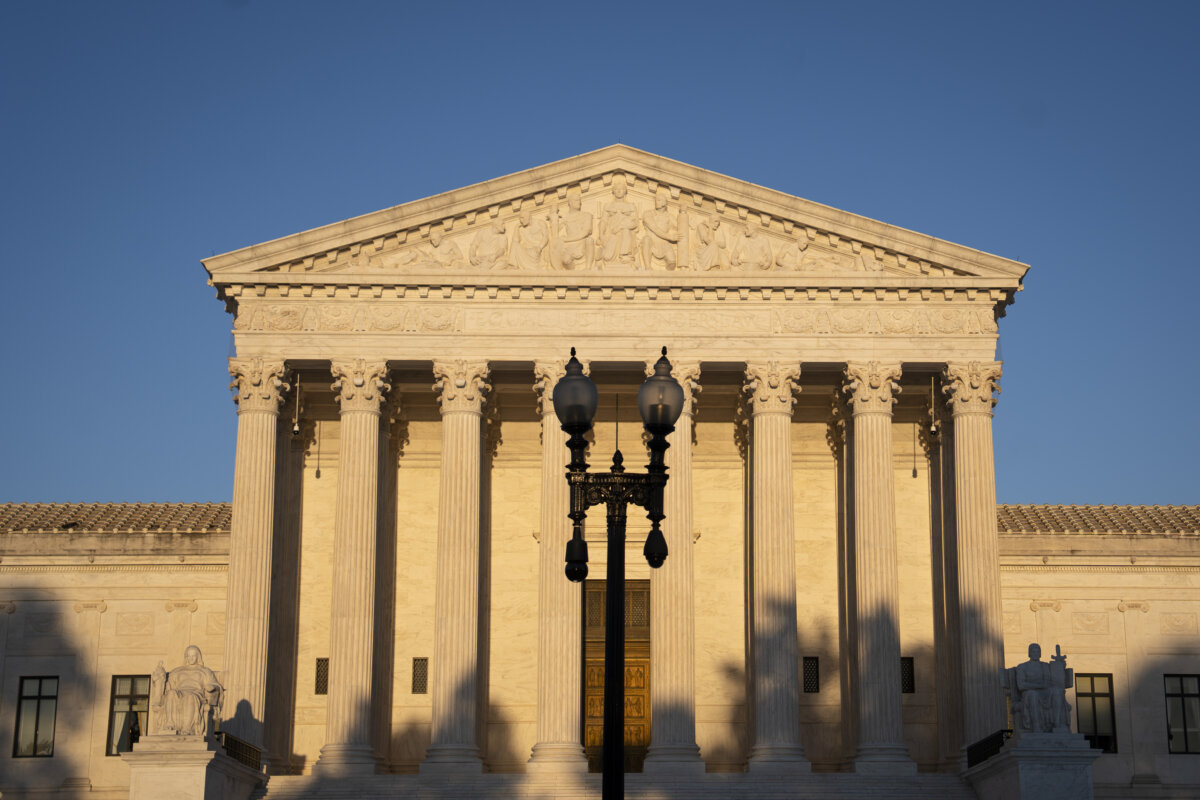

The U.S. Supreme Court on Oct. 5 declined to take up an appeal from Mark Cohen, a former judge in Pennsylvania who was suspended after praising Democrats and criticizing Republicans on social media.
The justices did not say why they declined the appeal, or writ of certiorari, from Cohen’s lawyers, and it’s not clear whether any justices voted to hear the case.
According to U.S. Supreme Court rules, at least four of the nine justices have to vote to accept such a petition, or it is denied.
Cohen, a former Democratic member of the Pennsylvania House of Representatives, became a Court of Common Pleas judge in Philadelphia County in 2018. While a judge, he posted positive Facebook posts about various Democrats, including former President Joe Biden, and criticism of Republicans and conservative organizations, such as former Rep. Kevin McCarthy (R-Calif.) and the National Rifle Association.
He was reported by a fellow judge, and the Judicial Conduct Board of Pennsylvania held a trial. The board said the judge violated judicial rules, including by undermining public confidence in the independence and impartiality of the judiciary, and the Court of Judicial Discipline of Pennsylvania backed that determination. He was suspended without pay.
Cohen appealed, arguing that his speech was protected by the U.S. Constitution’s First Amendment and the Pennsylvania Constitution. The Pennsylvania Supreme Court in January sided with the judicial board.
“Under the balancing test we adopt today, if a sitting judge speaks outside of his or her official duties on a matter of public concern, then courts must balance the Commonwealth’s interest in protecting the efficiency of the administration of justice, including the independence, integrity, and impartiality of the judiciary, against the judge’s interest in making the statement,” the court’s opinion said.
“Here, we hold the Commonwealth’s interests in preserving the judiciary’s reputation for impartiality outweighed Judge Cohen’s interests, as a sitting judge who was not a candidate for judicial office, in publicly advocating for the Democratic Party on Facebook and espousing his partisan political views.”
The court declined to apply a heightened standard known as strict scrutiny, which involves judges reviewing whether a policy or law, in this case Pennsylvania code, is “narrowly tailored” to effectuate a governmental interest. Instead, judges used a different test because the speech did not involve Cohen’s official duties.
Cohen then sought U.S. Supreme Court intervention.
“This case presents a recurring question of national importance—whether a state must satisfy strict scrutiny to restrict the speech of sitting judges on matters of public concern,” his lawyers said in a brief to justices.
They added: “Despite precedent from this Court applying strict scrutiny to restrictions on the political speech of judicial candidates … courts have struggled for nearly 25 years to determine whether those holdings also apply to sitting judges and are now deeply divided on the applicable standard of First Amendment review. Further percolation of the issue is unlikely to resolve this important question, and this Court’s immediate resolution is needed.”
The board’s lawyers said that the nation’s top court should not accept the case because the previous rulings were correct.
“There is no reason for this Court to review that straightforward application of familiar rules that judges around the country have followed for decades,” they said.
 Friends Read Free
Copy
Facebook
Tweet
Friends Read Free
Copy
Facebook
Tweet