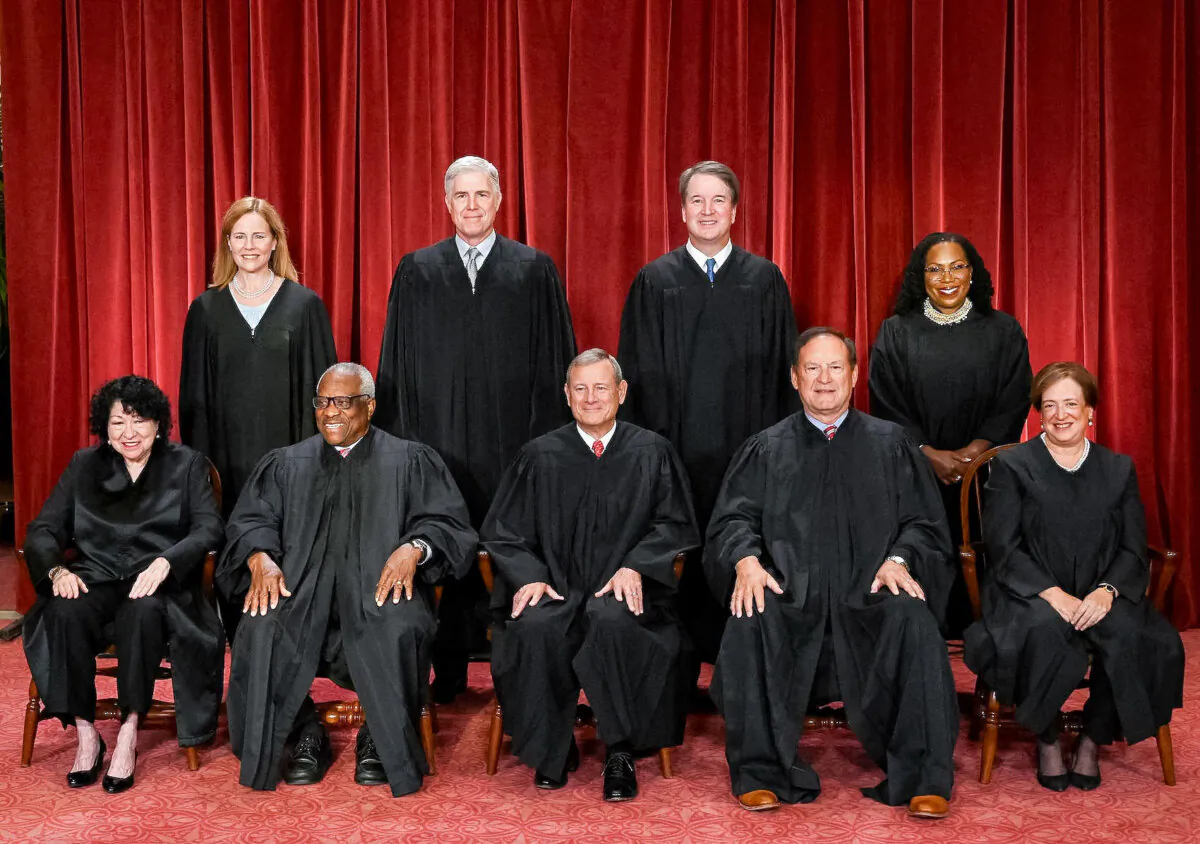

The U.S. Supreme Court released the final orders scheduled for the 2024–2025 term before the nine justices go on their summer break, including rulings on birthright citizenship and nationwide injunctions, Obamacare, online age verification, LGBT-related books in schools, and a federal internet subsidy program.
The justices will now go on their scheduled break and will take up cases again in the fall.
Nationwide Injunctions, Birthright Citizenship
On President Donald Trump’s January order that would deny citizenship to U.S.-born children of people who are in the country illegally, the Supreme Court’s 6–3 ruling authored by Justice Amy Coney Barrett did not let the policy go into effect immediately and did not address whether the policy violated the Constitution. The order granted a Trump administration request to narrow the scope of several nationwide injunctions issued by federal judges earlier this year that halted enforcement of the measure.
“No one disputes that the Executive has a duty to follow the law,” Barrett wrote in the order. “But the Judiciary does not have unbridled authority to enforce this obligation—in fact, sometimes the law prohibits the Judiciary from doing so.”
The high court’s majority left open the possibility that the birthright citizenship changes could remain blocked nationwide.
In a dissent, Justice Sonia Sotomayor wrote that the majority “ignores entirely whether the President’s executive order is constitutional” and only focuses on whether lower courts have the authority to hand down nationwide injunctions.
“Yet the order’s patent unlawfulness reveals the gravity of the majority’s error and underscores why equity supports universal injunctions as appropriate remedies in this kind of case,” she wrote in the dissent, jointed by Justices Elena Kagan and Ketanji Brown Jackson.
The high court decision, which opens an avenue for the Trump administration to take steps to implement its earlier order to end automatic birthright citizenship, was hailed by the president in a post on his Truth Social media network as a “GIANT WIN.”
“Even the Birthright Citizenship Hoax has been, indirectly, hit hard. It had to do with the babies of slaves (same year!), not the SCAMMING of our Immigration process,” Trump said in his Friday post, referring to arguments that were made by his administration regarding the 14th Amendment of the U.S. Constitution.
Reacting to the order on Friday, Attorney General Pam Bondi also wrote in a post on X that the Supreme Court “instructed district courts to STOP the endless barrage of nationwide injunctions against President Trump.” After the order, she said, her office “will continue to zealously defend [Trump’s] policies and his authority to implement them.”
Key Obamacare Element
Also on Friday, the high court issued a ruling upholding the constitutionality of a panel created by the Affordable Care Act, also known as Obamacare, that makes rules requiring insurers to cover preventive medical services such as cancer screenings without cost to patients.
The justices, in a 6–3 decision, reversed a lower court order that had said that members of the U.S. Preventive Services Task Force, which has a role in choosing what services can be covered under the law, were appointed in an unconstitutional manner.
The Fifth Circuit ruled in 2024 that the task force’s structure violates the Constitution, as the plaintiffs claimed. That was reversed by the Supreme Court on Friday in an order authored by Justice Brett Kavanaugh.
Texas Law on Age Verification
In another order, the Supreme Court ruled 6–3 to uphold a Texas law that mandates that pornographic websites verify that visitors to their websites are aged 18 or older.
Justice Clarence Thomas wrote the majority’s opinion for the high court. Sotomayor, Kagan, and Jackson dissented.
In his opinion, Thomas wrote that protecting children from sexually explicit material online justifies the burden that age-verification places on adults accessing those sites.
“The First Amendment leaves undisturbed States’ traditional power to prevent minors from accessing speech that is obscene from their perspective,” he wrote. “That power includes the power to require proof of age before an individual can access such speech. It follows that no person—adult or child—has a First Amendment right to access such speech without first submitting proof of age.”
According to the Age Verification Providers Association, roughly 24 states have passed laws that mandate laws for age verification for pornographic websites, requiring users to be aged 18 and up.
The group that filed the lawsuit against the law, the Free Speech Coalition, said the law puts an unfair free speech burden on adults by requiring them to submit personal information that could be vulnerable to hacking or tracking. It agreed, though, that children under the age of 18 shouldn’t be seeing such content.
Fee to Subsidize Phone Services
In a 6–3 order, the justices reversed an appeals court ruling that struck down the Universal Service Fund, which has allowed a charge to be added to Americans’ phone bills for decades.
The fee provides funding to phone and internet services in libraries, rural areas, and schools. The Federal Communications Commission collects the money from telecommunications providers, which pass the cost on to their customers, in order to subsidize those services.
But a majority of justices had agreed that ending the fund could be devastating for millions of people.
Writing for the majority, Kagan argued “that no impermissible transfer of authority has occurred” under the rule, adding that “Congress sufficiently guided and constrained the discretion that it lodged with the FCC to implement the universal-service contribution scheme.”
Justices Neil Gorsuch, Samuel Alito, and Thomas dissented.
Opt-Out Over LGBT Books
The Supreme Court also ruled 6–3 on Friday that Maryland parents who have religious objections can pull their children from public school lessons using “LGBTQ+ inclusive” storybooks.
Authored by Alito for the majority, the order reversed lower-court rulings in favor of the Montgomery County school system in suburban Washington.
“The parents are likely to succeed on their claim that the Board’s policies unconstitutionally burden their religious exercise,” Alito wrote, while adding that the books conveyed a “normative message” that sought to separate biological sex from gender. He noted that such viewpoints are contrary to the plaintiffs’ religious beliefs.
“In the absence of an injunction, the parents will continue to be put to a choice: either risk their child’s exposure to burdensome instruction, or pay substantial sums for alternative educational services,” Alito wrote. “As we have explained, that choice unconstitutionally burdens the parents’ religious exercise.”
Jackson, Sotomayor, and Kagan dissented. In her opinion, Sotomayor argued that the majority was trying to allow parents to separate their children from experiences that are “critical to our Nation’s civic vitality” and would sow “chaos” in public schools across the United States.
She added that “an education and an opportunity to practice living in our multicultural society … will become a mere memory if children must be insulated from exposure to ideas and concepts that may conflict with their parents’ religious beliefs.”
Louisiana Map Case
Also Friday, the highest court declined to rule in a dispute involving a Louisiana electoral map that increased the number of minority congressional districts in that state. They argued that the case can be argued again.
“These cases are restored to the calendar for reargument. In due course, the Court will issue an order scheduling argument and specifying any additional questions to be addressed in supplemental briefing,” said the brief order, which was unsigned.
The majority did not provide any reasoning on why the case should be reheard. As a result, Louisiana’s map will remain in effect until the case is decided.
Thomas dissented in the case, writing that the Supreme Court has “an obligation to resolve such challenges promptly” over congressional redistricting matters.
“We should have decided these cases this Term. These are the only cases argued this Term in which our jurisdiction is mandatory,” he wrote.
The Associated Press contributed to this report.
 Friends Read Free
Copy
Facebook
Tweet
Friends Read Free
Copy
Facebook
Tweet