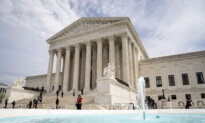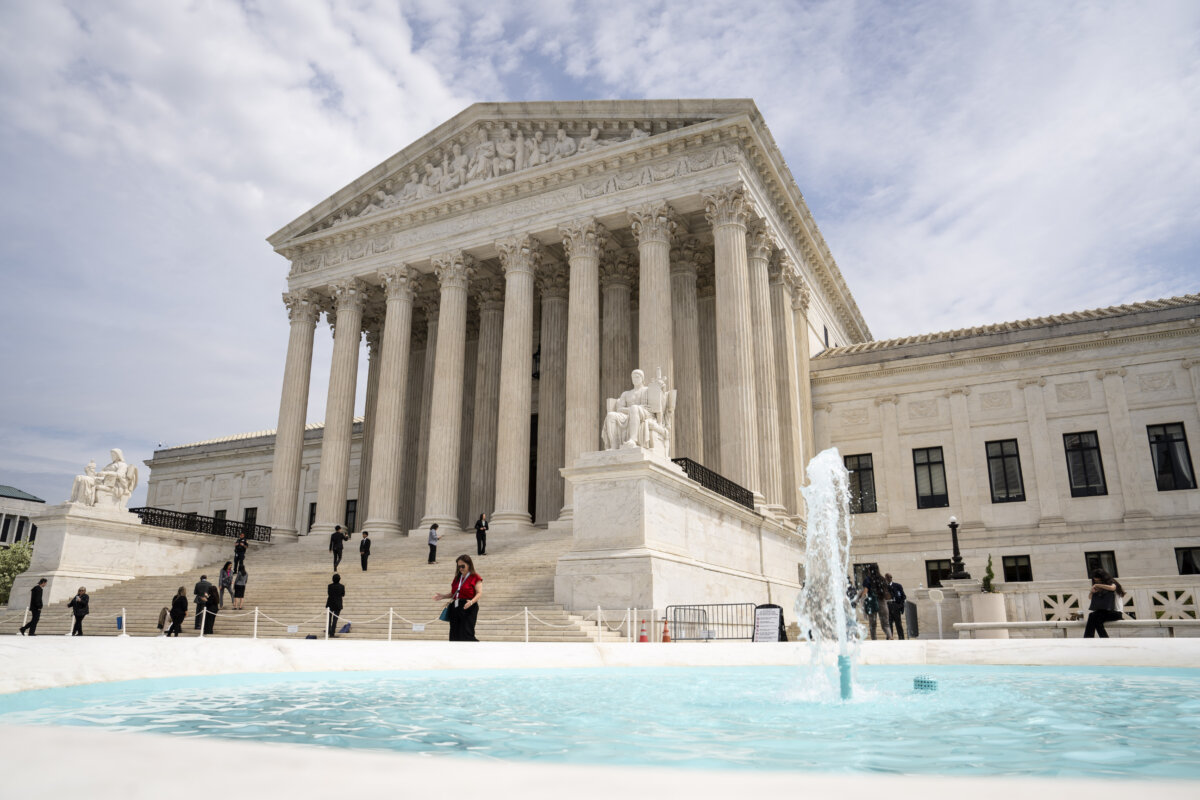

The Supreme Court on April 27 will hear oral arguments in a case with major implications for privacy rights—and how law enforcement uses Americans’ cellphone data while investigating crimes.
The case, Chatrie v. United States, centers on law enforcement’s use of “geofencing warrants”—judge-authorized requests for cellphone location data near the scene of a crime.
Okello Chatrie told the Supreme Court that the government’s use of these warrants, which resulted in a criminal conviction over his robbing a bank while his smartphone was on his person, violated his Fourth Amendment rights. The government, meanwhile, has argued that such data are not protected when provided voluntarily to a “third party” such as Google.
The court said it would focus on the circumstances of Chatrie’s case rather than the constitutionality of geofencing more generally. However, experts say that the Supreme Court’s decision will reverberate through future cases concerning privacy in the digital age.
David Super, a professor of law at the Georgetown University Law Center, described the case to The Epoch Times as “once-in-a-generation,” whatever the outcome.
Chatrie’s Warrant
In 2019, law enforcement received a geofence warrant from a state court seeking anonymized location data for devices within 150 meters of the bank robbery. In this form, the data couldn’t be used to identify specific cellphone users.
After Google complied with the first request, law enforcement sought location data for devices over a longer, two-hour period, without seeking an additional court warrant. Google again provided the information.
Then—still without seeking a warrant—investigators asked Google for “de-anonymized subscriber information for three devices,” and Google complied.
One of those devices belonged to Chatrie, and the information provided the basis for Chatrie’s eventual conviction for armed robbery.
Although Chatrie confessed, his lawyers argue that the geofencing evidence should be tossed because the warrant deprived him of his Fourth Amendment rights, which guarantees that “the right of the people to be secure in their persons, houses, papers, and effects, against unreasonable searches and seizures, shall not be violated, and no Warrants shall issue, but upon probable cause.”
Chatrie’s lawyers argued that the geofence warrant allowed investigators to gather the location history of people who were near the scene of the crime even though there was no other probable cause.
Super told The Epoch Times that geofencing was “pivotal” to the case against Chatrie.
“The question in Chatrie is whether something as dramatic as a geofencing search is limited by the Fourth Amendment and requires the government to show specific needs with a proper basis,” he said.
Digital Privacy
For people to use certain services on their phones, cellphones must constantly transmit their exact location to service providers. Several services store this data.
Through the use of a so-called geofence warrant, law enforcement can request location data on every person who was present at a specific location over a certain period of time.
In recent years, such information has increasingly become more frequently sought out by law enforcement agencies to assist in investigating crimes.
In the case at hand, a geofencing warrant was issued against Google. However, such warrants have also been served to Apple, Lyft, Snapchat, and Uber, according to a filing from Chatrie.
“The question is whether the Fourth Amendment will be adapted to cover these new technologies,” Super said.
Nathan Moelker, a senior attorney covering the case for the American Center for Law and Justice, told The Epoch Times: “We’re not talking about whether this particular individual should be released or not, right? Rather, we’re talking about … the fundamental principles at stake here.”
The Department of Justice told the court that a warrant was unnecessary for obtaining geofencing data.
“The government in this case did not conduct a ‘search’ within the meaning of the Fourth Amendment,” it said in a filing. “Individuals generally have no reasonable expectation of privacy in information disclosed to a third party and then conveyed by the third party to the government.”
In another filing, the Justice Department argued that restricting geofencing warrants could “render it seemingly impossible for judges to authorize the acquisition of valuable evidence” in cases such as Chatrie’s and would completely foreclose the use of a valuable tool to catch criminals.
Big Tech Data
According to some previous court rulings in Chatrie and related cases, the data collected and held by Big Tech firms such as Google, Apple, and Meta are considered “third-party” data.
Third-party data, the Supreme Court has said, are exempt from normal rules governing evidentiary warrants.
Established in the 1976 Supreme Court case United States v. Miller, the so-called third-party doctrine allows the government to gather without a warrant certain kinds of information shared by individuals with third parties.
Chatrie’s attorneys have argued that the third-party doctrine shouldn’t apply in the case.
Historically, the doctrine has allowed law enforcement to request information such as bank records from third parties.
But Chatrie’s attorneys—and others opposing the state’s position—have argued that the scope of Google location data constitutes an account more akin to a “digital diary.”
They also raised doubts about the government’s claim that Chatrie voluntarily opted into sharing his location data. They cited opaque and complex terms of service and pop-ups during phone setup.
Big tech companies—Microsoft, X, and Google—backed some of Chatrie’s arguments. In an amicus brief, Google told the Supreme Court that geofence searches were overbroad and that the third-party doctrine shouldn’t apply to tech companies. The company long ago stopped recording the kind of location data that contributed to Chatrie’s arrest.
Chatrie’s allies also point to a 2018 Supreme Court decision known as Carpenter v. United States. In that case, which involved the third-party doctrine and cellphone location data, a majority of the Supreme Court said the FBI had invaded a man’s reasonable expectation of privacy.
“Cell phone location information is not truly ‘shared’ as one normally understands the term,” Chief Justice John Roberts, writing for the majority, said.
He described cellphones and their services as pervasive.
“Apart from disconnecting the phone from the network, there is no way to avoid leaving behind a trail of location data,” he said.
Justices Sonia Sotomayor and Elena Kagan joined that decision. Justices Samuel Alito, Clarence Thomas, and Neil Gorsuch were among those who dissented.
“By obtaining the cell-site records of MetroPCS and Sprint, the Government did not search Carpenter’s property,” Thomas said. “He did not create the records, he does not maintain them, he cannot control them, and he cannot destroy them.”
Potential Decision
Experts who spoke to The Epoch Times said that the complexity of the case makes it difficult to predict how the matter will be decided.
In Chatrie’s case, one district judge ruled that the practice may be unconstitutional yet permitted the evidence to go to trial.
The U.S. Court of Appeals for the Fourth Circuit ultimately held that the search wasn’t the type to which the Fourth Amendment would apply. Because Chatrie opted to share his location history with Google, “he cannot … claim to have had a reasonable expectation of privacy,” Judge Julius Richardson wrote for the majority.
When the whole circuit reviewed the case, it similarly rejected Chatrie’s constitutional arguments.
In reviewing the Fourth Circuit’s reasoning, the Supreme Court could rule in a variety of ways.
Chatrie told the court that even if the initial warrant was constitutional, the government violated his rights in the way it executed it. Additional warrants, he said, were needed for the second and third requests involving narrower sets of device information.
Because those narrower sets of information weren’t specified in the initial warrant, the warrant itself was too broad to be constitutional. Chatrie pointed to a Supreme Court case—Groh v. Ramirez—from 2003 that rejected a warrant because it wasn’t “particularized” enough.
“If the government’s going to get all this location data for all these people … courts [should] look at that very closely to determine if those requests are appropriate,” Moelker said.
The government defended the authorities’ actions, stating that the initial warrant laid out three separate searches that they could undertake. It also stated that the issuance of a warrant itself implied that the multiple searches were reasonable.
Correction: A previous version of this article misspelled the name of American Center for Law and Justice senior attorney Nathan Moelker. The Epoch Times regrets the error.
 Friends Read Free
Copy
Facebook
Tweet
Friends Read Free
Copy
Facebook
Tweet