
The Supreme Court on Oct. 7 weighed a dispute over the Air Force’s attempt to explode expired munitions in Guam, where environmentalists say the military’s activity would pollute the area and disrupt fragile ecosystems.
The case, Department of the Air Force v. Prutehi Guahan, centers on a permit the Air Force sought in order to explode the munitions, and whether that request had to undergo an environmental review required by federal law.
During the oral argument, the justices focused on the two questions the case presents: whether the application itself is “final agency action” that can be challenged under the Administrative Procedure Act (APA), and whether the hazardous waste rules in the Resource Conservation and Recovery Act (RCRA) displace the broader study requirements in the National Environmental Policy Act (NEPA).
Assistant to the Solicitor General Sopan Joshi said that a permit application is not final agency action.
“It’s a request to someone else to take action” that begins a back-and-forth process “whose outcome is, by definition, a moving target until a decision on the permit is issued,” Joshi said.
“Treating an application as final would just lead to a multiplicity of suits throughout a permitting process, which I think defeats the whole point of the finality requirement,” he said.
Joshi argued the court might not need to decide if the two environmental statutes contradict each other at all. NEPA, he said, does not apply to action that is not final. If the justices agree the application is not final, “that would not only resolve the threshold issue in the case; it would also have the effect of resolving respondent’s claim on the merits.”
If the justices do reach that question, he said, RCRA already answers it. The statute, the lawyer said, specifies “which environmental review must occur at each step” of the permit process.
Trying to insert all of NEPA at the application stage, Joshi said, would be “not only duplicative of RCRA’s requirements, which are the functional equivalent, but inconsistent with RCRA’s specification of when each of those requirements should occur.”
Chief Justice John Roberts pressed Joshi on what the government’s theory does to judicial review.
“You’re saying that there’s no point at which the Air Force’s decision can be challenged, because even if … Guam goes ahead and says, ‘OK, granted,’ you’re saying you don’t have to go forward with it? You could always change your mind? … The Air Force’s action is never final and, therefore, never reviewable?” Roberts said.
Joshi replied that the application “is never going to become final agency action. And there is no cause of action under NEPA itself. Congress didn’t provide one, so any review would have to go through the APA, and I don’t think the APA provides a cause of action for this application at any point in time.”
Justice Elena Kagan asked Joshi whether any agency decision that still needs outside permits is automatically non-final. With a large construction or cleanup project that needs multiple regulatory approvals, “there’s no way to challenge what appears to be the agency decision to go ahead?” she said.
Justice Brett Kavanaugh said it doesn’t make sense to say that it is not final, yet NEPA still applies.
Someone might go through the whole RCRA permitting process and then still have to go through the NEPA process, he said. “And that’s just completely counterintuitive.”
Justice Neil Gorsuch told Joshi, “You’re rolling the dice here.”
“If you want to do the NEPA process, you can, and if you don’t, you don’t, and you take your chances, right?”
Justice Sonia Sotomayor asked Joshi how the Supreme Court can decide if it lacks authority to hear the case.
“If there’s no final agency action, how are we deciding a question over which we have no jurisdiction?”
She also noted that Congress “explicitly does away with NEPA in a bunch of different ways, and they know how to do it because they do it frequently,” but has not done so here.
Gorsuch asked, “Don’t we usually say, ‘If you can do both—if you can comply with both of Congress’ commands—you should do so?”
Caroline Flynn, attorney for the nonprofit Prutehi Guahan, said the Air Force “was required to comply with NEPA before choosing to continue open detonation on Tarague Beach.”
“We can obtain judicial review of that violation now,” she said.
Congress, she said, has provided that NEPA is displaced only when another law excludes it or there is a “clear and fundamental conflict.”
The government answers that RCRA is specifically about hazardous waste, she said, but “because the laws can be harmonized, that observation can’t carry the day.” NEPA, she told the court, is what agencies refer to as an “umbrella law” meant “to consolidate and streamline all required environmental analysis at an early juncture to ensure a better decision and better planning.”
Flynn said the Air Force had to complete its NEPA analysis before committing to the site. The statute, she told the court, requires the study “before proposing a major federal action,” and before “resources are committed” and “the die is cast.” Doing it only after the Air Force “bakes its plan” and “tees it up” for a permit, she said, would not satisfy NEPA. The decision at issue, she said, was the choice “to carry out these open detonations at Tarague Beach.”
The attorney said the Air Force’s choice was not tentative. Submitting the renewal application had “the concrete effect of authorizing open detonation operations past the date when they otherwise would have ended,” Flynn said.
Waiting for Guam’s environmental agency would not fix that, she said, because “Guam EPA has no NEPA obligation. It has no obligation to enforce the Air Force’s NEPA obligations.”
Justice Clarence Thomas called the case’s posture unusual. In a typical administrative law case, he said, the court is examining a regulator’s decision. Here, “we are talking about a regulated body asking permission to do something.”
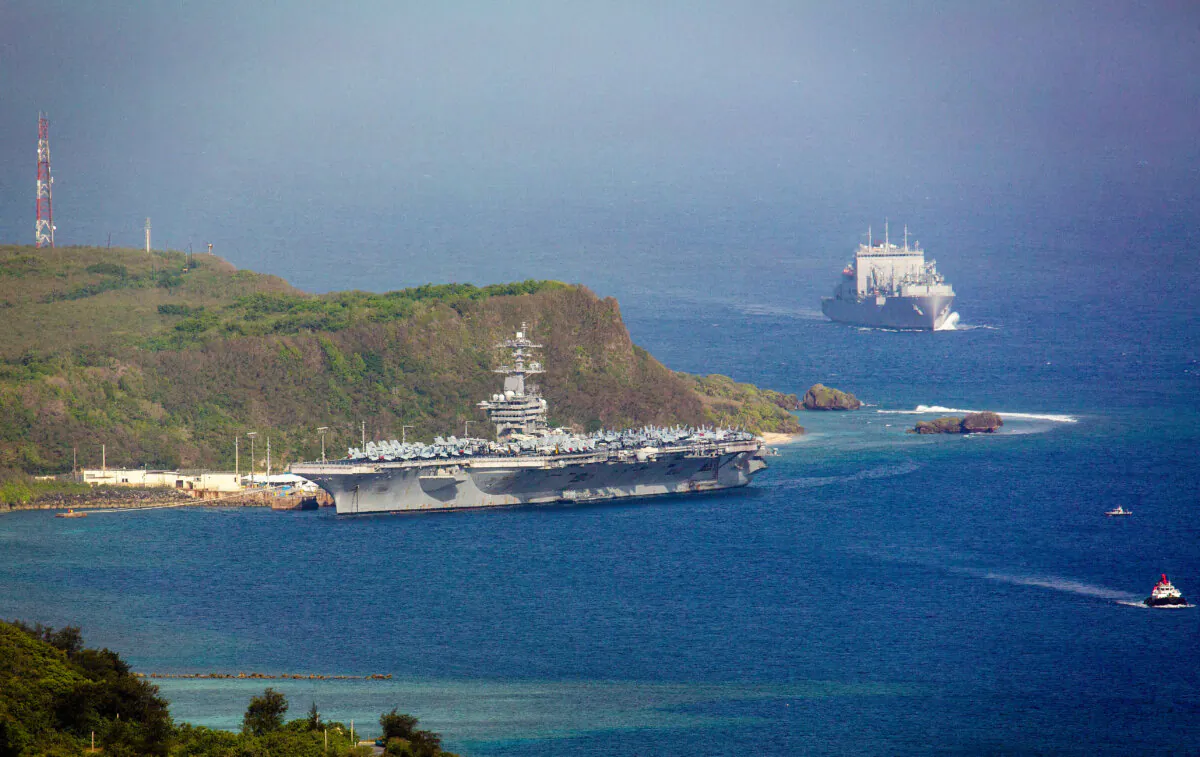
Guam, an unincorporated U.S. territory in the Western Pacific Ocean and part of the Mariana Islands, is an anchor for U.S. military operations in the region.
Since 1982, the Air Force has used Tarague Beach, a restricted-access site, to dispose of dangerous munitions. The beach, located not far from Andersen Air Force Base, is a nesting habitat for endangered turtles and sits atop an aquifer that supplies most of the island with drinking water.
In 2021, the Air Force asked regulators in Guam to renew its permit for open burning and open detonation of hazardous waste at the beach without first completing a NEPA review. Prutehi Guahan sued, arguing that the application was the Air Force’s decision to keep the operations going.
A federal district court in Guam dismissed the case, ruling the group lacked standing, that no final agency action had been taken, and even if the group could sue, the lawsuit still failed on the merits. Standing refers to the right of someone to sue in court. The parties must show a strong enough connection to the claim to justify their participation in a lawsuit.
A three-judge panel of the U.S. Court of Appeals for the Ninth Circuit later reversed on all three grounds, voting 2–1. The appeals court agreed that the Air Force needed an environmental impact assessment under NEPA before filing to renew the permit. The Air Force then appealed to the Supreme Court.
The Supreme Court is expected to issue a ruling by June or July 2027.
 Friends Read Free
Copy
Facebook
Tweet
Friends Read Free
Copy
Facebook
Tweet