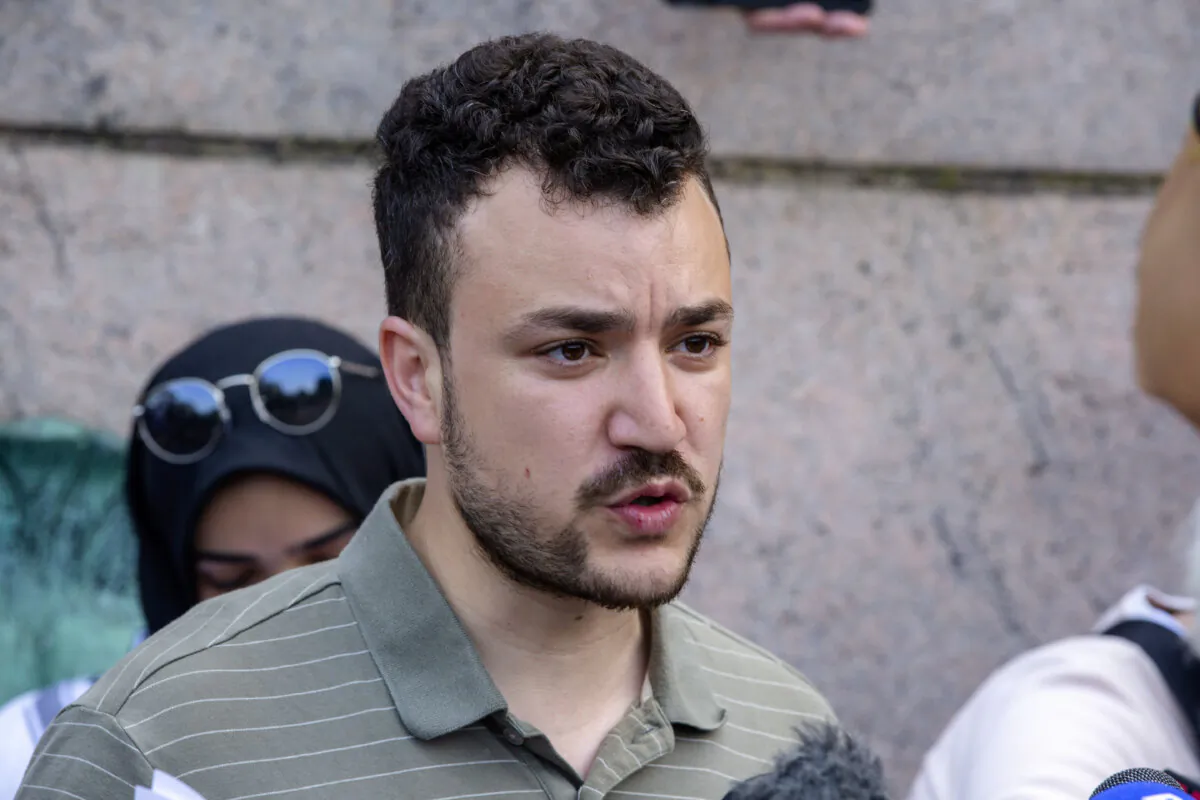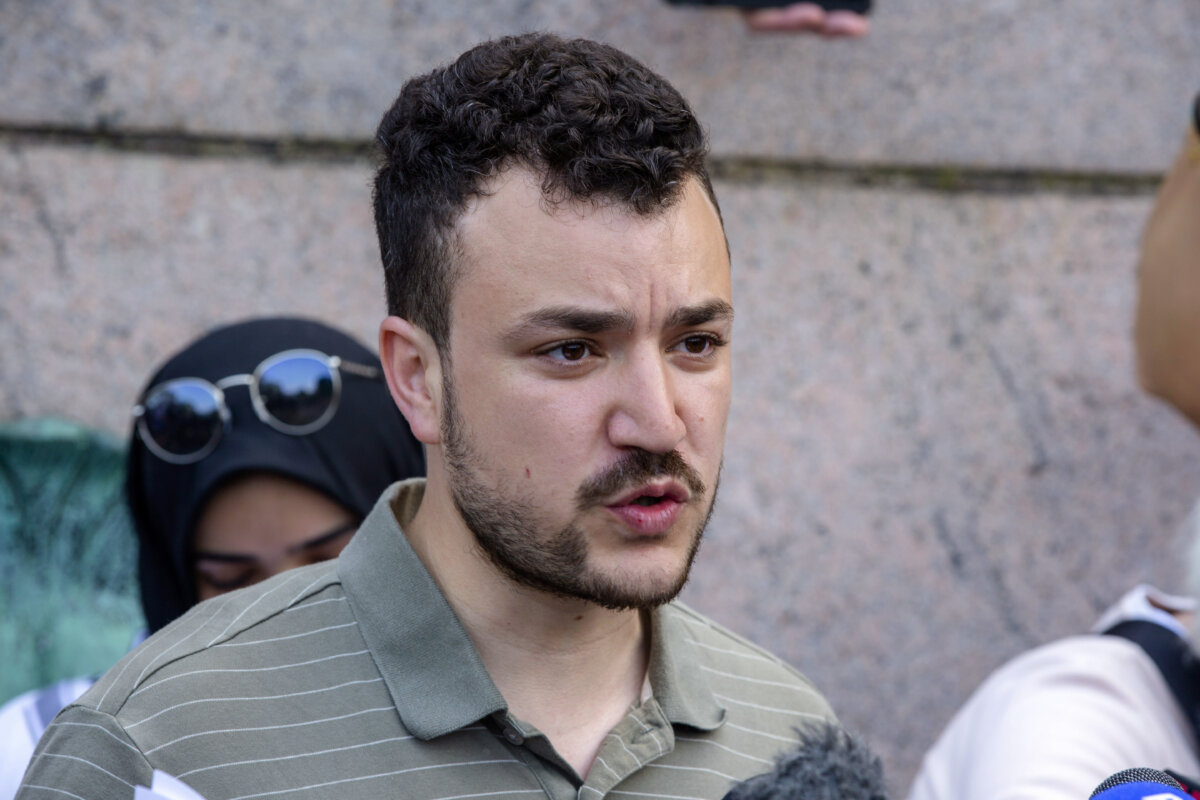

A federal judge ruled on June 11 that President Donald Trump’s administration cannot use foreign policy interests to justify detaining Mahmoud Khalil, a Columbia University student who played a leading role in the pro-Palestinian protests at the school in 2024.
U.S. District Judge Michael Farbiarz granted Khalil an injunction against deportation or continued detention, ruling that Khalil had met the “irreparable harm” standard required to receive a federal court order in his favor.
“The Petitioner’s career and reputation are being damaged and his speech is being chilled,” the judge wrote. “This adds up to irreparable harm.”
Despite the ruling, Farbiarz has delayed a release order in the case, preventing it from going into effect until 9:30 a.m. ET on June 13 to give the administration time to appeal.
Khalil was arrested on March 8 in the lobby of a university-owned apartment in New York—the first of several arrests after the Trump administration revoked some student visas in its efforts to combat anti-Semitism on college campuses following protests and riots at major universities across the United States in 2024.
Following the arrest, Khalil was transported from New York state for detention by immigration authorities in Louisiana, where he has been held since.
The administration has argued that the detention—and eventual deportation—of Khalil is justified under the Immigration and Nationality Act of 1952, which gives the secretary of state authority to determine whether the presence of a particular noncitizen in the country harms U.S. foreign policy interests.
Secretary of State Marco Rubio has sought to apply the act in Khalil’s case, arguing that Khalil’s protest activity against Israel threatened U.S. foreign policy goals.
Rubio said that Khalil was eligible to be deported under the 1952 legislation, which prohibits “presence or activities in the United States the secretary of state has reasonable ground to believe would have potentially serious adverse foreign policy consequences for the United States.”
Khalil, 30, was the face of Columbia University’s student protests in 2024 criticizing Israel’s military operation against the Gaza-based Hamas terrorist group in response to the group’s attacks on Israel on Oct. 7, 2023, during which it killed more than 1,100 and kidnapped more than 250.
Critics have argued that application of the law to Khalil could have a chilling effect on free speech. Farbiarz agreed, saying that free speech concerns were particularly in Khalil’s favor.
The judge cited precedent that “when a plaintiff is claiming the loss of a First Amendment right, courts commonly rule that even a temporary loss outweighs any harm to defendant and that a preliminary injunction should issue.”
The Department of Homeland Security has also proposed that Khalil may be eligible for deportation because of errors on his lawful permanent resident application.
Farbiarz also rejected this argument, suggesting that it was just a pretext and that the 1952 law was the driving factor in the case.
“The evidence is that lawful permanent residents are virtually never detained pending removal for the sort of alleged omissions in a lawful-permanent-resident application that [Khalil] is charged with here,” the judge wrote. “And that strongly suggests that it is the Secretary of State’s determination that drives the Petitioner’s ongoing detention—not the other charge against him.”
 Friends Read Free
Copy
Facebook
Tweet
Friends Read Free
Copy
Facebook
Tweet