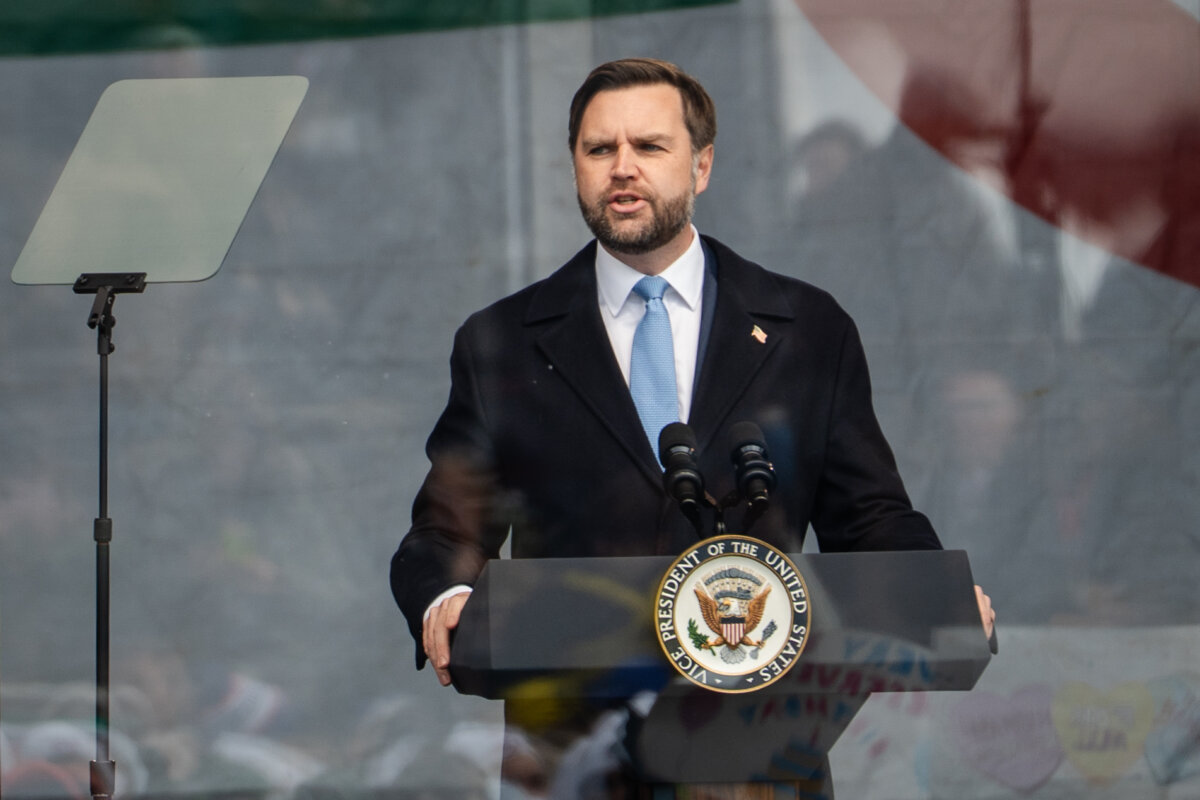

Vice President JD Vance said on Feb. 26 that President Donald Trump is approaching the prospect of military intervention in Iran cautiously and with “no chance” of the United States becoming mired in the Middle East in a forever war.
Making the remarks in an exclusive interview with the Washington Post, Vance said Trump is still weighing what to do about Iran to make sure it doesn’t acquire a nuclear weapon, either by diplomacy or force.
Describing Trump as preferring a diplomatic resolution to ordering military strikes, Vance said the president’s decision will ultimately be based on Tehran’s attitude.
“I think we all prefer the diplomatic option,” Vance said. “But it really depends on what the Iranians do and what they say.”
But while Trump is considering using force, Vance said there is “no chance” that a U.S. military intervention in Iran would mean getting bogged down “in a Middle Eastern war for years with no end in sight.”
Vance said Trump’s foreign policy is aligned with the “America First” paradigm, and that the president moves with caution to ensure his decisions benefit the American people.
“I do think we have to avoid repeating the mistakes of the past. I also think that we have to avoid overlearning the lessons of the past,” Vance said. “Just because one president screwed up a military conflict doesn’t mean we can never engage in military conflict again. We’ve got to be careful about it, but I think the president is being careful.”
As examples of Trump-led interventions that were “very clearly defined” rather than sweepingly gung-ho, Vance pointed to last year’s targeted strikes against Iranian nuclear facilities and the recent surgical mission by U.S. special operations forces to oust Venezuelan leader Nicolás Maduro from power.
US–Iran Negotiations Continue
Vance’s remarks came as the third round of indirect talks between the United States and Iran, moderated by Oman, concluded on Feb. 26 in Geneva, Switzerland, with no major breakthrough.
Omani Foreign Minister Badr Al Busaidi, the key mediator in the U.S.–Iran negotiations, signaled some progress and said the parties plan to keep talking. Al Busaidi said the sides would meet next week in Vienna, Austria, for technical discussions.
Iranian Foreign Minister Abbas Araghchi, representing Iran in the negotiations, also signaled progress.
The White House did not respond to a request for comment about the Geneva talks by publication time.
Ahead of the Geneva talks, Vance said there was evidence Iran is trying to rebuild its nuclear program and pursue a warhead. Trump had dispatched U.S. special envoys Steve Witkoff and Jared Kushner to Switzerland to negotiate with the Iranian delegation to “try to address that problem” diplomatically, Vance added.
Trump said on Feb. 24 that Tehran was developing missiles that can reach the United States and that it’s trying to reboot its nuclear program.
“We wiped it out, and they want to start all over again. And they’re at this moment again pursuing their sinister ambitions,” Trump said during his State of the Union address in Congress.
“We are in negotiations with them. They want to make a deal, but we haven’t heard those secret words: ‘We will never have a nuclear weapon.’”
Iranian officials have denied they’re pursuing nuclear arms and have threatened to retaliate forcefully against any U.S. military strikes.
Lawmakers Move to Rein in War Powers
Vance’s remarks came as congressional Democrats pledged to introduce war powers resolutions to block any U.S. strike on Iran without prior approval from Congress.
Sen. Tim Kaine (D-Va.) said he plans to force a Senate vote next week, while House Armed Services Committee Democrats backed a similar measure led by Reps. Ro Khanna (D-Calif.) and Thomas Massie (R-Ky.). They argued that launching a new Middle East conflict without congressional authorization would be unconstitutional and reckless.
Splits have emerged in the GOP over the matter. Some Republicans, including Sen. Mike Rounds (R-S.D.) and Rep. Don Bacon (R-Neb.), have suggested military action may be necessary. Others, such as Sen. Rand Paul (R-Ky.), urged restraint and called for Congress to weigh in before any strike.
Ryan Morgan contributed to this report.
 Friends Read Free
Copy
Facebook
Tweet
Friends Read Free
Copy
Facebook
Tweet