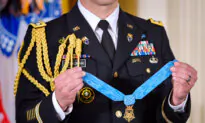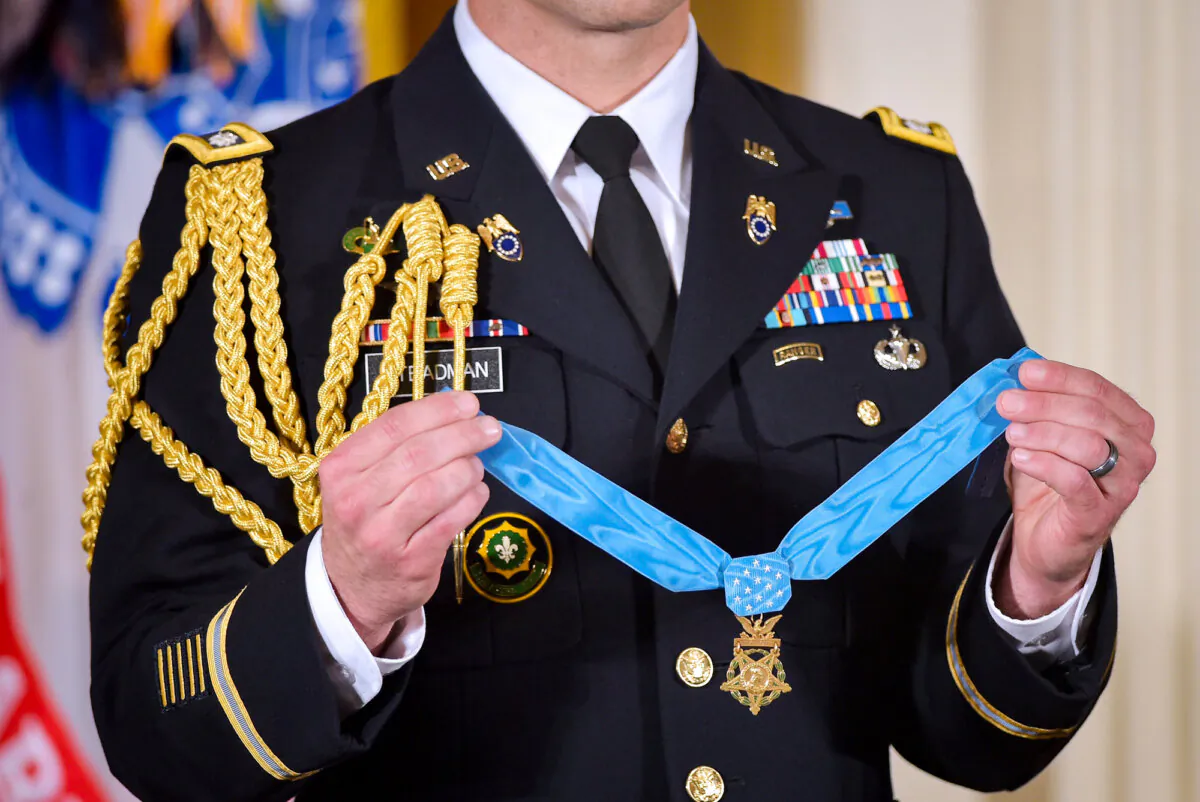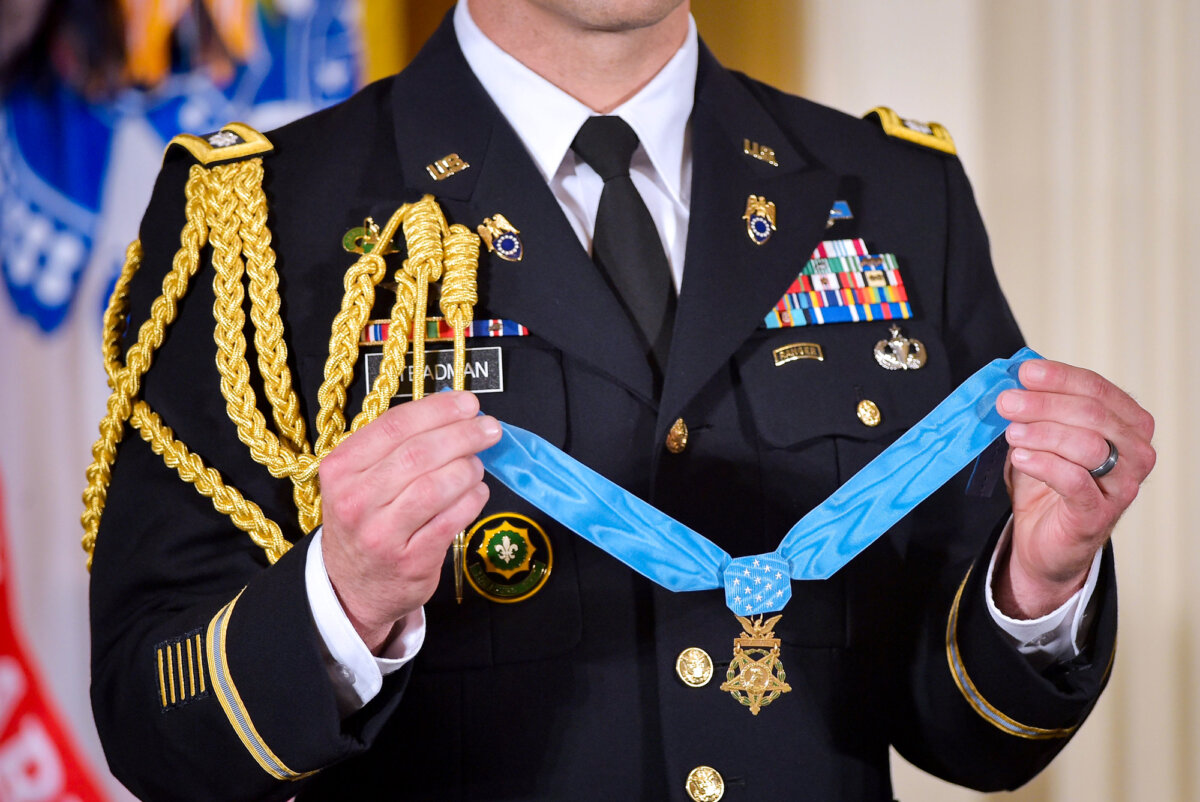

President Donald Trump will award the Medal of Honor to three U.S. Army veterans on March 2, the White House said.
The nation’s highest military decoration will be presented posthumously to Master Sgt. Roderick Edmonds, a former prisoner of war during World War II, and an Afghanistan War veteran, Staff Sgt. Michael Ollis. Command Sgt. Maj. Terry P. Richardson, retired, a Vietnam War veteran, will also receive the award, which recognizes service members who demonstrate extraordinary bravery and go beyond the call of duty.
The White House announced the awards on Feb. 26, following recent Medal of Honor presentations by Trump to an Army officer and a retired Navy fighter pilot at the State of the Union address.
Edmonds was held as a prisoner of war in Germany from Dec. 19, 1944, to March 30, 1945. On Jan. 27, 1945, the day he was transferred to a second prisoner of war camp, Nazi officials ordered that only Jewish American prisoners report for roll call the next morning, threatening execution for noncompliance. Believing the Jewish prisoners would be killed, Edmonds directed approximately 1,200 American POWs to stand together in formation.
When the camp commandant saw all the Americans assembled, he angrily demanded that Jewish service members identify themselves. Edmonds cited protections under the Geneva Convention. The commandant pressed a pistol to Edmonds’ head and threatened to shoot him if the Jewish prisoners did not step forward. Edmonds said, “We are all Jews here,” and warned that such an act would constitute a war crime after the war. The officer ultimately backed down.
In March 1945, as Allied forces advanced, German guards prepared to evacuate the camp eastward. Edmonds instructed the American prisoners to form up in front of the barracks and then break ranks and return inside when transport arrived. His defiance and leadership helped thwart the evacuation, and German forces ultimately abandoned the camp, leaving the American prisoners behind.
Ollis served in Afghanistan at Forward Operating Base Ghazni. On Aug. 28, 2013, the base came under a coordinated enemy assault involving vehicle-borne improvised explosive devices, suicide bombers, indirect fire, and small arms fire. Ollis directed soldiers in a nearby building to move to bunkers, then reentered the structure to check for casualties after accounting for his personnel, advancing toward enemy fighters who had breached the perimeter.
He located a coalition forces officer, and the two moved toward the point of attack armed only with rifles and without personal protective equipment. Joining other friendly forces, Ollis helped organize a counterattack to push insurgents from the airfield and adjacent buildings.
Under sustained small arms, indirect, and rocket-propelled grenade fire, Ollis maneuvered with fellow soldiers, delivering accurate fire. When an insurgent suddenly emerged and opened fire, wounding the coalition officer, Ollis placed himself between the attacker and the wounded officer, who could not move. He neutralized the insurgent, but as he approached, the attacker detonated a suicide vest, killing him.
Richardson served during the Vietnam War. On Sept. 14, 1968, while leading a reconnaissance mission, his platoon encountered heavy automatic weapons and small arms fire from a North Vietnamese Army battalion. He rescued three severely wounded soldiers before returning to find his company surrounded.
Braving intense fire, Richardson advanced to the top of Hill 222—his unit’s objective—to secure a position from which to direct tactical air strikes. He soon realized the hill was an enemy regimental base camp. Despite being wounded by a sniper, Richardson continued directing air strikes in close proximity to his own position and that of his troops for seven hours. After enemy forces withdrew, he declined medical evacuation in order to remain with his soldiers. His actions saved 85 lives.
 Friends Read Free
Copy
Facebook
Tweet
Friends Read Free
Copy
Facebook
Tweet