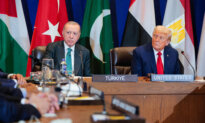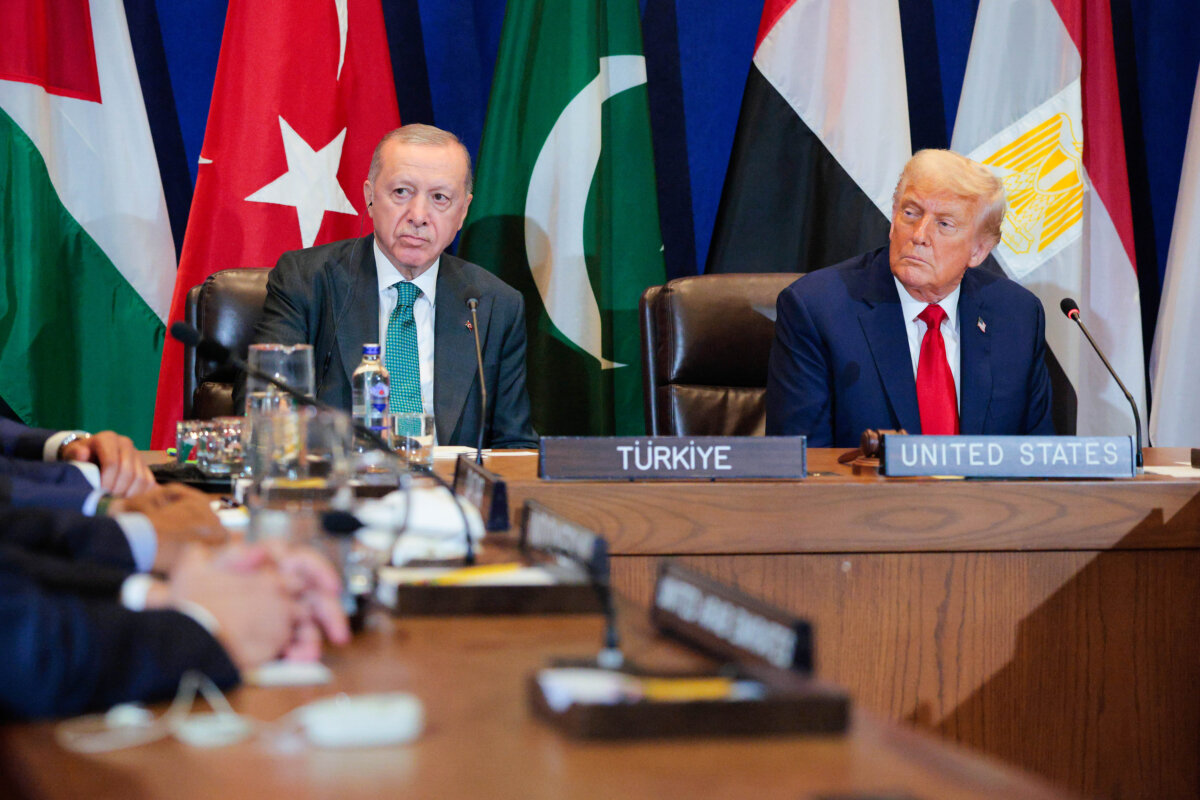
WASHINGTON—U.S. President Donald Trump welcomed Turkish President Recep Tayyip Erdogan to the White House on Sept. 25 to discuss a Boeing deal and bilateral issues, including the long-standing dispute over Turkey’s purchase of a Russian air defense system.
“We do a lot of trade with Turkey, and we’re going to continue,” Trump said in the Oval Office at the beginning of his bilateral meeting with Erdogan. “They build great products—really fantastic manufacturers.”
Trump also said the two leaders would discuss Turkey’s efforts to purchase F-16 and F-35 aircraft.
“We’re just going to have, I think, a very interesting couple of hours. We’re going to get a lot done,” Trump said as he welcomed the Turkish president.
Trump announced the meeting on Sept. 19 on Truth Social, saying that he expected to finalize trade and military agreements, including “the large-scale purchase of Boeing aircraft” and to see progress on a major F-16 deal and the continuation of F-35 discussions.
The Turkish government is preparing to buy hundreds of Boeing airplanes, according to Turkish media reports.
In a recent interview, Turkish Airlines Chairman Ahmet Bolat confirmed that the carrier may finalize a deal to purchase 250 Boeing aircraft during the visit. If announced at the White House, the order would mark a major expansion for the country’s national flag carrier, which currently operates a fleet of 485 planes.
Trump noted that Erdogan had remained a friend throughout the previous administration.
“When I was in exile, we were still friends,” Trump said. “That’s always a good way to find out—a test of friendship.”
“I am very pleased to be here with my colleagues and friends,” Erdogan said in response, noting that he looked forward to a “thorough discussion” on the F-35s, the F-16s, and the Halkbank case—referring to a U.S. court ruling that the Turkish bank could be prosecuted for allegedly helping Iran evade U.S. sanctions.
During the meeting, Trump joked about Erdogan, telling reporters that the Turkish president is “highly opinionated.”
“Usually, I don’t like opinionated people, but I always like this one. But he’s a tough one,” Trump said of Erdogan.
Trump’s relationship with Erdogan has changed significantly since 2018, when Washington pressed for the release of American pastor Andrew Brunson after he spent two years in Turkish custody.
Turkey freed Brunson following Trump’s threats to impose large sanctions on Ankara. A year later, Trump sent Erdogan a public letter warning that he could “destroy” Turkey’s economy if Ankara refused to end its military offensive in northern Syria. Since then, ties between the two leaders have steadily improved.
Trump mentioned the Brunson incident during the meeting.
“I always remember that, but he released him from 35 years in prison. And Pastor Brunson now is healthy, happy, and well. We’re very happy about that,” he said.
A key sticking point at the White House meeting is expected to be Turkey’s purchase of the Russian S-400 air defense system.
Turkey’s decision to purchase Russia’s S-400 air defense system in 2019 led to U.S. sanctions on the Turkish defense industry under the Countering America’s Adversaries Through Sanctions Act and its removal from the F-35 program.
With respect to lifting the sanctions, Trump said: “He needs certain things, and we need certain things. And we’re going to come to a conclusion. You’ll know by the end of the day.
“The best thing he could do is not buy oil and gas from Russia.”
Although Turkey is a NATO ally, the U.S. Congress “remains hostile to Turkey’s Russian ties and human rights record,” Asli Aydintasbas, a fellow in the Center on the United States and Europe at the Brookings Institution, wrote in a recent report.
Ongoing tensions between Turkey and Israel over Gaza and Syria pose a challenge to U.S. policy in the region, she said.
Trump has called out NATO allies over Russian oil purchases. In August, Turkey was the third-largest importer of Russian fossil fuels, after China and India, according to the Center for Research on Energy and Clean Air.
In a speech to the U.N. General Assembly on Sept. 22, Trump criticized NATO allies for “funding the war against themselves.”
Despite their differences, Ankara and Washington pursue broadly similar goals in Syria.
Following the fall of the Assad regime in December 2024, the United States and Turkey have become more closely aligned on their key objectives in Syria, with U.S. Ambassador to Turkey and special envoy for Syria Tom Barrack serving as a key coordinator.
“Like Ankara, Barrack has embraced the post-Assad regime in Damascus, led by interim President Ahmad al-Sharaa; supports the idea of a unified Syria; and broadly accepts the integration of U.S.-backed Syrian Kurds, the Syrian Democratic Forces, into the Syrian military—though with greater local autonomy than Ankara would prefer,” Aydintasbas said.
Erdogan is facing growing pressure from the international community after the arrest and suspension of Istanbul Mayor Ekrem Imamoglu sparked mass protests in Turkey, with tens of thousands taking to the streets. The European Commission and the German Foreign Office condemned the crackdown, stressing that political competition should not be fought through judicial or prison measures.
 Friends Read Free
Copy
Facebook
Tweet
Friends Read Free
Copy
Facebook
Tweet