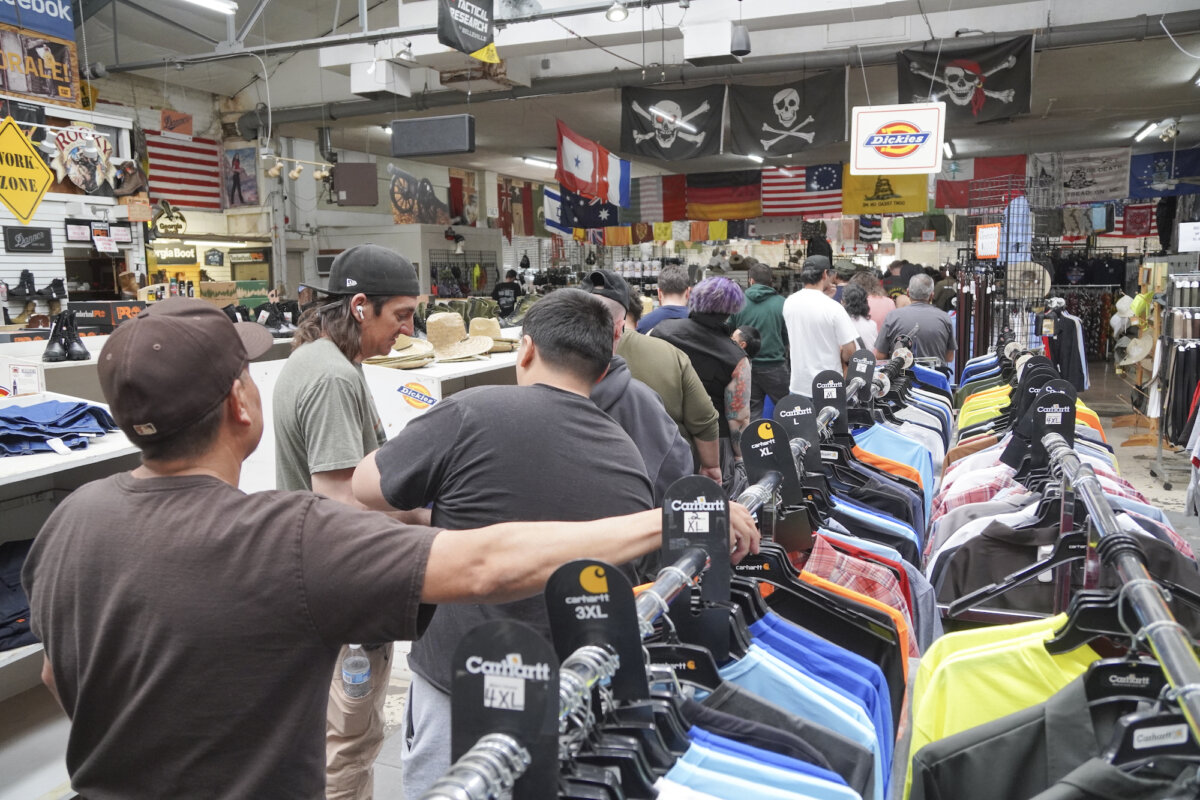

Consumer confidence in the United States declined marginally in May due to the continued persistence of price shocks from the ongoing Middle East conflict between the United States and Iran, according to a May 26 statement from think tank The Conference Board.
The board’s Consumer Confidence Index fell 0.7 points to 93.1 this month from April. The Present Situation Index, which assesses current labor market and business conditions, declined 3.2 points. On the positive side, the Expectations Index, which measures the short-term outlook among consumers for labor market, income, and business conditions, increased one point. The indexes are calculated from the Consumer Confidence Survey conducted by the think tank.
“Consumers’ write-in responses on factors affecting the economy continued to skew towards pessimism in May,” the statement said.
“References to prices and oil and gas increased in frequency for a second consecutive month, while mentions of war, geopolitics, and conflict remained elevated—likely signaling consumers’ underlying concerns about the inflationary impacts of the war in the Middle East on their wallets.”
The U.S.–Iran war began in late February, following which the 12-month inflation rate rose from 2.4 percent that month to 3.3 percent in March, and 3.8 percent in April, according to data from the Bureau of Labor Statistics.
The energy inflation rate has risen more dramatically, shooting up from 0.5 percent in February to 12.5 percent in March, and 17.9 percent in April.
In its statement, The Conference Board said that two-thirds of survey consumers said they were cutting back on spending due to rising prices. Most people who opted to do so delayed expensive purchases and bought fewer items.
“Many who said they are delaying purchases of items they want rather than need, plan to buy them in the next six months,” the statement said. “Consumers planned to economize on clothing and footwear, hobby items, and games/toys.”
In a May 26 post on X, Mohamed A. El-Erian, the chief economic adviser at financial company Allianz, said that The Conference Board’s consumer sentiment results were “less pessimistic” than those from the University of Michigan.
In addition, “relatively low overall sentiment has not, at least as yet, translated to hard economic data such as retail sales,” El-Erian wrote.
Robust Retail Sales
The University of Michigan’s survey showed that U.S. consumer sentiment dipped to a fresh record low in May and was down by more than 14 percent from a year back.
Joanne Hsu, director of consumer surveys at the university, said customers were worried that inflation could rise and spread beyond fuel prices, even over the long term.
However, retail sales have remained robust despite the dip in consumer sentiment. In April, U.S. retail and food service sales rose by 0.5 percent from the previous month and by 4.9 percent from a year back, according to a May 14 statement from the Census Bureau.
Arlan Suderman, chief commodities economist at StoneX, said in a May 22 note that there seems to be an “increasing disconnect” between consumer sentiment results and the actual behavior of customers on the ground.
“The consumer is still king in our economy, and the risk increasingly is that the consumer will say, ‘enough is enough’ and put the brakes on that spending. For now, the economy is solid, but this bears watching,” the note said.
In a May 19 research note, RBC Economics said that there were no signals suggesting the United States was heading into a recession.
“The U.S. economy remains on a solid footing, and it will take more than a few months of high gas prices to knock it off course,” the note said.
Consumer sentiment could improve once the U.S.–Iran war subsides, which can lead to lower energy prices and inflation rates.
In a May 22 speech in Germany, Federal Reserve Bank Governor Christopher J. Waller said he was “hopeful that the conflict is on a path toward a peaceful resolution.”
The ultimate impact of the war on inflation “will depend on the length of the conflict, how severely supplies are disrupted, and the pass-through of input costs to final product prices,” Waller said.
Peace negotiations continue as discussions have focused on certain key issues like the possible paths for dealing with Iran’s stockpile of enriched uranium.
President Donald Trump has reiterated his position that Iran cannot have any nuclear weapons.
 Friends Read Free
Copy
Facebook
Tweet
Friends Read Free
Copy
Facebook
Tweet