
The United States and India have reached a trade agreement and will begin lowering tariffs on each other’s goods immediately, U.S. President Donald Trump announced on Feb. 2.
As part of the deal, the United States will cut its reciprocal tariff rate from 25 percent to 18 percent, Trump wrote on Feb. 2 in a post on Truth Social. In exchange, he said, India has agreed to “move forward to reduce [its] Tariffs and Non Tariff Barriers against the United States to ZERO.”
India has also committed to buying American goods “at a much higher level, in addition to over $500 BILLION DOLLARS of U.S. Energy, Technology, Agricultural, Coal, and many other products,” Trump wrote.
If realized, that pledge would dramatically shift the trade balance between the two nations and the surplus New Delhi has long maintained. In 2024, India ran a $45.8 billion trade surplus with the United States.
Trump said India has agreed to “stop buying Russian oil,” a move he said would help end the war in Ukraine. Russia relies heavily on energy exports to fund the war, now approaching its fifth year, with India and China among the biggest buyers of Russian crude at steep discounts due to Western sanctions.
India also expressed interest in buying “much more” from Venezuela, according to Trump’s post. The South American country recently amended its hydrocarbons law to loosen state control over its oil sector and attract more foreign investment to develop the world’s largest known oil reserves.
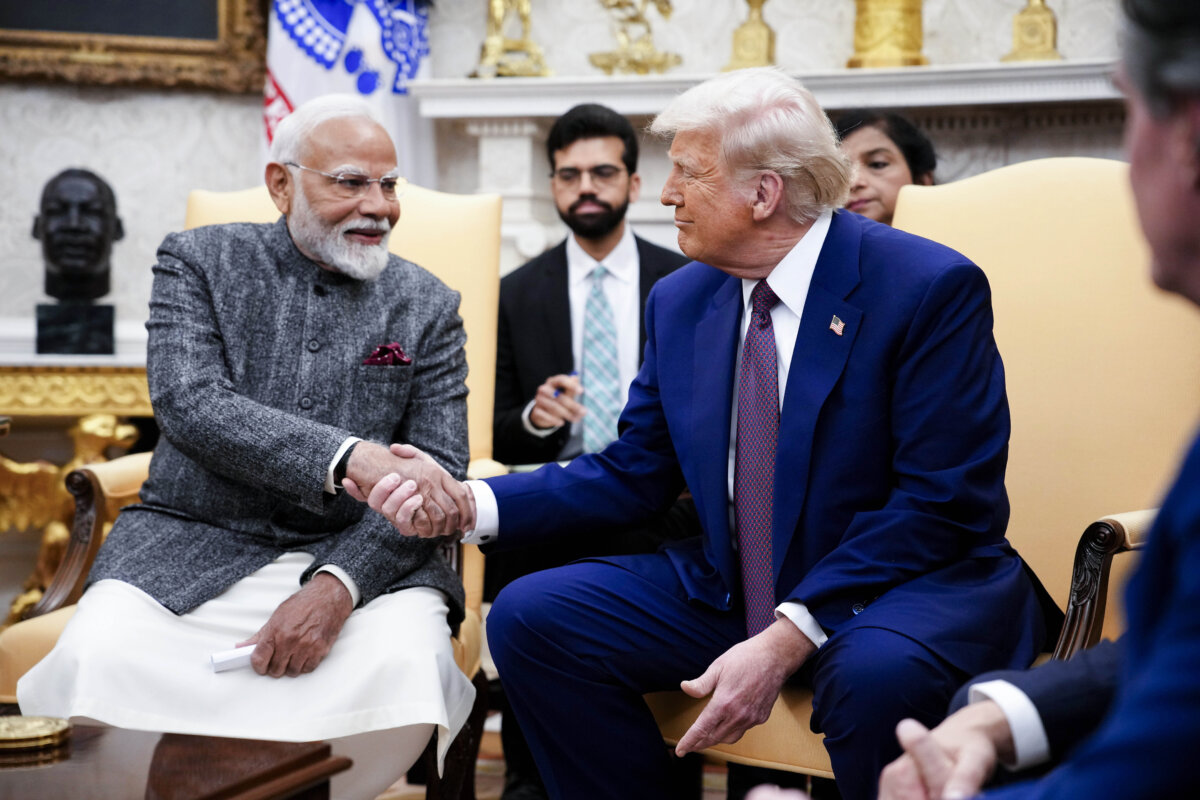
The U.S.–India trade deal, which had stalled last year, was finalized after a Feb. 2 phone call between Trump and Indian Prime Minister Narendra Modi that covered trade and the war in Ukraine, according to the president. He described Modi as one of his “greatest friends, and a powerful and respected leader.”
“Our amazing relationship with India will be even stronger going forward,” Trump wrote. “Prime Minister Modi and I are two people that GET THINGS DONE, something that cannot be said for most.”
Modi said he was “delighted” by the agreement and likewise referred to Trump as his “great friend.”
“India fully supports his efforts for peace,” Modi wrote in a post on X.
The warm tone resembles that of early 2025, when Modi visited the White House shortly after Trump’s second inauguration. At that time, the two leaders pledged to work toward a deal aimed at narrowing the U.S. trade deficit with India, and New Delhi signaled that it would buy more U.S. energy, weapons, and civil nuclear technology as part of that effort.
However, in the months that followed, the relationship grew more complicated as the two countries clashed over a range of issues, including the conflict between India and Pakistan, India’s purchases of Russian oil, U.S. policy shifts on H-1B visas that many Indian workers depend on, and disagreements over access to India’s sensitive agriculture and dairy markets.
After negotiations over the trade deal broke down, the Trump administration imposed 50 percent tariffs on Indian goods in August 2025—among the highest rates applied to any U.S. trading partner. That included a 25 percent baseline tariff and an additional 25 percent penalty tied to India’s continued purchases of Russian oil, which the White House said were indirectly funding Moscow’s war against Ukraine.
Trade between the two economies dipped in the months after the punitive tariffs took effect, although India’s exports rebounded in November 2025 after the Trump administration exempted a group of agricultural and food-related products such as coffee, tea, bananas, and certain fertilizers from the 50 percent tariff list. India’s top exports to the United States, electronics and pharmaceuticals, were kept outside the tariff scheme.
Overall, according to data from India’s commerce ministry, bilateral goods trade between India and the United States totaled $105.31 billion from April 2025 to December 2025, with India recording a trade surplus of $26.45 billion. That compares with $94.97 billion in trade during the same period a year earlier, when the surplus stood at $25.09 billion.
Since U.S. tariffs were announced, India stepped up efforts to strike trade deals with other countries in an apparent bid to minimize the impact of the tariffs. In December 2025, it concluded a pact with New Zealand. That was days after New Delhi entered an economic partnership with Oman during Modi’s visit to the Gulf nation.
The latest deal comes one week after India concluded a major free trade agreement with the European Union, which European Commission President Ursula von der Leyen hailed as the “mother of all deals.” Under that agreement, India will gradually reduce tariffs on European goods ranging from cars and machinery to chemicals and wine over the next decade.
With the new 18 percent rate, India faces a duty level lower than or comparable to those of several South Asian and Southeast Asian countries, including Bangladesh (20 percent), Sri Lanka (20 percent), and Vietnam (20 percent). This tariff would remain slightly higher than the tariffs applied to more developed economies such as Japan (15 percent) and South Korea (15 percent) under negotiated trade frameworks.
 Friends Read Free
Copy
Facebook
Tweet
Friends Read Free
Copy
Facebook
Tweet