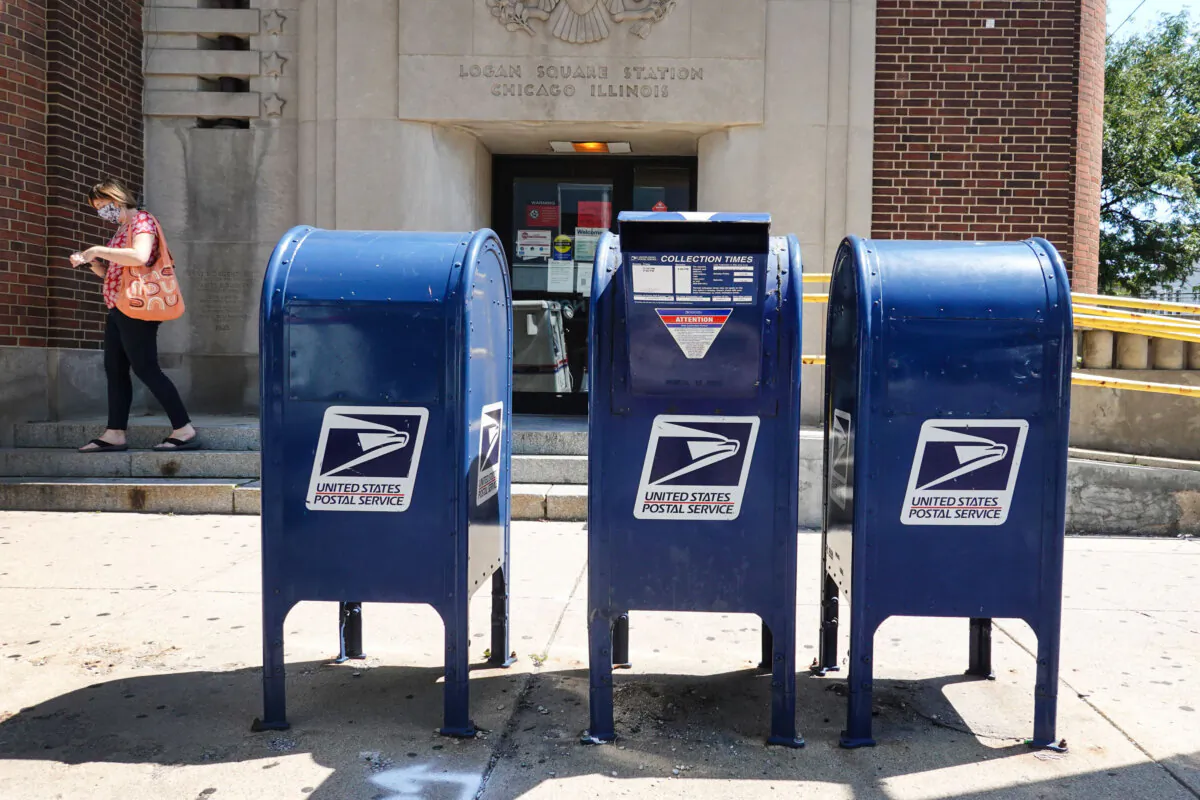

The Postal Service (USPS) is implementing the next phase of its delivery service changes beginning July 1, the agency said in a July 1 statement.
On March 20, the USPS announced that it planned to implement changes to its service standards, which refer to the expected number of days to deliver a piece of mail.
The new standards, projected to be implemented in two phases on April 1 and July 1, are expected to save the USPS a minimum of $36 billion over the next decade through cost savings in transportation, real estate, and mail and packaging costs.
At the time, USPS said that while delivery times may extend by one day for mail collected at certain post office locations, overall delivery speeds of both mail and packages are expected to improve.
Under the new policy effective from July 1, USPS will increase the geographic reach of its two-, three-, and four-day delivery service for first-class mail and Ground Advantage, ensuring faster deliveries at more locations. At present, such deliveries can take up to five business days.
The agency attributed the increased coverage of speedier delivery times to faster transportation dispatch from regional processing and distribution centers.
As for mail and packages originating from and destined for the service area of a processing facility, the USPS will provide two- and three-day delivery service for single-piece first-class mail and Ground Advantage.
The USPS said the increased geographic coverage area and updated delivery timeframes “will add value” for its customers.
Customers can check out the agency’s Service Commitments webpage to “find the expected delivery day for postal products depending on the sender and recipient’s ZIP codes,” it said.
One of the changes the USPS implemented on April 1 was increasing delivery times by one day for Ground Advantage and single-piece first-class mail and periodicals that originate within a five-digit ZIP code located more than 50 miles from its nearest regional processing and distribution center.
The USPS delivery standard rules implemented on April 1 and July 1 are part of the 10-year Delivering for America plan that aims to boost the agency’s financial and operational efficiency.
The changes to mail delivery service were previously criticized by the Postal Regulatory Commission in a Jan. 31 statement.
“[The USPS plan depends on] defective modeling and does not appear to be ready for implementation,” the statement reads.
Moreover, it states, the projected cost savings rely on “overly optimistic and unsubstantiated financial projections.”
The commission also raised concerns that the changes under the Delivering for America plan would have “significant negative impacts on rural communities throughout the United States.”
Privatization and USPS
During a June 24 hearing of the House Committee on Oversight and Government Reform, titled “The Route Forward for the U.S. Postal Service,” the issue of private entity involvement and privatization cropped up.
James Cochrane, CEO of Package Shippers Association, a trade association with member companies managing more than 80 percent of all packages delivered in the United States, recommended increased private sector involvement in USPS activities.
“To truly revitalize the Postal Service and ensure its long-term viability, we must acknowledge the limitations of a purely governmental approach,” he said. “A critical component of any new strategy must include embracing … strategic public-private partnerships, particularly in areas where the private sector excels.”
Cochrane recommended that USPS partner with private sector carriers for certain transportation activities, arguing that such a move could “significantly reduce costs, improve transit times, and enhance overall network fluidity.”
“Actively seek collaboration with the private sector, particularly for middle-mile logistics, software development, and cutting-edge technology to achieve efficiency that the Postal Service is failing to attain alone,” he said.
At the hearing, Brian L. Renfroe, president of the National Association of Letter Carriers, warned against any attempt at privatizing the USPS.
“We must invest and modernize, not downsize and privatize,” he said.
“The Postal Service is a lifeline for American communities that can’t be jeopardized. Any privatization efforts threaten that.
“Americans love and trust the Postal Service and have never supported privatization. They want a thriving Postal Service that grows along with the country. To ensure that prospect, the Postal Service must remain an independent nonpartisan agency.”
After being elected, President Donald Trump suggested the idea of privatizing USPS, saying it was “not the worst idea” he had heard.
“We’re looking at it,” he said.
On Feb. 21, the White House said Trump had no intention of taking control of the USPS. There was no executive order aimed at dissolving the board of governors at the agency and placing it under Commerce Secretary Howard Lutnick, a spokesperson from the White House told The Epoch Times.
Zachary Stieber contributed to the report.
 Friends Read Free
Copy
Facebook
Tweet
Friends Read Free
Copy
Facebook
Tweet