
Many of the roughly 600,000 Venezuelans who have temporary protected status (TPS) in the United States can now return home because of the capture of Venezuelan leader Nicolás Maduro, according to a Jan. 4 post on X by Department of Homeland Security (DHS) Assistant Secretary for Public Affairs Tricia McLaughlin.
The post shared a media report in which McLaughlin said Venezuelans can return to a place where they can now enjoy peace, prosperity, and stability.
Under TPS, foreign citizens can remain in the United States for a period of time when returning to their home nation proves dangerous. The DHS secretary makes this determination.
The TPS designation is granted when nations undergo environmental disasters, epidemics, ongoing armed conflict, or other extraordinary, temporary conditions. Once granted, the foreign national is considered not removable from the United States and can obtain employment authorization.
In 2021, the Biden administration instituted TPS for about 250,000 Venezuelan nationals living in the United States. In 2023, an additional 350,000 Venezuelans were added, bringing the total to roughly 600,000 individuals.
In February 2025, DHS Secretary Kristi Noem terminated the 2023 TPS designation, and in September 2025, the 2021 designation was terminated.
However, as Maduro was still in power at the time, the issue of Venezuelans going back posed a challenge.
This has now been resolved with the Trump administration’s capture of the Venezuelan leader.
“President [Donald] Trump is bringing stability to Venezuela and bringing to justice an illegitimate Narco Terrorist dictator who stole from his own people,” DHS said in a Jan. 4 post on X.
“Secretary Noem ended Temporary Protected Status for more than 500,000 Venezuelans, and now they can go home to a country that they love.”
Maduro Arrest Response, Celebrations
Meanwhile, Maduro’s arrest has triggered a wave of conflicting opinions.
Sen. Tammy Duckworth (D-Ill.) criticized President Donald Trump in a Jan. 3 statement, accusing him of carrying out “reckless and unconstitutional operations” in Venezuela.
“The Constitution requires the American people, through their elected representatives in Congress, to authorize any President to engage in acts of war—because they will be the ones to live with the consequences of the decision—and it is unacceptable for this President to deny them that responsibility,” the statement reads.
The arrest, according to the statement, was “not about enforcing law and order because if [it was], [Trump] wouldn’t hide [it] from Congress.”
“Maduro was unquestionably a bad actor, but no President has the authority to unilaterally decide to use force to topple a government, thrusting us and the region into uncertainty without justification, a defined end-state or a real plan for preventing the instability that could come next,” the statement reads.
On NBC’s “Meet the Press” on Jan. 4, Secretary of State Marco Rubio clarified that the United States was not going to war with the Latin American nation.
“We are at war against drug trafficking organizations and not [in] a war against Venezuela,” he said.
In a Jan. 3 statement posted on X, Senate Minority Leader Chuck Schumer (D-N.Y.) said the prospect of the Trump administration planning to run Venezuela should “strike fear” in the hearts of Americans.
According to Schumer, the Trump administration assured him more than three times that it was not planning military action or regime change in Venezuela. He alleged that the operation was conducted by the administration to distract Americans from “skyrocketing costs” and the Jeffrey Epstein files.
U.S. officials said the military action was taken because of Maduro’s refusal to accept multiple offers to change course, especially with his approach to the United States.
“The president offered multiple off ramps, but was very clear throughout this process: the drug trafficking must stop, and the stolen oil must be returned to the United States,” Vice President JD Vance said in a Jan. 3 post on X.
Maduro and his wife were indicted in the Southern District of New York on Jan. 3. Back in 2020, Maduro and 14 other Venezuelan officers were charged with narco-terrorism, drug trafficking, corruption, and other charges in New York City, Washington, and Miami.
At the time, then-U.S. Attorney for the Southern District of New York Geoffrey S. Berman said Maduro and the defendants “expressly intended” to flood the United States with cocaine in a bid to undermine the health and well-being of the country. He accused Maduro of having “very deliberately deployed cocaine as a weapon.”
In a Jan. 3 post on X, Attorney General Pam Bondi said: “Nicolas Maduro has been charged with Narco-Terrorism Conspiracy, Cocaine Importation Conspiracy, Possession of Machineguns and Destructive Devices, and Conspiracy to Possess Machineguns and Destructive Devices against the United States. They will soon face the full wrath of American justice on American soil in American courts.”
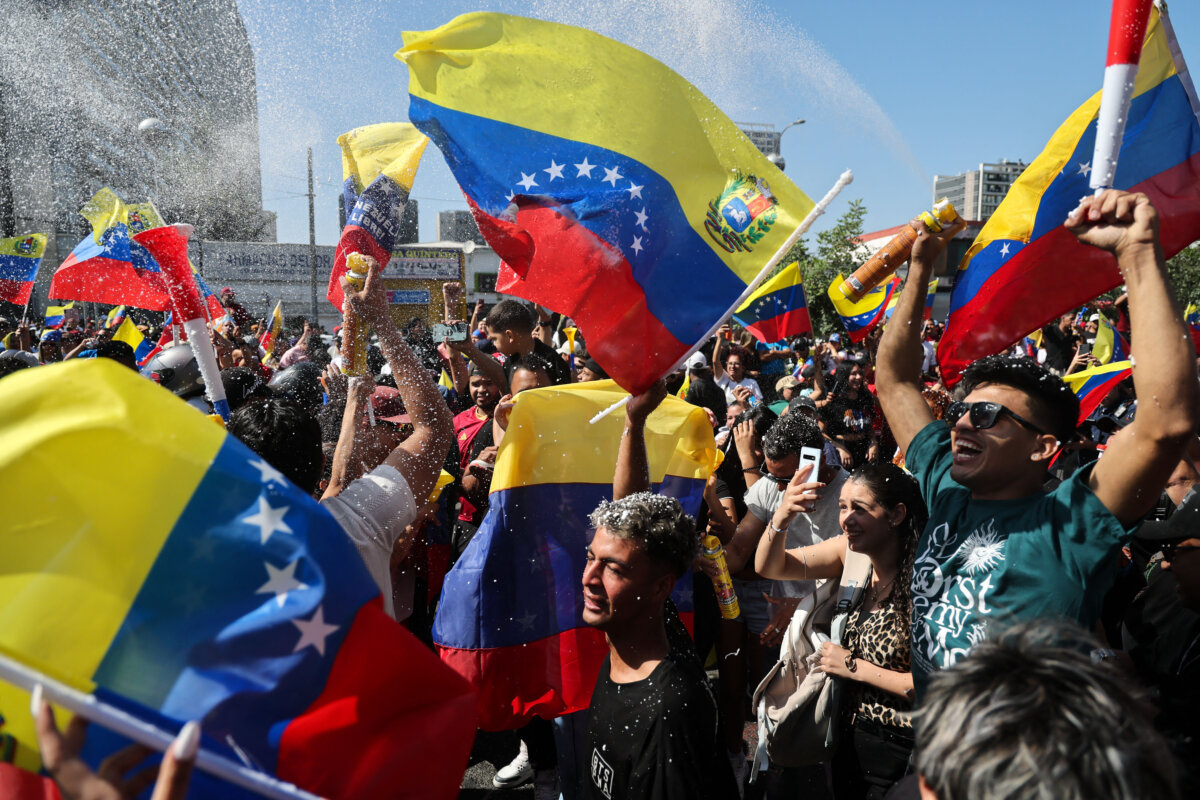
Venezuelans across the world celebrated the capture of Maduro, from Spain and Latin America to the United States.
“We are free,” said Khaty Yanez, a Venezuelan woman in Santiago, Chile, who has spent the past seven years in that country. “We are all happy that the dictatorship has fallen and that we have a free country.”
Her compatriot Jose Gregorio said: “My joy is too big. After so many years, after so many struggles, after so much work, today is the day. Today is the day of freedom.”
Since 2014, 7.7 million Venezuelans, or 20 percent of the population, have left the country, unable to afford food or seeking better opportunities abroad, according to the U.N. International Organization for Migration.
Reuters contributed to this report.
 Friends Read Free
Copy
Facebook
Tweet
Friends Read Free
Copy
Facebook
Tweet