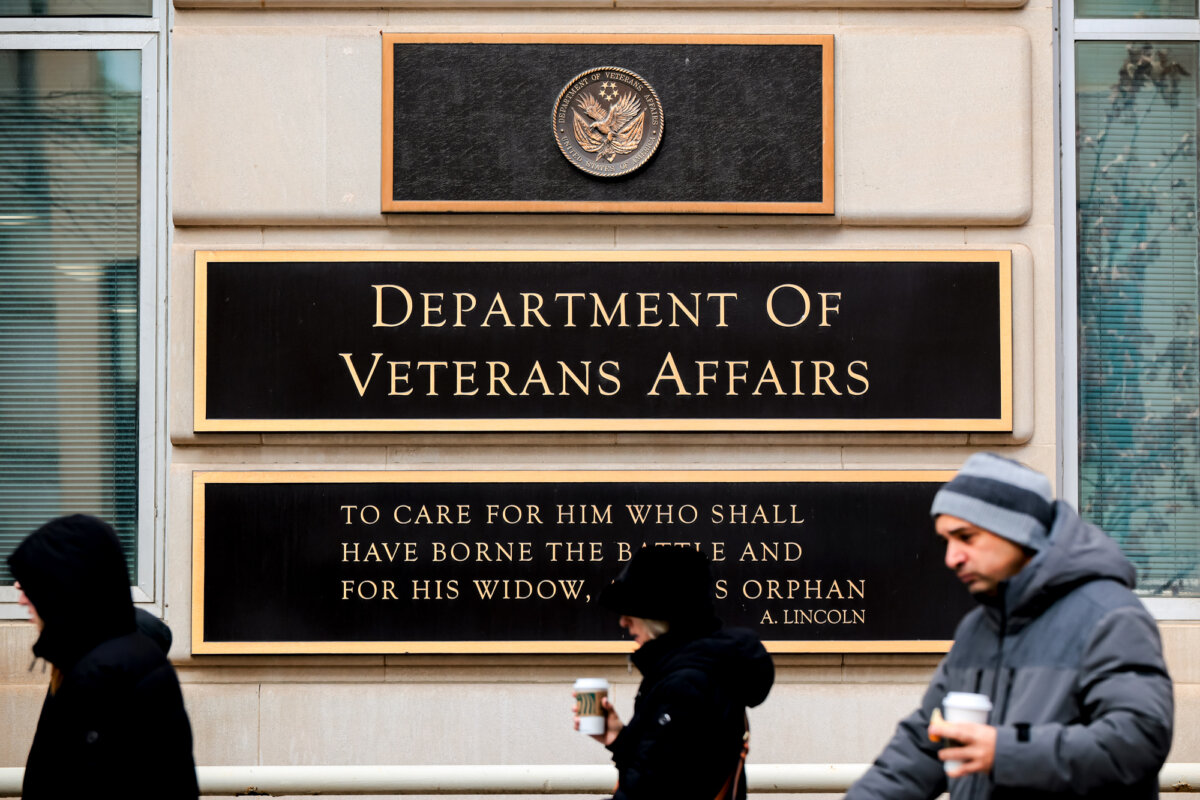

The Department of Veterans Affairs (VA) will shed 30,000 employees by the end of September through attrition, the agency said on Monday, reversing course from earlier plans to cut more than twice that number with involuntary layoffs.
The VA said it is on track to meet its revised workforce reduction goal by the end of the current fiscal year, thereby “eliminating the need for a large-scale reduction-in-force (RIF).”
The department has already shed 17,000 employees since January, and plans to cut another 12,000 through a combination of hiring freezes and voluntary separation incentives, including early retirement offers and “deferred resignations,” which allow employees to remain on paid leave for several months before officially exiting the agency.
The VA emphasized that there are multiple safeguards in place to make sure the cuts will not impact veteran care or benefits. Mission-critical roles are exempt from separation incentives, and more than 350,000 positions are excluded from the federal hiring freeze.
Originally set to end on July 15, the hiring freeze was extended to Oct. 15 under a new memo issued Monday by President Donald Trump.
In March, it was reported that the department had initially planned to shrink its workforce to fiscal year 2019 levels, or just under 400,000 employees. At the start of 2025, the VA employed around 484,000 people, meaning the original plan would have required cutting more than 84,000 jobs.
VA Secretary Doug Collins has said the proposed reductions would streamline bureaucracy without compromising services to veterans. On Monday, however, Collins confirmed that the RIF is no longer on the table.
“Since March, we’ve been conducting a holistic review of the department centered on reducing bureaucracy and improving services to veterans,” Collins said in a statement announcing the decision. “As a result of our efforts, VA is headed in the right direction—both in terms of staff levels and customer service.”
The initial layoff plan drew strong opposition from Congressional Democrats. In April, Sen. Ruben Gallego (D-Ariz.), a Marine Corps veteran, vowed to place a blanket hold on all VA nominees in protest. Gallego was also among the Democrats behind a Senate resolution condemning the proposed cuts, which was later blocked by Senate Republicans.
In response to the reversed plan, Sen. Richard Blumenthal (D-Conn.) and Rep. Mark Takano (D-Calif.), the top Democrats on the Senate and House VA Committees, respectively, issued separate statements expressing dissatisfaction, noting that the department is still pursuing a net loss of employees rather than the net gain typically expected.
“This is still a reduction in force—except VA has been able to do it without accountability and transparency to veterans and Congress,” Blumenthal said.
Meanwhile, Senate VA Committee Chairman Jerry Moran (R-Kan.) praised the move, which he said provides “greater certainty” for both VA employees and the veterans they serve.
“I look forward to hearing more details about potential reorganization plans as VA works in coordination with Congress to right-size the VA workforce,” Moran said in a statement.
Going forward, the VA said it is “exploring a number of additional reforms” to improve operations. These include centralizing administrative support functions across its three major divisions—the Veterans Health Administration, Veterans Benefits Administration, and the National Cemetery Administration—to eliminate “duplicative and costly” operations.
The department is also considering consolidating areas such as procurement, IT, and budgeting to improve efficiency and coordination.
 Friends Read Free
Copy
Facebook
Tweet
Friends Read Free
Copy
Facebook
Tweet