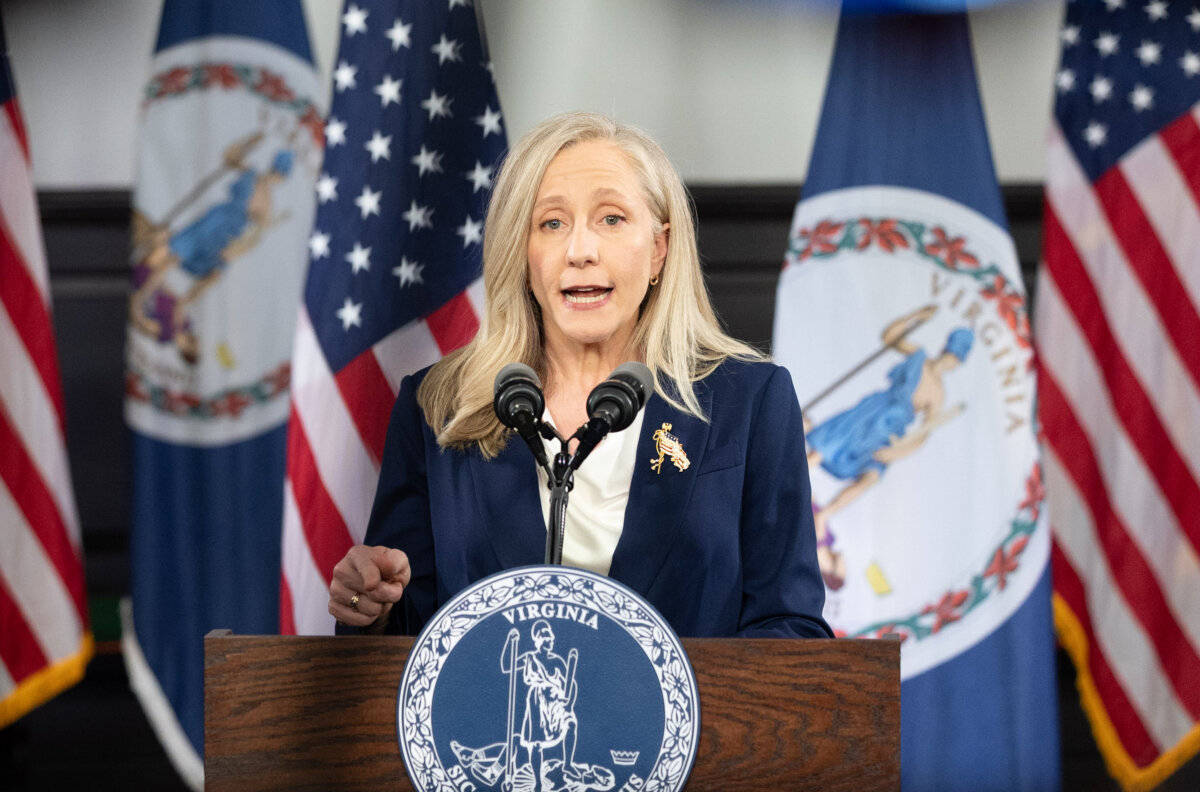

Virginia Gov. Abigail Spanberger is facing criticism from fellow Democrats after she amended or vetoed several bills passed by the Democratic-led General Assembly, including measures on marijuana legalization, immigration enforcement, and gun safety.
On April 15, Spanberger finalized her action on 1,100 bills from the 2026 session—signing 972 into law, amending 180, and vetoing eight. Several of the amended bills were top Democratic priorities, and the changes did not sit well with some of the lawmakers who wrote them.
Sen. Lashrecse Aird (D-Henrico) and Del. Paul Krizek (D-Fairfax), who carried Virginia’s retail marijuana legislation, released a two-page statement on April 14 that said the “substantially rewritten” legislation “falls short of the standard established in the [original] bill.”
The governor’s version delays the start of retail cannabis sales until July 1, 2027, cuts the number of authorized retail stores from 350 to 200, and drops the possession limit from 2.5 ounces to 2 ounces. It eliminates statutory allocations that sent 40 percent of cannabis tax revenues to early childhood care and education and 30 percent to a Cannabis Equity Reinvestment Fund.
The amendments also add new criminal penalties, including a Class 2 felony for transporting marijuana that carries 20 years to life in prison.
“The Governor’s Substitute represents a significant departure from the framework passed by the General Assembly, raising serious concerns about fairness, access and public safety,” Aird said.
Krizek said the amended bill “creates a less accessible legal marketplace” that redirects demand “back to the illicit market.”
Spanberger said the amendments were an effort to “set up a marketplace that is controlled, regulated, and responsible.”
The governor also amended two bills, SB351 and SB352, aimed at limiting cooperation with Immigration and Customs Enforcement (ICE) and requiring federal officers to identify themselves while operating in Virginia. Her changes explicitly allow the Department of Corrections, local sheriffs, and jails to honor ICE detainers and transfer custody of a felon to federal agents.
Sen. Saddam Azlan Salim (D), who sponsored the bills, criticized immigration enforcement operations and said the amendments would make the bills “toothless, a right without a remedy.”
“Virginia should not be complicit in federal overreach, family separation, or the targeting of people simply because of who they are or where they come from,” Salim said in a post on X.
Spanberger said her ICE amendments as setting “the terms of our ongoing collaboration” with federal partners.
Her amendments to several gun bills—including measures banning future sales of so-called assault weapons and restoring universal background checks—added exemptions for certain semi-automatic shotguns used for hunting and softened safe storage requirements to allow a firearm rendered inoperable with a gun lock to qualify as safely stored.
Spanberger also vetoed a bill from Salim that would have prohibited plea agreements from forcing defendants to waive their Fourth Amendment rights, saying it would “limit plea agreement options for defendants and Commonwealth’s Attorneys as they seek negotiated resolutions.”
Criticism has extended beyond Democrats whose bills were rewritten.
State Sen. L. Louise Lucas (D) wrote on X on April 15 that what the governor “has to correct is her policies don’t match her rhetoric from the campaign trail. Her issue is credibility.”
The General Assembly reconvenes on April 22 to take up the governor’s amendments and vetoed bills. A simple majority in either chamber can reject her amendments, sending the original bills back to Spanberger—who would then have to sign them, veto them, or let them become law without her signature.
Overriding her eight vetoes outright would require a two-thirds vote in both chambers. Lawmakers will return the following day for a special session to finalize the two-year budget they failed to pass before adjourning in March.
Spanberger did not respond to a request for comment from The Epoch Times before publication.
 Friends Read Free
Copy
Facebook
Tweet
Friends Read Free
Copy
Facebook
Tweet