
The Pentagon has approved plans to build a dedicated facility for training members of the Qatar Armed Forces in Idaho.
War Secretary Pete Hegseth announced the new facility last week after meeting with Qatar’s defense minister in Washington.
The announcement was met with some skepticism online due to Qatar’s historical ties to several terror groups, but the origins of the project go back several years.
Here’s what we know about the new training facility.
New Training Facility at Existing US Base
The new training facility will be an extension of the Mountain Home Air Force Base, roughly 50 miles southeast of Boise.
Mountain Home AFB is an ideal location for aerial exercises and other military training due to its expansiveness, tucked on a plateau between two mountain ranges.
The base currently houses the U.S. Air Force’s 366th Fighter Wing, nicknamed the “Gunfighters,” and maintains a training facility for a fighter squadron from Singapore.
Both the construction and maintenance of the new facility will be funded by Qatar as part of a 10-year commitment to promote interoperability between the two militaries.
The construction will be done by local companies.
The base and its security as a whole will continue to be managed by the U.S. Air Force, which currently maintains a combined military and civilian staff of about 5,100 people.
Focus on Skills Development for Arms Purchases
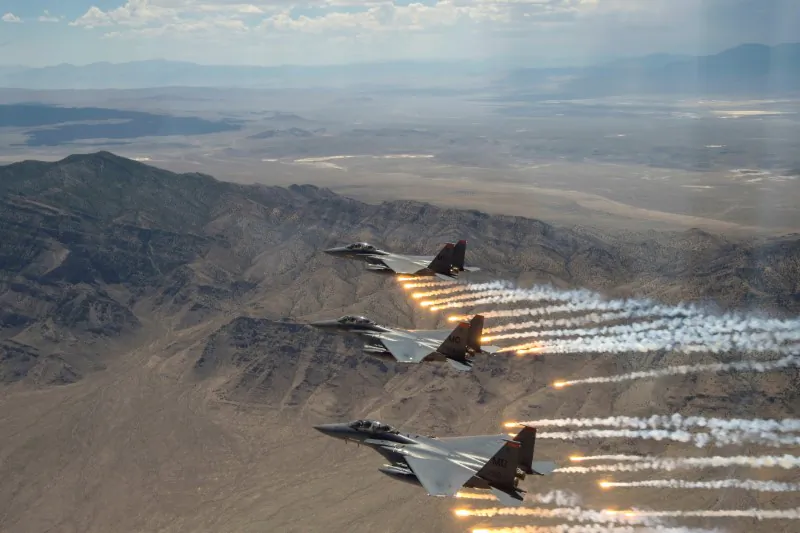
Planning for the facility goes back to 2017, when Qatar purchased 36 F-15 fighter jets from the United States, and went on to spend several billion more dollars on more of the same aircraft throughout the year.
Discussions between Doha and Washington as to how best they could train pilots on the F-15 began not long after the initial purchase.
In 2019, the U.S. Air Force and Qatar’s armed forces held their first joint aerial exercises in Qatar.
That same year, the Air Force identified Mountain Home AFB as a possible site for a new training facility.
The facility proposed in that report would house 12 Qatari F-15 jets and about 300 additional personnel, fitting with the description of the training program given by the Pentagon this week of a small contingent of Qatari pilots.
Qatar’s Connections to International Terror
Popular concern about the new facility stems from Qatar’s historic connections to several terror organizations, including al-Qaeda, Hamas, and the Muslim Brotherhood, as well as its alleged role in helping to finance Iranian state-backed terror groups.
Because of these ties, Qatar has also been accused of providing support to terrorists by other Middle East powers, including Bahrain, Egypt, Israel, Saudi Arabia, and the United Arab Emirates.
Likewise, U.S. President Donald Trump in 2017 described Qatar as “a funder of terrorism at a very high level,” even as the United States moved to ink its sale of F-15s to Qatar.
Trump has since shifted his stance towards Qatar, and last month issued an executive order, titled “Assuring the Security of the State of Qatar,” unilaterally pledging to defend the country with the full might of the U.S. military and to treat any attack on Qatar as an attack on the United States.
“Over the years, the United States and the State of Qatar have been bound together by close cooperation, shared interests, and the close relationship between our armed forces. The State of Qatar has hosted United States forces, enabled critical security operations, and stood as a steadfast ally in pursuit of peace, stability, and prosperity, both in the Middle East and abroad, including as a mediator that has assisted the United States’ attempts to resolve significant regional and global conflicts,” Trump’s order stated.
“In recognition of this history, and in light of the continuing threats to the State of Qatar posed by foreign aggression, it is the policy of the United States to guarantee the security and territorial integrity of the State of Qatar against external attack.”
US, Qatar Increasingly Intertwined
The United States and Qatar have become increasingly intertwined beyond the scope of mere arms sales and training, in large part due to Qatar’s strategy of investing deeply in U.S. defense architecture and lobbying.
Qatar paid to build and currently maintains the Al Udeid Air Base near Doha, for example, which serves as the United States’ military nerve center in the Middle East.
The base can house more than 8,000 service members and hundreds of allied coalition forces.
Qatar underwrites a significant U.S. presence in the Middle East, paying for the United States’ ability to project power into the region.
Recently, Trump has also accepted the gift of a $400 million jumbo jet from Qatar, to be used as the future Air Force One.
 Friends Read Free
Copy
Facebook
Tweet
Friends Read Free
Copy
Facebook
Tweet