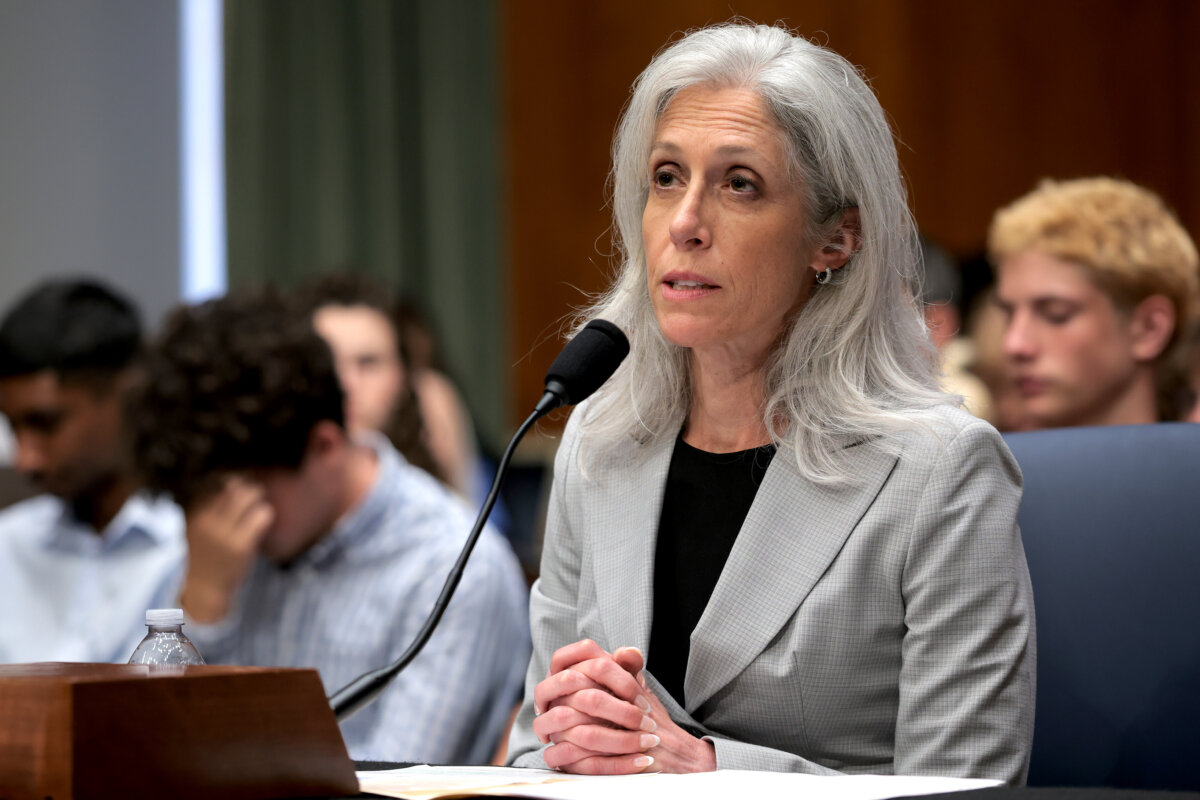

Less than a month after she was sworn in, Centers for Disease Control and Prevention Director Susan Monarez has been fired, the White House announced.
White House spokesman Kush Desai, late on Wednesday, said Monarez was not “aligned with the President’s agenda of Making America Healthy Again.”
Since she had “refused to resign despite informing [Department of Health and Human Services] leadership of her intent to do so, the White House has terminated Monarez from her position with the CDC,” Desai said.
The HHS announced earlier on Wednesday that Monarez was no longer the director of CDC, adding that Health Secretary Robert F. Kennedy Jr. “has full confidence in his team … who will continue to be vigilant in protecting Americans against infectious diseases at home and abroad.”
Mark Zaid, a lawyer representing Monarez, told The Epoch Times in an email on Aug. 28 that a White House staffer notified her that she was fired. He added that Monerez never communicated an intention to resign.
“As a presidential appointee, Senate-confirmed officer, only the president himself can fire her,” he said. “For this reason, we reject the notification Dr. Monarez has received as legally deficient and she remains as CDC director. We have notified the White House counsel of our position.”
“The president fired her, which he had every right to do,” White House press secretary Karoline Leavitt told reporters in a briefing on Thursday.
Monarez, who has a background as a federal government scientist, was President Donald Trump’s second nominee for the role. She was confirmed by the Senate in a 51–47 vote on July 29 and sworn in by Kennedy on July 31.
Former Republican congressman and outspoken vaccine safety advocate Dr. David Weldon was the first nominee. Trump withdrew Weldon’s nomination hours before his scheduled confirmation hearing in March.
Before serving as CDC director, Monarez worked in various positions in HHS and the Department of Homeland Security. She was the first CDC director since 1953 to not hold a medical degree. She received a doctorate in microbiology and immunology.
Lawyers representing Monarez posted on X Wednesday evening that “contrary to govt statements, Dr. Monarez has neither resigned nor yet been fired.”
Lawyers Mark Zaid and Abbe Lowell alleged that Monarez had been targeted after refusing to “rubber-stamp unscientific, reckless directives and fire dedicated health experts.”
“Dr. Monarez has neither resigned nor received notification from the White House that she has been fired, and as a person of integrity and devoted to science, she will not resign,” the lawyers wrote.
Kennedy previously said he handpicked Monarez for the role, describing her as a “longtime champion of [Make America Healthy Again] values.”
Monarez told senators during her confirmation process that she values vaccines, public health interventions, and rigorous scientific evidence. She mostly avoided questions about whether those positions placed her at odds with Kennedy, who for years has questioned the efficacy and safety of vaccines.
“Vaccines absolutely save lives, and if I’m confirmed as CDC director, I commit to making sure that we continue to prioritize vaccine availability,” Monarez told senators in June.
Monarez faced early adversity after taking office. At the end of her first full week on the job on Aug. 8, a Georgia man killed a police officer and fired more than 180 shots into CDC buildings before killing himself. He blamed the COVID-19 vaccine for making him depressed and suicidal.
Kennedy has made multiple changes to vaccine policies since taking office earlier this year.
In recent months, HHS dismissed all 17 members of the CDC vaccine advisory panel, ended the agency’s COVID-19 vaccine recommendations for pregnant women and healthy children, and ordered the removal of mercury from influenza vaccines.
On Aug. 27, before the news about Monarez surfaced, Kennedy announced that federal regulators had revoked emergency authorization for COVID-19 vaccines.
“The emergency use authorizations for Covid vaccines, once used to justify broad mandates on the general public during the Biden administration, are now rescinded,” Kennedy said on X on Aug. 27.
A new document released by the CDC on Aug. 20 reported that a group that advises the agency will review various aspects of COVID-19 vaccines, including concerns about the persistence of messenger ribonucleic acid (mRNA).
The Advisory Committee on Immunization Practices work group on COVID-19 vaccines will review data on the shots related to their safety, effectiveness, and immunogenicity, according to the document.
Members of the work group also plan to look at gaps in existing knowledge “relating to bio distribution, pharmacokinetics, and persistence of the spike protein, mRNA, and lipid nanoparticles to inform immunization recommendations,” the document states.
The group plans to issue new recommendations regarding the shots after reviewing the data and consulting with experts at the CDC, the Food and Drug Administration, and outside the government.
Zachary Stieber, Joseph Lord, Reuters, and The Associated Press contributed to this report.
 Friends Read Free
Copy
Facebook
Tweet
Friends Read Free
Copy
Facebook
Tweet