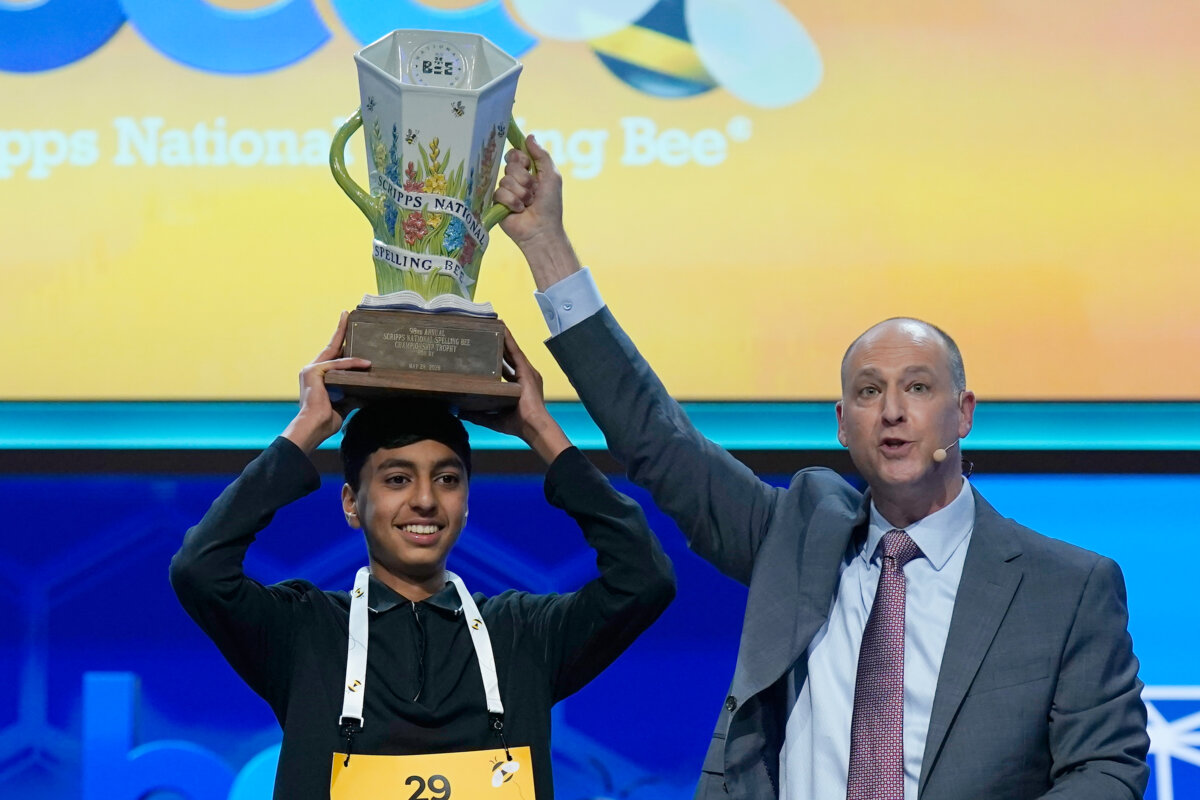

Shrey Parikh, an eighth grader from California, was all business during multiple rounds of the Scripps National Spelling Bee finals May 28, not showing any signs of nervousness, relief, or joy.
He finally flashed a smile when the judges handed him the trophy, which he held over his head as his family joined him on stage.
“When you’re on stage, you always kind of doubt yourself,” he said regarding one word earlier in the night that nearly tripped him up. “I’m glad I really stuck with my gut.”
Other than that, he said, “It was just like another day of spelling for me.”
Parikh finished ahead of 246 peers who also made the trip to Washington for the three-day competition. This was his third and final trip to the finals. He missed last year’s event, finished third in 2024, and 89th in 2022.
Parikh and runner-up Ishan Gupta remained deadlocked past the final round, forcing a spell-off where the winner is decided by how many words they spell correctly in 90 seconds.
Parikh spelled 32 words correctly to claim the $50,000 top prize and an all-expenses paid family vacation to Orlando’s Universal Studios. Gupta spelled 25 and received a $25,000 prize.
Gupta, a seventh grader from New Jersey, competed in last year’s event, finishing 20th. He’s eligible for the 2027 competition.
It was an athletic feat of sorts, like something that would appear on ESPN SportsCenter Top 10 highlights. Both boys looked like machines.
“It’s going to give you even more respect for just how powerful these brains are,” television announcer Paul Loeffler said ahead of the tiebreaker. “The volume of words that these kids have committed to memory is just unreal.”
Ultimately, these students weren’t opponents; they were fellow combatants in a last-one-standing fight against one big, difficult book—the Merriam-Webster dictionary.
Leading up to the event, the competitors spent months looking at the dictionary, learning the origins of words from other countries, including Greek, French, Latin, and even North American Indian tribes, to understand how vowel and consonant combinations work in different languages.
Ahead of the spell-off, Parikh spelled Bhubaneswar, potto, Pluchea, hwyl, Metohija, Telei, and Philepitta. He also provided the correct definition of stymie.
Parikh, who also qualified for a California state-level math competition this year, is a percussionist in his school band and also enjoys tennis, chess, and reading, according to his bio on the event website. His parents called his work ethic “unparalleled.”
The dramatic finish capped off the 101st annual competition.
In recognition of the 100th anniversary, organizations last year called this a strong tradition that has been preserved despite the onset of computers, smartphones, digital learning environments, and artificial intelligence. It’s a living piece of American history, they said, that inspires excellence, curiosity, and connection.
 Friends Read Free
Copy
Facebook
Tweet
Friends Read Free
Copy
Facebook
Tweet