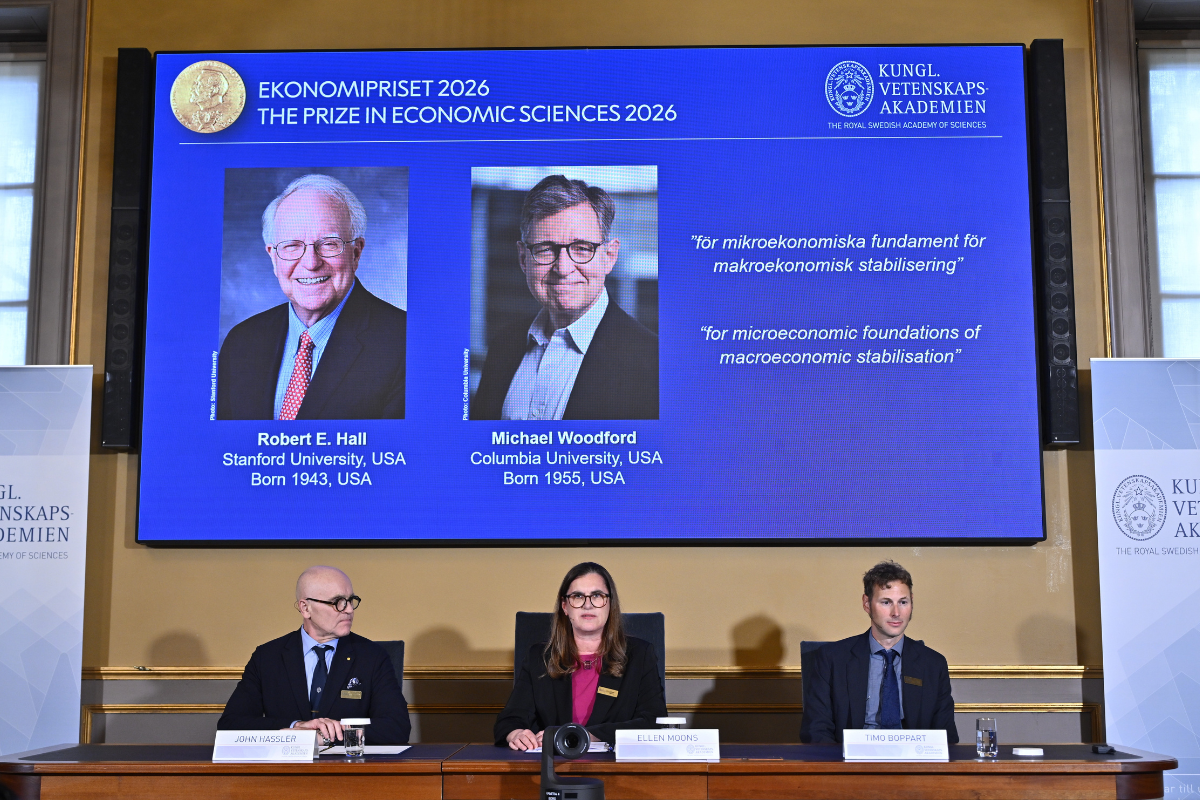

American academics Robert E. Hall and Michael Woodford have been awarded the 2026 Nobel Prize in economics for their work on developing economic models used by central banks to manage economic shocks, such as inflation and energy crises.
The Royal Swedish Academy of Sciences said in an Oct. 12 statement that Hall’s and Woodford’s macroeconomic models were based on a microeconomic understanding of how the actions of businesses and individual households affect the economy, rather than by focusing on top-down theories.
The academy said that central to these models was that businesses and households are “forward looking” when making decisions about purchases or savings. That means if governments communicate economic plans to these groups, they can influence their view of the future and influence the direction of the economy more effectively.
Since their deployment, these new macroeconomic models have been helpful in managing recent economic downturns, the Royal Swedish Academy of Sciences said.
John Hassler, chairman of the Committee for the Prize in Economic Sciences, said in the statement that the laureates’ work has created a foundation for the models now used around the world.
“With them, we are better equipped to deal with shocks in the economy, such as energy crises or sudden changes in how much households consume,” Hassler said.
Hall and Woodford
Hall is an applied economist and professor at Stanford University and previously served as adviser to the U.S. Treasury Department, the Justice Department, and the Federal Reserve Board.
His insight in a 1978 paper that household decisions on consumption are a perfect indicator of their expectations was used by Woodford in a model on how consumption is determined.
Woodford, a professor of political economy at Columbia University, also showed that central banks can suppress or stimulate economic activity by adjusting interest rates, rather than just by the amount of money in circulation.
“Authorities shouldn’t view stabilization of the economy as an exercise that is simply conducted by people pulling levers to control the economy independently of what people in the economy understand about this,” Woodford, 70, said during a press conference.
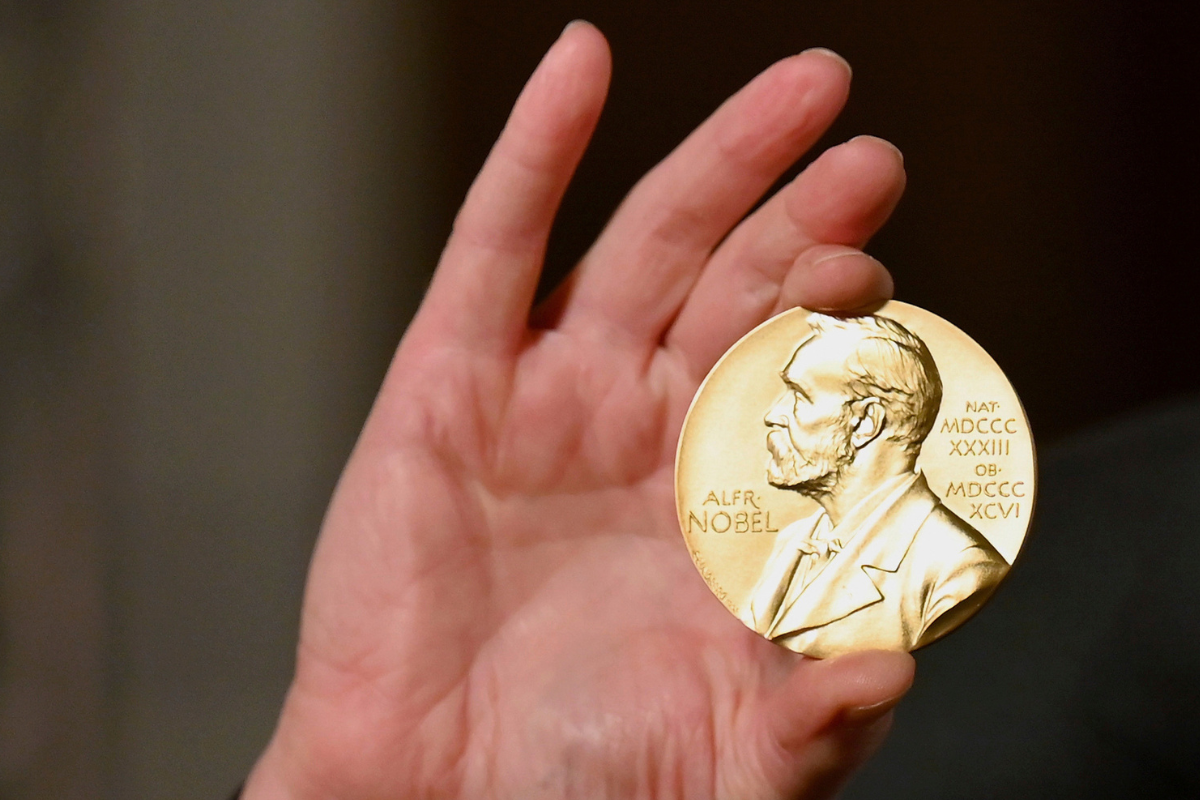 A Nobel medal is held up during a ceremony in New York City on Dec. 8, 2020. (Angela Weiss/Pool Photo via AP)
“Making more explicit statements about the likely future path of interest rate policy, as opposed to relying on simply being able to cut interest rates further immediately, that was an important part of the policy response in the years from 2009 onward,” he said.
Recent Nobel Prize Awards
The economics prize is formally known as the Sveriges Riksbank Prize in Economic Sciences in Memory of Alfred Nobel.
It was established in 1968 by Sweden’s central bank, the Sveriges Riksbank, and was first awarded the following year. It is not one of the original five awards created in the 1895 will of Alfred Nobel, the industrialist famous for inventing dynamite.
The prize is awarded by the Royal Swedish Academy of Sciences, in Stockholm and is worth 12 million Swedish kronor ($1.2 million), which will be split between the two laureates.
It is the last Nobel award to be given out this year, with the prizes for chemistry, literature, medicine, peace, and physics having been announced this past week.
On Oct. 9, the Nobel committee awarded the Peace Prize to South African-born international jurist and former United Nations human rights commissioner Navi Pillay.
Pillay, 85, was at one time Nelson Mandela’s lawyer. She was later elected by the U.N. General Assembly to be a judge at the International Criminal Tribunal for Rwanda, where she served for eight years.
Reuters and Chris Summers contributed to this report.
 Friends Read Free
Copy
Facebook
Tweet
Friends Read Free
Copy
Facebook
Tweet