
News Analysis
In a rare turn of events, a federal cabinet minister has abandoned her post for the second time in less than one year.
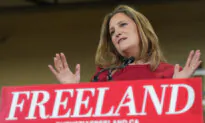
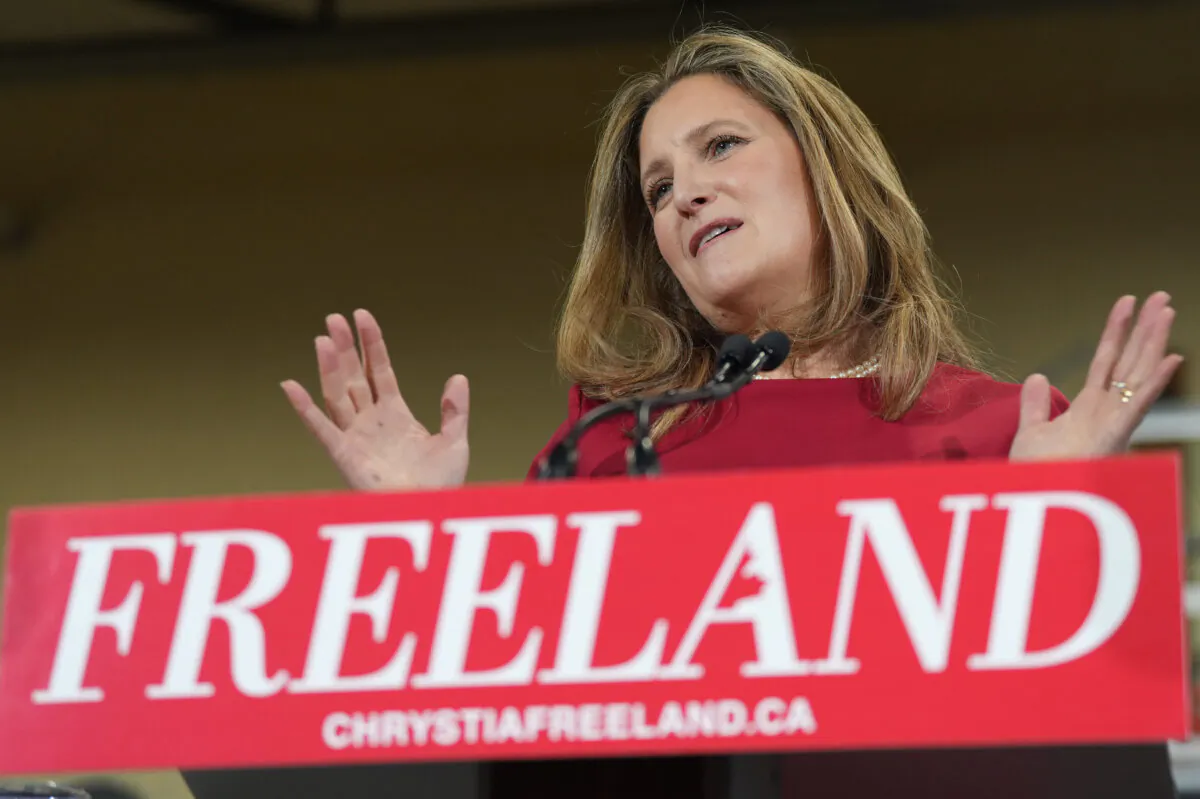
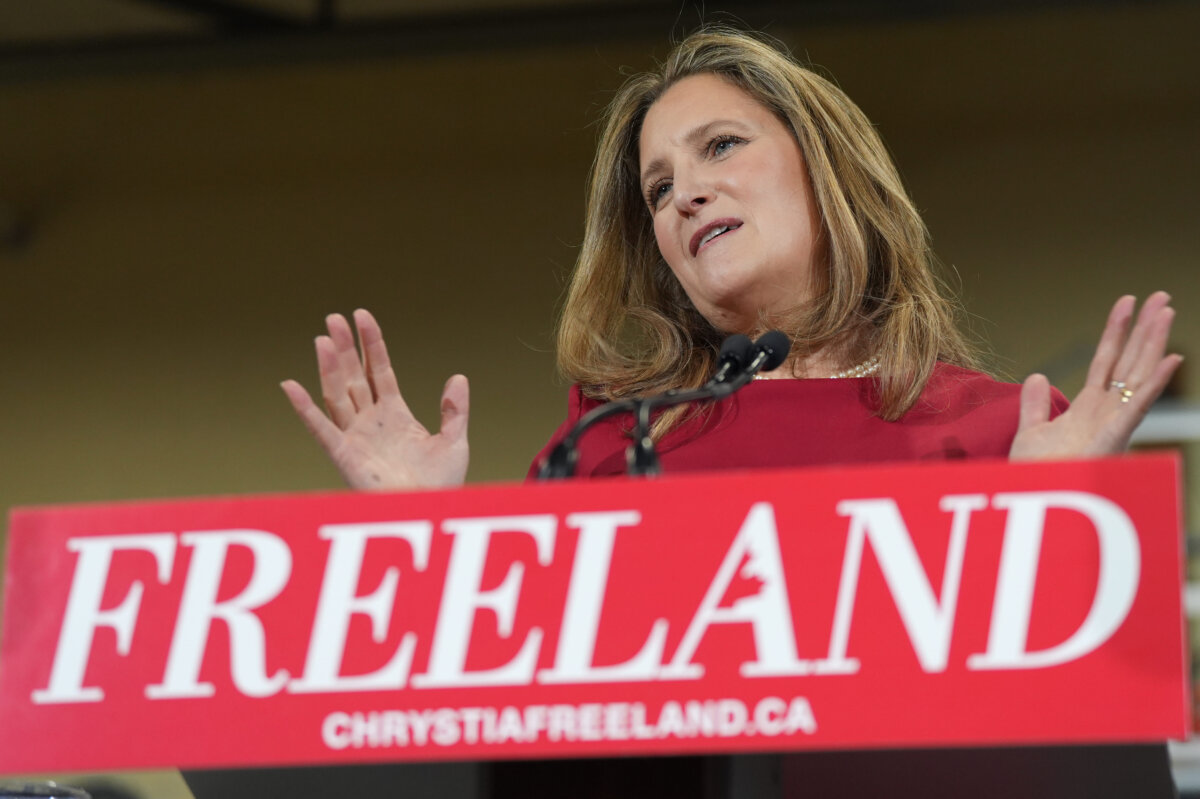
Chrystia Freeland announced on Sept. 16 she is stepping down as minister of transport and internal trade and that she would not be seeking re-election.
Here are some takeaways from the resignation.
Different Approach
This was Freeland’s second resignation from cabinet after taking a similar road in December 2024.
The circumstances appear significantly different this time, however, or at least there’s been a conscious effort to avoid any potential fallout.
Whereas Freeland had dropped a grenade when she resigned from Prime Minister Justin Trudeau’s cabinet, accusing him of being fiscally out of touch, this time she praised her boss Prime Minister Mark Carney.
Instead of only posting a statement on social media to announce her resignation, as politicians typically do, Freeland inserted a photo side-by-side showing her and Carney smiling and hugging.
“Mark Carney is a unifier in a time of crisis, and I have absolute confidence in his ability to lead us through it,” Freeland wrote in her Sept. 16 statement.
In comparison, on Dec. 16 last year, Freeland said she no longer had the confidence of Trudeau to continue as minister. “For the past number of weeks, you and I have found ourselves at odds about the best path forward for Canada,” she wrote.
Not for Family
Very often when politicians leave public office, they cite family reasons. It was the case for Nova Scotia Liberal MP and now-Justice Minister Sean Fraser when he announced, on the same day as Freeland last year, that he was stepping down as a cabinet minister and not seeking re-election.
“I can tell you, more than anything else, I want to spend more time with my kids, and I hope my kids are spending more time with me,” he said at the time, abandoning the housing portfolio after having also served as immigration minister.
Somewhere along the way, between Trudeau announcing his resignation in early January and Carney winning the Liberal leadership race in March, Fraser changed his mind and decided to run in the April 28 election.
Freeland made sure to tell Canadians that her latest resignation is not about seeking to be closer to family, and neither is it due to the pressure of ministerial work.
“I am not leaving to spend more time with my family or because the burden of elected office is too heavy to bear,” she wrote. “For me and for my wonderful husband and children, public service has been a privilege and not a sacrifice.”
Ukraine Envoy
Freeland did not say in her statement what she would be doing next. She only said that “now is the right time for me to make way for others and to seek fresh challenges for myself.”
Clarification about her future came by way of the prime minister, who said he asked Freeland to fill in a new foreign affairs role.
“I have asked Chrystia to serve as Canada’s new Special Representative for the Reconstruction of Ukraine, in addition to her responsibilities as a Member of Parliament,” Carney wrote in a statement thanking Freeland for her service.
Freeland is of Ukrainian descent and she had been instrumental in not only leading Canada’s response to Russia’s invasion of Ukraine in 2022, but also playing a role on the international stage to impose sanctions on Moscow.
It is not yet clear what the new envoy role will entail.
Lower Interest
Freeland’s latest position as the minister of transportation and internal trade, compared to her time as deputy prime minister, comes with less attention and rank compared to being No. 2. It is also a less important portfolio in the government hierarchy than her previous positions as minister of finance or foreign affairs.
Freeland stayed a good team player after pulling the pin on Trudeau. She did not cause additional stir after her bombshell resignation and she waited for the Liberal leadership race to attempt a shot at the highest office in the land.
Her campaign landed her in a distant second in a race won by Carney by a landslide in March. Shortly after, she was appointed to the prime minister’s first cabinet. Even though she had previously served in finance and foreign affairs, those two departments went to other veteran Trudeau ministers.
Freeland nonetheless was given a role that was a key part of Carney’s economic agenda for the country when it comes to removing internal trade barriers in the face of U.S. tariffs.
The Liberal government successfully passed in June its One Canadian Economy act to remove federal barriers to internal trade.
Key Moments
Freeland, who worked as a journalist before politics, is leaving cabinet after having gone through many major moments in recent Canadian history.
“We did big things together. We signed a trade deal with Europe, we renegotiated NAFTA, and we got tariffs on steel and aluminum lifted,” she said. “We saved lives, protected workers and businesses, and got through a pandemic while maintaining Canada’s essential Triple-A credit rating and the lowest debt and deficit in the G7.”
Much ink has been spilled in recent months about the trade conflict with the United States, with Liberals calling it an “existential crisis.” The tone has now changed as dominoes have fallen into place to reveal that, according to Carney, Canada already has the “best deal” possible with the United States.
This is because the vast majority of trade between the two countries is tariff-free due to the Canada-United States-Mexico free trade agreement (CUSMA). U.S. President Donald Trump has imposed a 35 percent tariff on Canada, due to concerns about poor efforts to counter fentanyl trafficking, but most goods are exempt under a CUSMA exception.
That deal was negotiated when Freeland was minister of foreign affairs and Trump was in his first term as president. There was no lost love between the two, with Freeland saying Trump was a “bully” during negotiations. When Freeland resigned last December, Trump said it would now be easier for Canada to strike a deal and that “She will not be missed!!!”
Freeland was appointed finance minister after the resignation of Bill Morneau in August 2020. Morneau stepped down as he was under an ethics probe in relation to the WE Charity controversy. He was also at odds with Trudeau over pandemic spending.
As the pandemic arrived, the massive government spending that came with it occurred during Freeland’s tenure, as did the rise in inflation afterwards.
In 2022, Freeland had a key role in Ottawa’s response to the Freedom Convoy protest against COVID-19 policies such as vaccine mandates. One measure implemented by the finance department under the Emergencies Act involved ordering the freezing of protesters’ bank accounts.
Freeland’s resignation in December 2024 over calls for more responsible fiscal policy set in motion a chain of events that culminated in Trudeau’s resignation.
Freeland launched her unsuccessful bid for the leadership of the Liberal Party in January, shortly after Trudeau said he intended to resign.
As part of Carney’s cabinet, Freeland’s department as trade minister and ministers of internal trade was also a key part of his key legislation meant to remove federal barriers to internal trade, the One Canadian Economy act, which was passed this summer.
 Friends Read Free
Copy
Facebook
Tweet
Friends Read Free
Copy
Facebook
Tweet