News Analysis
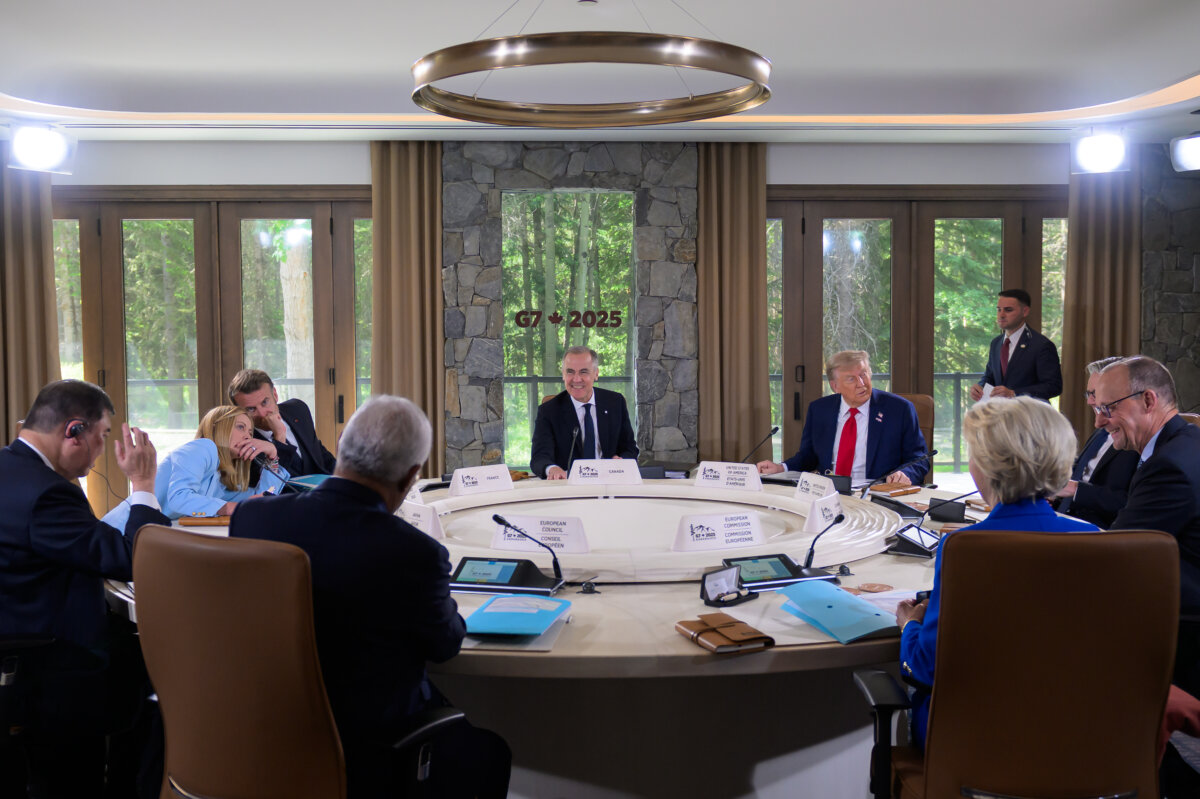
It was expected that U.S. President Donald Trump’s attendance at the G7 Summit in Kananaskis, Alberta, would loom large, and the predictions did not disappoint.
Trump’s participation in the summit was notable both for what he said and what he didn’t say by way of a statement, as well as for his early departure.
The summit was also an occasion for Trump and Prime Minister Mark Carney to provide an update on the state of their negotiations to reach a deal on trade and security.
The visit by another world leader, Indian Prime Minister Narendra Modi, also marked a shift in relations between Ottawa and New Delhi.
30 Days for a Deal
Talks between Carney and Trump on reaching a trade agreement have been ongoing since late March but had not progressed far enough to announce the new terms during the president’s visit to Canada.
Trump has imposed three sets of tariffs on Canada since taking office in January, which has been met by similar counter measures by Ottawa.
Even though there was no breakthrough during the G7 summit, both sides signalled being close to reaching a deal. Trump said reaching an agreement within days or weeks is “achievable,” whereas Carney’s office said the two leaders had agreed to come to terms “within the coming 30 days.”
The negotiations have been broader than trade, given that Trump’s tariffs were imposed on national security grounds. Carney, who had campaigned during the election by repeating that the “old” relationship with the United States was over, has been aiming to form a “new economic and security partnership” with the country.
Trump said at the summit that negotiations have hit a stumbling block due to the two leaders’ “different concepts” around trade: He supports tariffs, while Carney has a “more complex idea.”
Speaking after his early departure from the summit, Trump cautioned against being “too complex,” because complicated deals tend to “never get done, and we need speed.”
Asked about the matter during his post-summit press conference, Carney said “complexity is in the eye of the beholder.” He added that Canada and the United States have some mutual interests around security, defence, and commercial prosperity, but that his government would only agree to “those things that are fundamentally in the interests of Canada.”
Trump Leaves Early
Carney had the opportunity to hold a bilateral meeting with Trump, but the same cannot be said for leaders of other countries invited to attend the summit.
At the end of the first day and after the leaders’ dinner, Trump departed for Washington to deal with the Israel-Iran war. He told reporters on the flight back that doing so would make him better informed and would avoid using telephones. “Being on the scene is much better,” he said.
During the press conference, Carney said it’s hard to deal with a military crisis and that he understood Trump’s decision of wanting to do so from the U.S. capital. “It’s an exceptional situation,” he said.
After leaving, Trump told reporters on Air Force One that he had accomplished all he wanted at the G7 summit, noting the signing of a trade deal with the United Kingdom. “We went very far down the line with a lot of deals,” he said, adding his country had a “good G7.”
The first day of the summit was reserved for G7 countries and representatives of the European Union, while the second day included outreach leaders from invited countries and international organizations.
Mexican President Claudia Sheinbaum had been invited to attend and expected a bilateral meeting with Trump, which would have been the first in-person meeting between the two. Mexico has faced the same U.S. tariffs as Canada, including those related to Trump’s concerns with the border and drug trafficking.
An in-person meeting was not possible, but Sheinbaum said on June 17 she had a phone conversation with Trump, who told her he had to leave urgently to address the situation in the Middle East.
“We agreed to work together to quickly reach an agreement on various issues of concern to us today,” she said on social media.
Trump also had a call with Indian Prime Minister Narendra Modi instead of meeting with him in Kananaskis.
India Reset
Modi’s attendance at the summit, aside from Trump’s, was the most impactful for Canada. It was also the most controversial, given that ties have been strained since Ottawa accused New Delhi in late 2023 of being involved in the assassination of pro-Khalistan activist Hardeep Singh Nijjar in Vancouver.
Ottawa stepped up the pressure last year with the expulsion of six Indian diplomats, including its high commissioner, saying they were “persons of interest” in the Nijjar case.
India called the allegations “politically motivated” and criticized Canada for being a safe haven for anti-India activities from pro-Khalistan activists, who seek to carve out an independent state in India. New Delhi responded by expelling six Canadian diplomats, including its acting high commissioner.
Carney’s invitation to Modi to attend the summit signalled that Canada was willing to move past the conflict and rebuild diplomatic relations with India. And that’s precisely what happened: The two leaders agreed to appoint new high commissioners and return to regular services in diplomatic missions in both countries.
Ahead of the bilateral meeting between the leaders on June 17, Carney noted the “importance” of Modi’s leadership and said some of the issues that they can tackle together include energy security, energy transition, and the “fight that we have against transnational repression, against terrorism.”
Canadian authorities say that India has allegedly been conducting transnational repression on Canadian soil, while Carney’s reference to countering terrorism was likely meant to signal that Canada understands India’s concerns about separatists willing to use violence.
Modi, for his part, called the relations between the two countries “extremely important” and said they should work to achieve a “win-win cooperation in several areas.”
“We can strengthen humanity if we work together to optimally utilize all our resources,” he said, speaking through an interpreter.
After the meeting, Carney said the two had discussed the importance of having a law-enforcement-to-law-enforcement dialogue and of addressing transnational repression.
“Obviously, there is a judicial process that’s underway, and I need to be careful about further commentary,” he said. Suspects in the Nijjar case have been apprehended.
The Khalistani issue and India’s involvement in transnational repression is discussed in the 2024 annual report from the Canadian Security Intelligence Service (CSIS), which was released publicly the day after the G7 summit.
It says CSIS only considers a “small group” of individuals as Khalistani extremists because they “continue to use Canada as a base for the promotion, fundraising or planning of violence primarily in India.”
“Real and perceived Khalistani extremism emerging from Canada continues to drive Indian foreign interference activities in Canada,” the report says.
No Joint Statement on Ukraine
Ukrainian President Volodymyr Zelenskyy is another leader who had been invited to the summit but didn’t manage to get face time with Trump after he left early.
The two leaders have had a complicated relationship, which unravelled in front of world cameras when Zelenskyy visited the White House in February. Ties have since been mended, but progress on reaching a peace deal with Russia has stalled.
Zelenskyy arrived in Canada after a fresh attack by Russia involving hundreds of drones and dozens of missiles targeted the Ukrainian capital.
The Ukrainian president intended to discuss with Trump the sanctioning of Russia, weapons purchases, and his country’s proposed free-trade deal with the United States.
The day before Zelenskyy’s arrival in Kananaskis, Trump criticized Russia’s removal from the G7, which took place in 2014 after Russia invaded Crimea. Trump said the broader war would not have occurred had President Vladimir Putin been at the table and if he had been U.S. president when Russia invaded in 2022.
“It was a mistake in that you spend so much time talking about Russia, and he’s [Putin is] no longer at the table, so it makes life more complicated,” he said.
Zelenskyy received support from the other G7 countries, along with a $4.3 billion pledge in assistance from Canada, but the leaders did not issue a joint statement on Ukraine as they did on other issues.
Carney downplayed that when asked about it during his post-summit press conference. He said the lack of statement on Ukraine doesn’t say anything about the G7’s unity on the matter and that there was no issue with the United States specifically.
He remarked that his own statement as G7 chair contains language on Ukraine which had been discussed by all of the leaders at the dinner on June 16.
“If you want a nuance, or if you want a sense, there would be things that some of us, Canada included, would say above and beyond what was said in the chair’s summary,” Carney said, implying that some members, probably the United States, had an influence on his statement.
Carney’s summary says the G7 leaders have “expressed support for President Trump’s efforts to achieve a just and lasting peace in Ukraine.” It adds that Ukraine has committed to an unconditional ceasefire and that Russia must do the same, and that G7 leaders are looking at all options to increase pressure on Russia.
Carney said that with the “tragic and intense” events in the Middle East, it was “more important in a sense to have a G7 statement on the Iranian situation.”
Statement on Iran
G7 countries have not been united on the issue of Gaza, as the United States has maintained its support for Israel while countries like Canada, France, and the United Kingdom have been more critical.
They have found some consensus on another front recently opened by Israel, as it targets Iran’s top military leadership and its nuclear program. The two countries have been attacking each other with bombs and missiles since Israel launched its first strike on June 12.
In a June 16 statement, the G7 leaders stated their support for Israel’s right to defend itself and accused Iran of being the “principal source of regional instability and terror.”
Israel has been in open conflict with some of Iran’s main proxies in the region.
After Iran-backed Hamas conducted raids inside Israel in October 2023, Israel has been seeking to eliminate the group in the Gaza Strip. Israel has also dealt a massive blow to the Iran-supported Lebanese Hezbollah by decimating its top leadership and taking down its military infrastructure along the border with Israel.
The G7 statement also says the group’s leaders have been “consistently clear that Iran can never have a nuclear weapon.”
The U.S. administration has been making the same argument based on President Trump’s stance on Iran’s nuclear program, as Trump considers the potential use of U.S. military resources to join Israel’s strikes on Iran’s nuclear sites.
“POTUS has been amazingly consistent, over 10 years, that Iran cannot have a nuclear weapon,” Vice President J.D. Vance wrote on X on June 17, seeking to address “a lot of crazy stuff on social media.”
Given that Trump has always touted his record of not starting new wars and had campaigned on pulling U.S. troops away from foreign conflicts, talk of getting involved in the Iran attacks has created turmoil in the president’s base.
“He may decide he needs to take further action to end Iranian enrichment,” Vance added. “That decision ultimately belongs to the president. And of course, people are right to be worried about foreign entanglement after the last 25 years of idiotic foreign policy.”
Israel’s attack came after expiration of Trump’s deadline of 60 days given to Iran to make a deal on the nuclear issue. It also followed the International Atomic Energy Agency’s resolution issued June 12 stating that Iran was not complying with its non-proliferation obligations.
G7 leaders also issued statements on securing critical minerals supply chains, countering transnational repression, and the adoption of artificial intelligence (AI).
Reuters contributed to this report.
 Friends Read Free
Copy
Facebook
Tweet
Friends Read Free
Copy
Facebook
Tweet