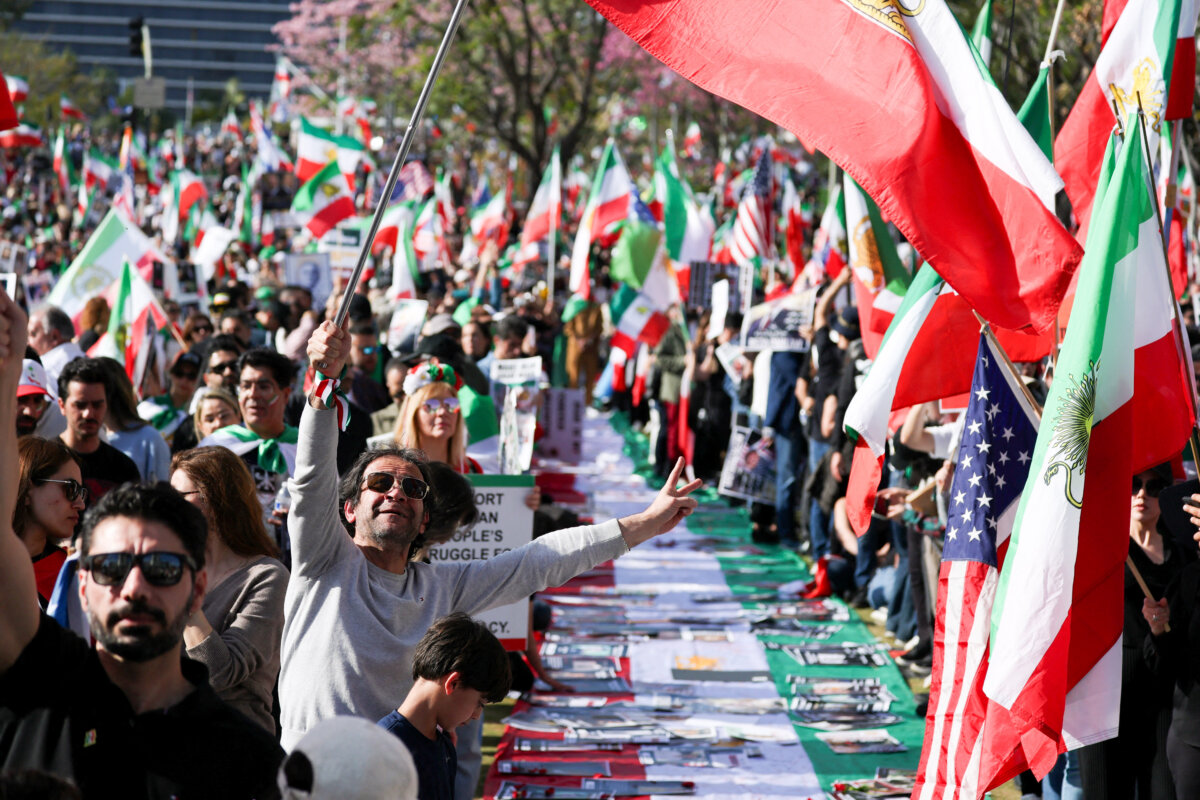
More than one million Iranians rallied in major cities around the world on Feb. 14 in what organizers described as a “Global Day of Action,” marking one of the largest coordinated diaspora demonstrations in recent years.
The protests, spanning Toronto, Los Angeles, Munich, and other cities worldwide, were sparked by a call from Iran’s exiled crown prince Reza Pahlavi, urging Iranians abroad to unify in support of those in their homeland.
“1M+ protesters came out in solidarity with the Iranian people,” Pahlavi wrote on X on Feb. 15. “They are not asking the world to fix the regime but to bury it.”
For policymakers and observers, the scale and coordination of the protests signal more than diaspora activism. They suggest a broad and increasingly unified Iranian opposition that could create a new opportunity for Western policymakers.
“Today, no one is more credible than Prince Reza Pahlavi to explain to policymakers around the world that the Iranian people are facing a government that oppresses them and threatens regional and global security,” Bijan Kian, a national security expert and former Trump administration official, told The Epoch Times. He described the moment as a rare opening for policy recalibration.
A Moment of Unusual Unity
In Munich, police estimated 250,000 people gathered Saturday as world leaders assembled nearby at the Munich Security Conference.
In Toronto, Canadian police provided early estimates of up to 350,000 participants, describing the event as one of the largest such demonstrations in the city’s history.
And in Los Angeles, authorities reported similar numbers.
The gatherings were peaceful and protesters handed flowers to police officers. Alongside American, Canadian, German, and Israeli flags, one symbol dominated: the historic Lion and Sun flag of Iran.
Pahlavi also called on people in Iran to join the protests from afar on the evenings of Feb. 14 and 15, and “raise your voices from your homes and rooftops: shout your demands, cry out your will, and show your unbreakable unity,” he urged.
In video posted on X by Iran International, Iranians could be heard chanting slogans including “death to the dictator” and “long live the king” from homes and rooftops Saturday night in response to Pahlavi’s call.
In Munich, Pahlavi told supporters: “Know that you are not alone. Your voice has reached the world.”
He described the current period as a decisive phase, quoting a slogan heard inside Iran: “This is our final battle.”
For decades, Iran’s opposition has been divided by ideology, ethnicity, and political history. Pahlavi said what makes the present situation different is an unprecedented convergence among opposition forces around shared national principles.
A broad spectrum of Iranians now agree on core foundations for the country’s future, he said: territorial integrity, secular governance, democratic choice through free elections, and the protection of individual rights and civil liberties.
Pahlavi described the alignment as a historic turning point, emphasizing that the movement is no longer focused on past rivalries, but on building a common future for Iran.
From Threat to Opportunity
At the Munich Security Conference, Pahlavi framed the Islamic Republic as a primary driver of regional instability and suggested that removing its repressive structures could fundamentally alter Tehran’s threat profile. The West could have a very different strategic relationship with a post-regime Iran, he said. Iran could go from being a permanent security liability to being a potential strategic partner.
The annual gathering of world leaders to discuss international security policy was held Feb. 13–16. Representatives of the Iranian government were disinvited after the regime’s violent crackdown on protesters, and Pahlavi was invited to attend the conference.
Kian expressed that view as well, arguing that the regime poses risks not only to its own people and to Israel—its primary ideological enemy—but also to Europe and the United States.
“This is a regime that came to power through hostage-taking and has sustained itself through repression and violence,” he said.
Kian voiced hope that the Munich conference would produce positive outcomes for Iranians who, in his words, are mourning but determined. “They are standing firm and they believe they will prevail,” he said.
Meanwhile Iran’s Foreign Minister, Seyed Abbas Araghchi, criticized the Munich Security Conference over its handling of Iran-related discussions. In a post on X on Feb. 14, Araghchi described the event as having turned into a “Munich Circus” on the issue of Iran.
In another post on Saturday, he argued that the European Union has misread developments inside Iran and lost geopolitical influence in the region.
For Washington and Brussels, Pahlavi’s framing carries implications. A post-Islamic Republic of Iran, proponents argue, could reduce regional proxy warfare, stabilize energy markets, become a counterweight to extremist movements, open one of the largest untapped economies in the Middle East, and reorient regional diplomacy toward coexistence, including normalized relations with Arab neighbors and Israel.
The debate is no longer only about containing Iran, but about what could happen if the political system changes.
A Symbol of Separation
The Lion and Sun flag seen at the demonstrations waved over Iran prior to the 1979 Islamic Revolution. After the revolution, the Islamic Republic replaced it with the current flag.
For many protesters, the Lion and Sun flag reflects Iran’s identity before the present political system. By carrying the flag, demonstrators proclaimed a difference between the Iranian nation and the current ruling authorities.
In several cities, activists tried to raise the Lion and Sun flag at Iranian embassies as a symbol that they belong to the Iranian people, not only to the government in power.
Some Iranians have adopted the Lion and Sun as a personal statement of patriotism—one that risks death.
Majidreza Rahnavard was executed in Iran in 2022 during nationwide protests following the death in police custody of Mahsa Amini. Rahnavard had the Lion and Sun emblem tattooed on his left arm, London-based political analyst Shahran Tabari told The Epoch Times.
Iranian authorities built a false case against Rahnavard, Tabari alleged. The 23-year-old was executed after a brief trial, on what Tabari described as politically motivated charges. In video before his execution, Rahnavard’s left arm was seen to be heavily bandaged and in a cast.
Tabari said Rahnavard lost his life in the struggle for freedom in Iran.
Although millions in Iran now have limited internet access, that struggle and the question of national identity has found its way into global digital spaces.
Central to the debate is the Iranian flag. In January, X changed Iran’s official flag emoji from the post-1979 Islamic Republic flag to the historical Lion and Sun. The move evoked outrage from Tehran, and ultimately resulted in official Iranian accounts removing the emoji altogether.
Strategic Calculation
Security analyst Shahram Kholdi, a specialist in security studies and international relations, told The Epoch Times the current military buildup in the region—which provides the United States with an array of options—could change decision-making in Washington.
“From a military point of view, the forces now in place seem enough for an operation,” Kholdi said.
In line with that prediction, U.S. President Donald Trump on Feb. 19 gave the Islamic regime a 10 to 15 day deadline to make a deal over its nuclear program, warning that “really bad things” would happen if it does not comply.
Kholdi suggested that any external strike could intersect with internal disruption, potentially producing a decisive shift.
There may be serious talks happening behind the scenes about a possible exit plan for Iran’s top leadership, he said. Options such as relocation to Russia or China may be under discussion. “It is not in anyone’s interest to see another 50,000 people killed or the country fall into civil war,” he said.
“In the end,” Kholdi said, “it depends on whether President Trump decides to authorize an attack that could change the situation.”
For Western governments long accustomed to viewing Iran primarily through the lens of nuclear negotiations and regional conflict, the Feb. 14 demonstrations introduced a new variable: a globally coordinated Iranian movement presenting itself as a political alternative.
Whether Washington opts for cautious distance or active recalibration remains to be seen. But the protests suggest Iran’s future may increasingly be shaped not only by its ruling establishment, but by a mobilized and increasingly unified civic opposition.
 Friends Read Free
Copy
Facebook
Tweet
Friends Read Free
Copy
Facebook
Tweet