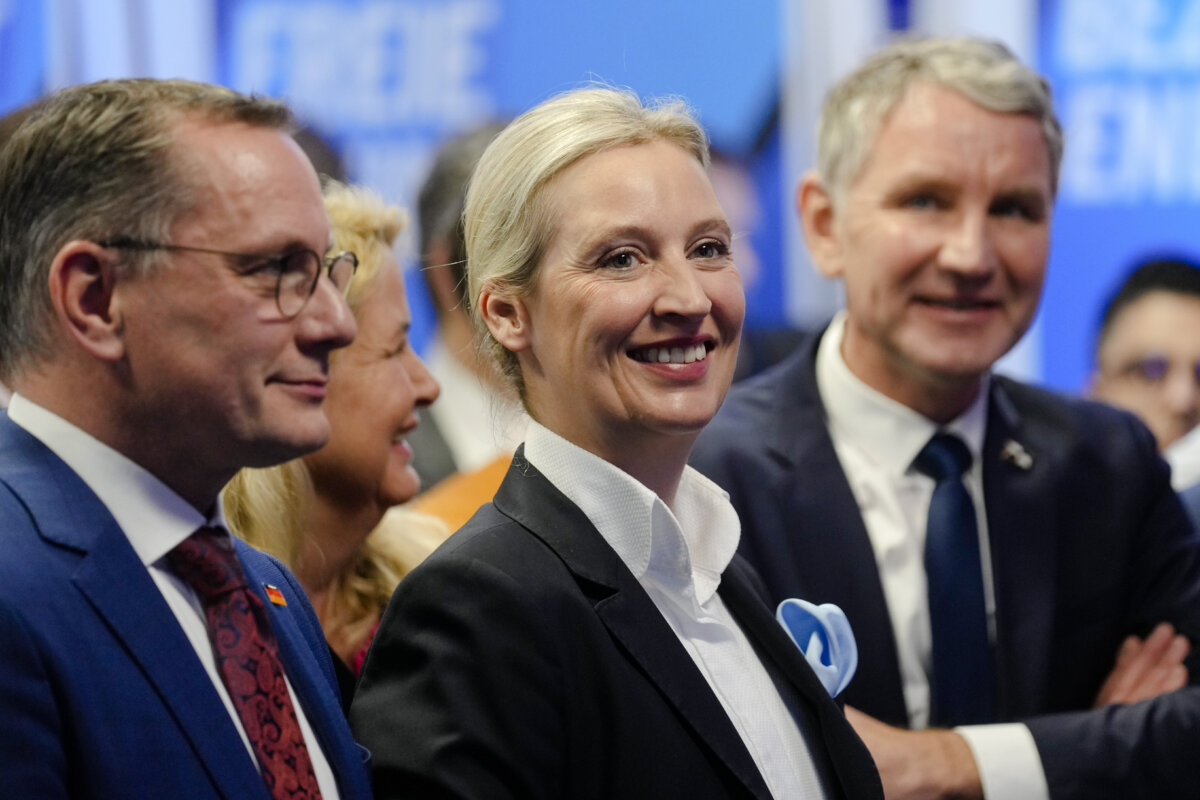

Local elections in North Rhine-Westphalia, Germany’s most populous state and industrial heartland, have resulted in almost a tripling of votes for the conservative Alternative for Germany (AfD) party, initial forecasts show.
The result is a key test of Chancellor Friedrich Merz’s coalition with the progressive Social Democrats (SPD) in his home state.
Forecasts from pollster Infratest dimap after voting ended on Sept. 14 in North Rhine-Westphalia’s local government elections, which cover councils, district assemblies, and mayors, showed that support for the AfD, an anti-illegal immigration party, has nearly tripled to 14.5 percent since 2020.
Merz’s CDU conservatives remained the strongest party, scoring 33.3 percent of the vote, roughly the same level as five years ago. SPD slipped to 22.1 percent from 24.3 percent, according to initial forecasts.
In Germany, election results are usually published in preliminary form on election night before final counts are confirmed.
According to official 2022 statistics, about 18.1 million people live in the region, which was once the industrial engine of the nation and the traditional stronghold of the SPD.
A post-industrial city in the region, Gelsenkirchen, has a large immigrant population and some of the highest rates of unemployment in the country.
“This is a major success for us,” AfD co-leader Tino Chrupalla said on X on Sept. 14. “We are a people’s party and we all bear great responsibility for Germany.”
AfD co-leader Alice Weidel said on X that the election was a huge success.
“According to initial forecasts, the AfD’s result in NRW has tripled. Sincere thanks to all our campaigners and our voters!” Weidel said.
The AfD came second in Germany’s national parliamentary elections, earning nearly 21 percent of the vote.
In August, the AfD became the most popular party in the country, according to a poll.
AfD’s policies include strong support for traditional marriage between a man and woman, the preservation of national independence in the face of the European Union’s increasing power, the preservation of German culture amid European integration and Islamization, and strong border security, including the expulsion of illegal immigrants.
In 2024, the party made an unprecedented breakthrough in state elections, emerging as the dominant political force in eastern Germany, securing nearly 33 percent of the vote in Thuringia and almost 31 percent in Saxony.
Writing in The European Conservative on Sept. 13 ahead of the vote, Richard Schenk, a research fellow at think tank MCC Brussels, said that the SPD routinely scored more than 50 percent in local elections in the Ruhr region in North Rhine-Westphalia.
“Today it struggles to hold 25 percent,” he said.
He said that the region never recovered from the collapse of the coal and steel industries.
He also said that all mainstream parties in Germany, except for the AfD, had signed a Fairness Agreement pledging not to talk about immigrants in connection with “negative social developments such as unemployment or threats to domestic security.”
“Yet this approach is disastrous, handing the AfD a monopoly on an issue that voters plainly care about,” Schenk said.
Merz has said his party will not form a government with the AfD, even though doing so would ensure a clear majority. The CDU is currently in a coalition deal with the SPD.
Germany’s economy, the largest in Europe, has experienced two years of contraction and is expected to broadly stagnate in 2025, according to an EU Commission macroeconomic forecast.
The country has gone through a major population shift; its net population increased by more than 3.5 million between 2014 and 2024, driven entirely by migration.
During this period, the number of German citizens fell by 2 million to 71.6 million, while the foreign population grew to 13.1 million from about 7.5 million, German Federal Statistical Office data show.
In 2015, under Chancellor Angela Merkel, more than 1 million refugees, many of them from Syria, as well as Afghans and Iraqis, arrived in Germany.
The AfD is locked in an ongoing legal battle with the state to avoid being branded an “extremist” right-wing movement.
The label was imposed on AfD by Germany’s domestic intelligence agency on May 2, only to be paused amid the transition to a new power-sharing government following a legal challenge.
The label means that the AfD became subject to the German domestic intelligence service’s highest tier of domestic intelligence monitoring.
The AfD’s Young Alternative youth wing in Thuringia was separately classified as “right-wing extremist” in March 2024. A German court ruled in January 2025 that AfD Saxony can also be designated as a right-wing extremist group by authorities.
The AfD’s joint leaders have denied that the party is extremist.
 Friends Read Free
Copy
Facebook
Tweet
Friends Read Free
Copy
Facebook
Tweet