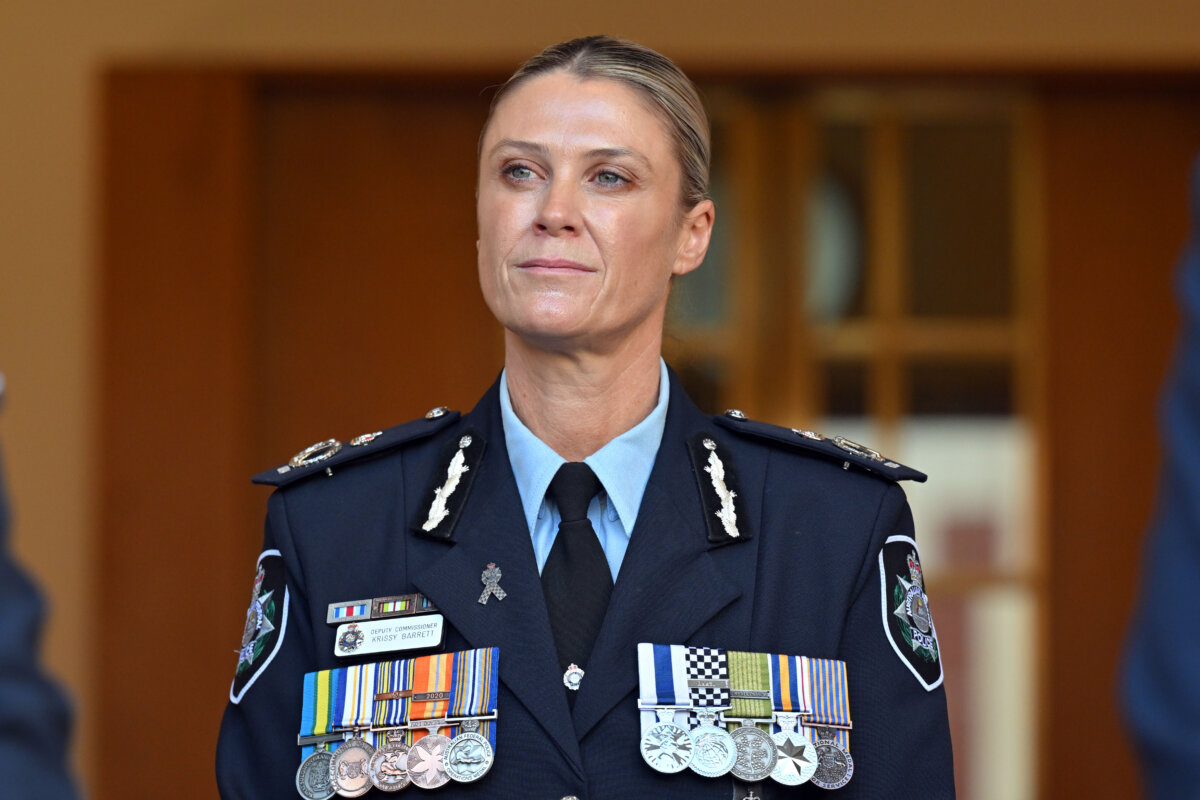

Australian Police Police (AFP) Commissioner Krissy Barrett says the force is confronting “decentralised online networks and loosely affiliated individuals” who glorify violence and cyberattacks.
“These offenders aren’t driven by money,” she warned. “They are motivated by nihilism and sadism.”
Speaking at the National Press Club on Oct. 29, Barrett said these groups were increasingly translating online hate into real-world violence.
“These crimes are now spilling into the real world, and they have real-world consequence,” she said.
The AFP has already identified 59 alleged offenders linked to such networks, with arrests of individuals as young as 17 preventing further child exploitation.
New Front in Gendered Violence
Barrett described the rise of offenders targeting pre-teen and teenage girls as “a new and disturbing front in traditional gender-based violence.”
To counter this, the AFP has launched Task Force Pompolid, a unit dedicated to identifying and dismantling digital ecosystems.
The AFP will also deploy AI technology co-developed with Microsoft, designed to interpret emojis and Gen Z slang in encrypted chats to detect child exploitation before it escalates.
The urgency is reinforced by new data from the Australian Human Rights Commission, showing four in 10 Australians were exposed to domestic violence as children, and nearly a third experienced physical, emotional, or sexual abuse—disproportionately affecting young women.
Youth Extremism on the Rise
Another key issue dominating security agencies is a surge in youth radicalisation.
Between 2020 and 2024, counter-terrorism teams investigated 37 minors, some as young as 12, for terrorism-related offences—with over half being charged with distributing violent extremist material.
Platforms such as Discord, Telegram, and TikTok are now key vectors for extremist propaganda, complicating detection and enforcement.
To tackle the issue, Barrett announced the appointment of a senior operational psychologist to map youth radicalisation patterns and created a Social Cohesion Consultative Board, bringing together community leaders and NGOs to combat hate crimes, sextortion, and foreign interference through trusted local voices.
In December, ASIO Director-General Mike Burgess told a Senate inquiry his agency was seeing “a new generation of online radicalisation” that “demands a community-wide response.”
National Security Shift
Barrett said Australia is facing a tougher security environment, with hostile actors testing “the resolve of democracies and our social cohesion.”
Her warning followed recent intelligence linking Iran to anti-Semitic attacks in Sydney and Melbourne after the events of Oct. 7, 2023.
ASIO and the AFP found Tehran directed both incidents—including the firebombing of Lewis’ Continental Kitchen and the Adass Israel Synagogue—as part of a campaign to sow fear and division.
Barrett confirmed one suspect who was involved in a string of tobacco-related arsons is also wanted over the synagogue attack.
“Of all the alleged criminals accused of threatening Australia, he [the suspect] is my number one priority,” she said.
The commissioner said the AFP would be “unwavering” in defending Australia from both domestic and foreign threats.
“We exist to protect Australians. We exist to serve you. We are your AFP,” Barrett said.
Barrett is the first woman to lead the force since its founding in 1979, and she brings three decades of experience in counter-terrorism and national security.
 Friends Read Free
Copy
Facebook
Tweet
Friends Read Free
Copy
Facebook
Tweet