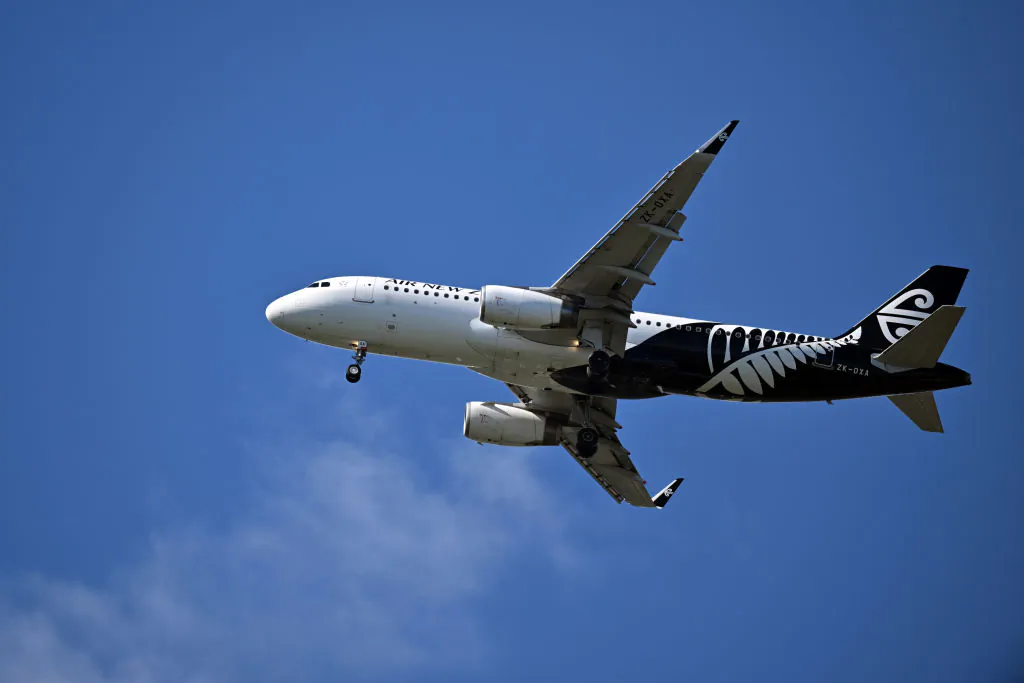

Air New Zealand has warned shareholders that its earnings guidance, issued when it released its interim results on Feb. 26, can no longer be relied upon amid a period of “unprecedented volatility” in global jet fuel markets following the Iran war.
The airline lost NZ$59 million (US$34.8 million) in the first half of the 2025-26 financial year and had forecast second-half earnings “broadly in line with, or modestly below” that figure. But that was based on the assumption that jet fuel prices would remain at around US$85 a barrel.
However, since war broke out in the Middle East, the average jet fuel price reached US$157.41 a barrel in the week ending March 6, a rise of 58.4 percent on the previous week.
Jet fuel pricing comprises two elements: the underlying crude oil price and the refinery margin (the difference between the crude oil price and the price of refined jet fuel).
Those prices, which were around $85 to $90 per barrel prior to the conflict, have increased sharply to between $150 to $200 per barrel.
“Since the conflict began, [refinery margins have] also been particularly volatile, widening from approximately US$22 per barrel before the conflict to as high as US$115 per barrel,” Air New Zealand said.
Fuel Price Hedging Helps Cushion the Blow
Air New Zealand is 83 percent hedged against crude oil prices for the second half of the 2026 financial year, but remains exposed to movements in refinery margins.
In the aviation industry, hedging is a risk-management strategy used by airlines to protect themselves against volatile or rising fuel costs.
It functions similarly to an insurance policy, allowing airlines to lock in or limit the price they will pay for fuel in the future through financial contracts, helping shield them from changes in market prices.
The airline said it expected to consume around 2.9 million barrels of jet fuel in the remainder of the financial year from March to June.
Air New Zealand already increased fares on some routes and warned that if the conflict leads to continued high jet fuel prices, it may need to take further pricing action and adjust its network and schedule as required. That potentially means suspending or cancelling some regional New Zealand routes.
So far, the flag carrier has raised one-way economy fares by NZ$10 on domestic routes, NZ$20 on short-haul services and NZ$90 on long-haul flights.
However, it also said it was “progressing ongoing cost reduction initiatives, which are expected to partially offset these pressures.”
The Impact of Fuel Prices on Airlines’ Profit
Around the world, fuel is typically the second-largest operating expense after labour, accounting for roughly 26 to 27 percent of airlines’ operating costs.
The industry’s profit margins remain thin—around 3.9 percent—a return that International Air Transport Association (IATA) Director General Willie Walsh described as a “pittance” in his 2025 year-end summary.
“[Airlines] stand at the core of a value chain that underpins nearly 4 percent of the global economy and supports 87 million jobs,” he said. “Yet Apple will earn more selling an iPhone cover than the $7.90 airlines will make transporting the average passenger.”
Prior to the outbreak of the Iran war, IATA forecast a moderate decline in crude oil prices to $62 a barrel and a smaller decline in jet fuel costs to $88 a barrel, as refinery margins increased.
However, the sharp rise in fuel prices in recent weeks have significantly added to the cost pressure on carriers already navigating tight airspace as they reroute to avoid the Middle East.
Analysts at Deutsche Bank have warned that thousands of aircraft around the world could be forced to be grounded and that a number of financially weak carriers could suspend operations if no near-term relief is provided.
Meanwhile, 2026 study found a correlation between oil prices and airline stock prices, noting that “changes in oil prices negatively affect the market value of aviation companies.”
During the 2008 oil spike, when prices rose from about $50 a barrel in early 2007 to $147 per barrel in July 2008, airline stocks across the globe collapsed by between 40 and 60 percent. As a result, a number of carriers collapsed while others were restructured.
Conversely, when oil prices collapsed between 2014 and 2016, with Brent crude falling from about $115 a barrel in mid-2014 to roughly $30 by early 2016. The decline reduced fuel costs for airlines and was generally viewed as supportive for airline profitability and share prices.
 Friends Read Free
Copy
Facebook
Tweet
Friends Read Free
Copy
Facebook
Tweet