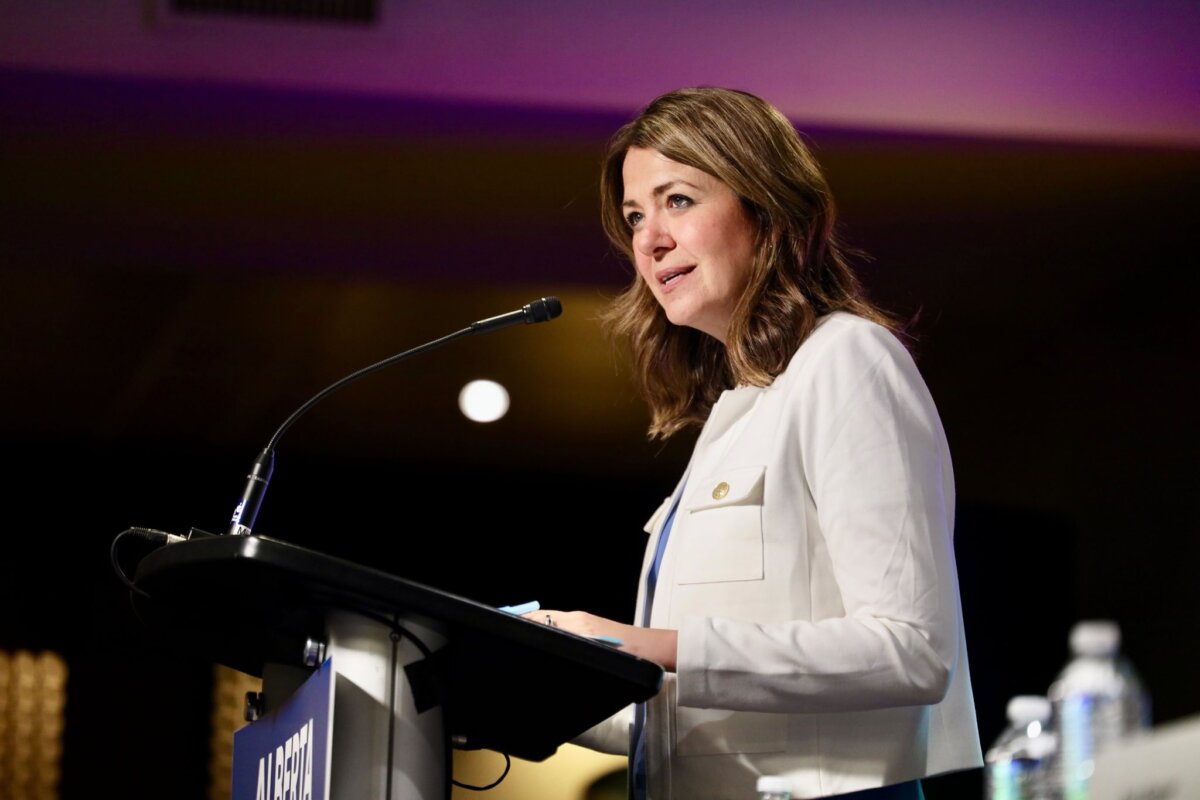

Alberta Premier Danielle Smith has directed officials to prepare legislation to invoke the Charter’s notwithstanding clause on gender laws for minors in the face of legal challenges by activists, according to a leaked government memo.
The province’s justice department has asked other departments to compile information on legal implications surrounding the matter and other options to consider, as per a directive from Smith’s office to invoke the notwithstanding clause.
“As you are aware, the premier’s office has directed that legislation be developed for the fall legislative session to amend the following pieces of legislation to permit each to operate notwithstanding the Canadian Charter of Rights and Freedoms and the Alberta Bill of Rights,” Deputy Justice Minister Malcolm Lavoie said in the Sept. 10 memo obtained by The Canadian Press.
Department officials will brief Smith before bringing the proposal before cabinet on Oct. 21, the document says, adding that the initiative is “highly sensitive and should be approached with the utmost confidentiality.”
The province’s justice department says using the notwithstanding clause in this case is an effort to protect children’s safety and well-being.
“Alberta’s government will continue to vigorously protect the safety and well being of children using all available legal and constitutional means at our disposal, including the notwithstanding clause should our government deem it necessary,” justice department spokesperson Heather Jenkins told The Epoch Times in a Sept. 19 email.
The three laws Alberta intends to use the notwithstanding clause on deal with gender issues in the province, including gender transition procedures for youth, regulations for transgender athletes in female sports, and parental rights in schools.
Transgender activist groups Egale Canada and the Skipping Stone Foundation are challenging in court the parental rights in schools law relating to students’ pronouns and the law that would limit transition procedures for youth.
In a Sept. 19 statement commenting on the leaked memo, Egale Canada accused the province of planning to “strip away the fundamental rights of Albertans, particularly youth, through extraordinary legal powers.”
“By weaponizing the notwithstanding clause, the Alberta government is taking extreme measures to push through harmful legislation (amendments to Bills 26, 27 and 29) that will undermine constitutional protections in health care, education, and sport,” the group said.
‘Last Resort’
The notwithstanding clause permits provincial governments to override specific provisions of the Charter of Rights and Freedoms by enacting a law, which also prevents judicial review of the legislation for five years.
Smith has said she would use the clause “as a last resort” to ensure the legislation on medical transition restrictions for youth was implemented, saying the legislation is in the best interest of children to ensure “they’re prepared to live with the consequences” when making a decision “that is not reversible.”
The law would prohibit doctors from providing transition surgeries for those younger than 18 years, and puberty blockers and hormone therapy for youth 15 years and younger. The law is not yet in effect due to a temporary court injunction that was issued in June. However, Alberta appealed the injunction in August, arguing the injunction was premature as the law was not fully in effect.
The second law, on parental rights in schools, came into effect at the start of the current school year. It requires students under 16 to have parental consent to change their names or pronouns in school. Those aged 16 and 17 years don’t require their parents’ consent, but their parents have to be notified.
The third law also came into effect at the beginning of September, and prohibits male-to-female transgender athletes from competing in women’s and girls’ divisions.
Supreme Court
Alberta is not the only province to use the notwithstanding clause, as Saskatchewan made use of the clause in 2023 to pass its similar school pronoun law. The province said the legislation was “an inclusionary policy” to ensure parents are at the “forefront of every important decision in their child’s life.”
Meanwhile, Ottawa is asking the Supreme Court of Canada to set limits on the manner in which provincial governments can use the clause. Federal Justice Minister Sean Fraser announced on Sept. 18 that he filed a factum with the court outlining the government’s “position on constitutional issues raised” by the usage of the clause.
Fraser said the case goes beyond the immediate issues before the court and will determine how governments use the clause “for years to come.”
Smith criticized the move, saying the clause is “integral” to the rights of Canadians and an “unassailable provincial constitutional right.” She described Ottawa’s bid to limit use of the clause as a risk to “national unity.”
“We are extremely disappointed that the Federal Government would risk national unity and a foundational principle of our constitution by attempting to attack the use of the notwithstanding clause by a sovereign provincial government in this manner and request they withdraw their appeal to the Supreme Court immediately,” Smith said in a Sept. 18 post on X.
Chandra Philip, Matthew Horwood, and The Canadian Press contributed to this report.
 Friends Read Free
Copy
Facebook
Tweet
Friends Read Free
Copy
Facebook
Tweet