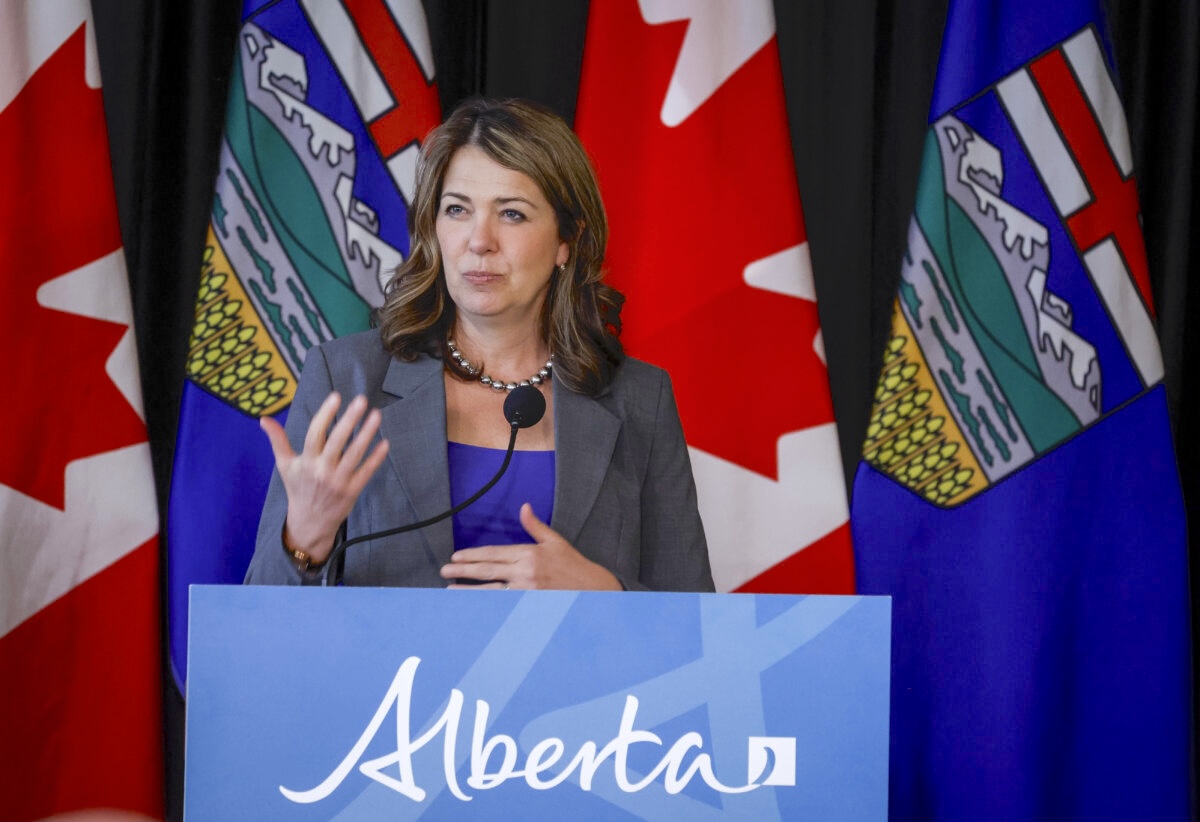

Alberta Premier Danielle Smith says she applauds the decision by the New Zealand government to stop the use of puberty blockers in minors, similar to a move her government made.
Smith’s government passed legislation in 2024 that prohibits the use of puberty blockers or cross sex hormones for those 15 years and younger, and bans gender transition surgeries for those under 18 years. It’s one of three pieces of legislation that deal with gender issues in the province, including regulations for transgender athletes in female sports, and parental rights in schools.
On Nov. 18, her government tabled legislation to invoke the notwithstanding clause to shield these laws from legal challenges.
Earlier this week, New Zealand announced a ban on new prescriptions of puberty-blocking medication for young people with gender dysphoria. It said the policy aligns with that in the UK, Sweden, Finland, and Norway.
Smith made her comments in a Nov. 20 post on social media, noting that New Zealand’s decision to stop using puberty blockers for minors “acknowledg[es] the lack of credible evidence and the growing concerns over long-term harm,” Smith wrote. “This is the right direction and Alberta applauds their decision.”
She said New Zealand joined Alberta, the UK, Sweden, Norway, Finland, and the United States in “taking these kinds of important steps to protect children.”
Smith also commented on the issue during a recent announcement of legislation that would restrict disciplinary action and mandatory training by regulatory bodies on its members.
“There are a lot of countries in the world that have taken a very similar stance that we have, that this kind of medication is not approved for use for this purpose, has unknown future consequences, there have been no clinical trials,” she said in response to a reporter’s question about medical treatments being used and recommended without supporting evidence of efficacy.
“Not only do we see no reporting on it, we also see no medical professionals willing to speak up about it,” Smith said during the Nov. 21 news conference.
New Zealand’s Health Minister Simeon Brown said the change would take effect on Dec. 19.
Those who are currently taking the medication for gender dysphoria will be permitted to continue.
Brown said the decision was made on advice from the Ministry of Health as well as the results of the Cass Review in the UK, which said there was “considerable uncertainty about the long-term safety and clinical effectiveness” of puberty blockers for gender dysphoria.
The drugs will be prohibited for use by new patients until a clinical trial in the UK is complete in 2031.
Alberta’s legislation restricting gender transition procedures for youth is facing a legal challenge, and Court of King’s Bench Justice Allison Kuntz granted a temporary injunction against the Health Statutes Amendment Act in June, saying it raises serious issues that need to be heard in court.
Kuntz said she wanted to prevent “irreparable harm” to young patients, and said the injunction would protect youth while the issue was further examined.
Egale Canada and the Skipping Stone Foundation, along with five Alberta families, filed a Charter challenge requesting the court issue an injunction.
Smith’s government filed an appeal against the injunction in July, arguing the injunction was premature as the law was not fully in effect.
 Friends Read Free
Copy
Facebook
Tweet
Friends Read Free
Copy
Facebook
Tweet