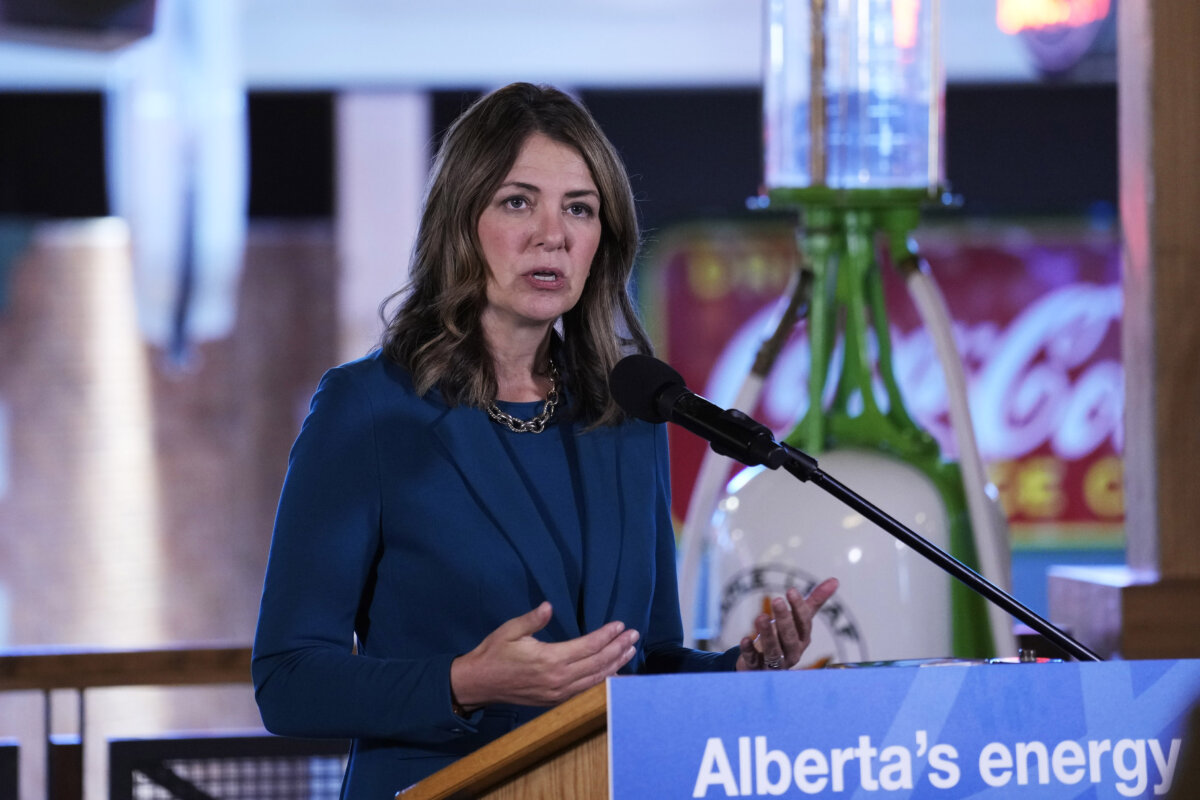

Alberta Premier Danielle Smith says she met with Prime Minister Mark Carney on Jan. 9 to urge him to expedite approvals for construction of an oil pipeline from Alberta to the B.C. coast in light of the events in Venezuela.
Smith said that Alberta will now submit a pipeline proposal to Ottawa’s Major Projects Office at an earlier date than previously announced, and also called on Carney to accelerate the approval process.
“It is clear recent events in Venezuela underscore the necessity to greatly expedite the approval of a one million barrel per day oil pipeline to Canada’s pacific coast as well as an expansion of the Trans Mountain pipeline,” she wrote in a Jan. 8 letter to Carney, a day before she spoke with him, adding that there is strong demand from Asia for Canadian oil.
A Nov. 27 memorandum of understanding (MOU) between Alberta and the federal government proposes to build one or more oil pipelines from Alberta to the B.C. coast if a private proponent comes forward, as well as lifting or adjusting a number of existing and proposed Trudeau-era energy regulations. In return, Alberta has committed to increase the industrial carbon tax, lower methane emissions, and pair the proposed pipeline with an elaborate carbon capture project.
The MOU says Alberta will submit the pipeline proposal to Ottawa’s Major Projects Office by July 1 for consideration of approval in two years, but Smith now says Alberta intends to submit the proposal “by June at the latest.” Smith also called on Carney to accelerate approval of the pipeline.
“To meet this moment, approval processes for nation-building projects must be accelerated. Within the current geopolitical context, timelines of up to two years are still woefully long and risk putting Canada at a disadvantage.”
Smith added that there needs to be a “competitive balance” between carbon tax levels and getting oil to market, as an “overly aggressive carbon pricing system” could make Canadian oil uncompetitive with “the United States, the Middle East, Russia, and now most pointedly, Venezuela.”
Smith’s letter to Carney comes amid statements from U.S. President Donald Trump that U.S. oil companies will help rebuild Venezuela’s infrastructure, and American refineries will “immediately” start refining and selling Venezuelan oil.
“The United States will immediately begin refining and selling up to 50 million barrels of Venezuelan crude oil which will continue indefinitely,” Trump said Jan. 9. “[Our] refining capacity was actually based very much on the Venezuelan oil.”
Heavy Crude
Both Venezuela and Canada produce a similar grade of heavy crude oil that is suited for a number of U.S. refineries on the Gulf Coast. Carney has said Canadian oil will remain competitive for export to the United States and not be displaced by Venezuelan oil, while Conservative Leader Pierre Poilievre wrote a Jan. 6 letter to Carney saying that Venezuelan crude oil potentially coming back online and exporting increasing quantities to the United States means Canada needs to fast-track approval of a new pipeline to the B.C. coast.
“Every barrel the United States sources from Venezuela could mean one less barrel these refineries would buy from Canada,” Poilievre wrote.
Smith echoed Poilievre’s words in a X post, saying she expressed in her meeting with Carney that “any delay risks ceding market share, losing investment, and undermining Canada’s competitive position in a rapidly changing global energy landscape.”
Venezuela’s largely untapped oil reserves are estimated at 303 billion barrels, while Smith noted that Alberta has heavy oil reserves of 167 billion barrels worth more than $9 trillion on today’s market.
Canada produces around 5 million barrels per day (bpd) of crude oil and exports around 4.2 million bpd to the United States. If Venezuela exports 50 million barrels over a year, that amounts to around 137,000 bpd, or about 30 times less than what the United States buys from Canada.
Venezuela’s once-thriving oil industry fell into disrepair and lagging production following the rise of late socialist leader Hugo Chávez in 1999 and expanded state control of the country’s oil and gas sector. Sanctions and corruption led to a further decline in oil production under Nicolás Maduro, who took over after Chávez’s death in 2013.
Executive fellow at the University of Calgary School of Public Policy Richard Masson said that Venezuela’s oil sector has a long path to becoming competitive and that Canada is not under economic threat from it.
“It’s going to take billions of dollars of investment—tens of billions or hundreds of billions of dollars—and years to see Venezuelan production increase,” Masson said in a Jan. 5 interview with The Epoch Times.
U.S. forces seized Venezuelan leader Maduro and his wife Cilia Flores in a military operation on Jan. 3 and extradited both to the United States to face narco-terrorism charges. Venezuela is now run by Maduro’s vice-president Delcy Rodríguez under the control of the United States.
 Friends Read Free
Copy
Facebook
Tweet
Friends Read Free
Copy
Facebook
Tweet