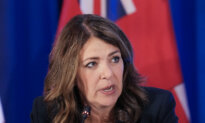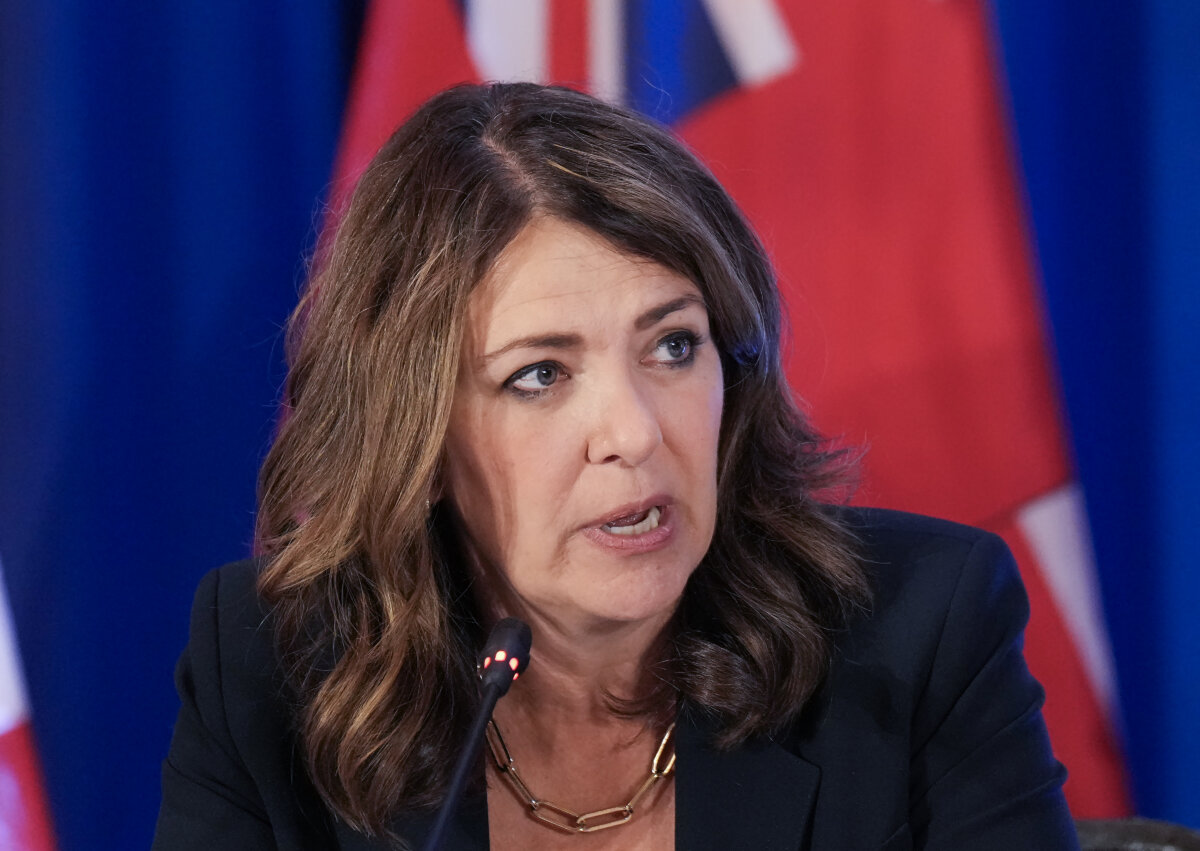

Alberta Premier Danielle Smith is repeating her calls for key federal legislative changes favouring the energy sector ahead of Parliament’s return on Sept. 15.
In her latest call, she is highlighting three pieces of legislation she wants removed: The cap on emissions in the oil and gas sector (which she says acts as a limit on production), the Impact Assessment Act (which she termed the “No New Pipelines Law”), and the tanker ban on B.C.’s coast.
“Canada has become economically weak and vulnerable to the whims of our largest export market,” Smith wrote in a Sept. 5 post on X, adding that “Ottawa continues to dither.”
Smith, along with former Alberta Premier Jason Kenney, call the Impact Assessment Act the “No More Pipelines” act because they argue that the strict environmental assessment laws prevent pipelines from being proposed and built.
Kenney put forward a constitutional challenge of the law that ultimately led to the Supreme Court ruling in 2023 that the act was partly unconstitutional. As a result, Ottawa put forward amendments narrowing the scope of federal review so that federal involvement is limited to effects clearly within federal jurisdiction such as with regard to fisheries, indigenous rights, and interprovincial projects. The changes became law in June of last year, but Alberta says the act still infringes on provincial jurisdiction and has continued its legal challenge.
The federal emissions cap on oil and gas regulates the exploration and production side of oil and gas, including offshore operations, oil sands extraction and processing of natural gas and liquefied natural gas. The law phases in limits between 2026 and 2030, ultimately seeking to limit emissions to less that 112 megatonnes (Mt) per year, a 38 percent drop from 2019 levels. Higher emissions up to 137 Mt are permitted if offset credits are purchased or funds are put into a decarbonization fund.
Alberta says the oil and gas cap functions as a de facto limit on production and is an infringement on provincial jurisdiction, while Ottawa says it is not a limit on production but rather on emissions, and thus falls under federal jurisdiction.
The tanker ban on B.C.’s north coast bars any oil tankers with loads over 12,500 metric tonnes of crude oil or oil products from doing business from the Alaska border down to near the tip of Vancouver Island, which in effect killed the Northern Gateway pipeline project meant to carry Alberta oil and gas to international markets.
“The national economic self-sabotage has to stop. Canadians deserve leaders in Ottawa with the courage to unleash our full potential, restore prosperity, and make our country strong again. We can do this!” Smith wrote in her Sept. 5 post.
Conservative Leader Pierre Poilievre has also referred to the legislation Smith wants repealed as Ottawa’s “anti-energy laws” on numerous occasions, most recently on Sept. 5 while criticizing the Carney government.
“He believes in energy poverty. I believe in energy abundance. He believes in taxing energy. I believe in unleashing energy,” Poilievre said.
Prime Minister Mark Carney has said that the Building Canada Act portion of the One Canadian Economy Act, which became law in June, allows the government to bypass certain regulations and legislation that may stand in the way of projects of national importance. This includes potentially overriding environmental assessment laws and indigenous consultation requirements, allowing for faster approval timelines.
The bill is currently being challenged by some First Nations who are asking for a court-ordered injunction and $100 million in damage as they say it overrides the government’s “constitutional obligation” to seek reconciliation with First Nations. Carney says the bill is necessary for Canada’s economic future, particularly amid current trade tensions with the United States.
“Canada has always been a nation of builders, from the St. Lawrence Seaway to Expo 67. At this hinge moment in our history, Canada must draw on this legacy and act decisively to transform our economy from reliance to resilience,” Carney said on Aug. 29 when announcing the creation of the Major Projects Office to fast-track major projects of national interest.
“We are moving at a speed not seen in generations to build ports, railways, energy grids – the major projects that will unlock Canada’s full economic potential and build Canada strong.”
 Friends Read Free
Copy
Facebook
Tweet
Friends Read Free
Copy
Facebook
Tweet